In a tectonic shift of geopolitical sentiment, the United States is facing an unprecedented decline in its regional standing across Latin America, while China continues to solidify its footprint as an economic and diplomatic heavyweight. A comprehensive new report from the Pew Research Center, surveying 42,151 individuals across 36 nations, reveals that in the critical corridor of Latin America, the traditional dominance of U.S. influence is eroding, giving way to a more balanced—and in some cases, China-leaning—regional outlook.
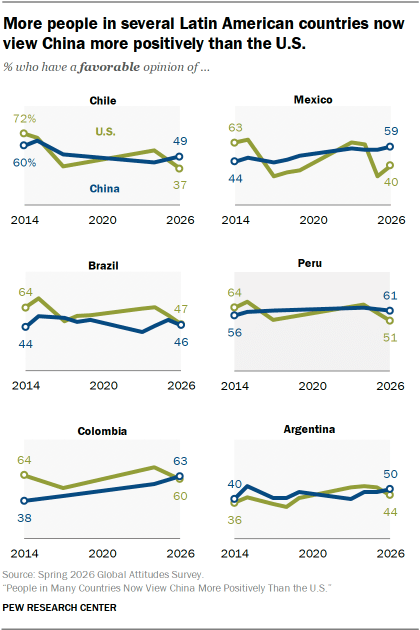
The findings, based on data collected between February and May 2026, paint a picture of a continent in flux. In Argentina, Chile, Mexico, and Peru, China is now viewed more favorably than the United States. In regional powerhouses Brazil and Colombia, the two superpowers are fighting to a statistical draw in the court of public opinion. This transformation marks a historic departure from the landscape of 2014, when the U.S. was viewed overwhelmingly more positively than China across the region.
The Core Data: A New Balance of Power
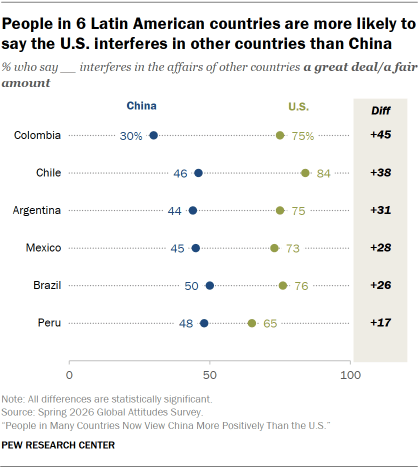
The survey of 6,132 respondents across Argentina, Brazil, Chile, Colombia, Mexico, and Peru highlights a growing disillusionment with U.S. leadership. Across these six nations, there is a widespread perception that Washington’s foreign policy is inherently interventionist.
A substantial majority of respondents in all six countries argue that the U.S. frequently interferes in the internal affairs of other nations. Conversely, perceptions of Chinese interventionism remain significantly lower. In Colombia, for example, 75% of respondents cite U.S. interference as a major concern, compared to just 30% for China.

Furthermore, the "reliability gap" is narrowing. While Washington has historically marketed itself as the most dependable partner in the Western Hemisphere, that narrative is struggling to gain traction. In Mexico and Chile, more citizens now identify China as a more reliable partner than the U.S. In other nations, the divide is nonexistent, with public opinion split down the middle, signaling that the U.S. can no longer rely on automatic hemispheric allegiance.
Chronology of Declining Influence
To understand the current impasse, one must look at the historical trajectory of these relations over the last decade.
- 2014: The "Golden Era" of U.S. soft power in the region. With the exception of Argentina, every country surveyed viewed the U.S. with significantly higher favorability than China.
- 2017-2018: Early signs of strain emerged. Data from these years began to show the lowest levels of U.S. favorability ever recorded by the Pew Research Center in countries like Brazil, Chile, and Peru.
- 2023: A baseline for modern interference metrics. Polling in Argentina, Brazil, and Mexico showed that while perceptions of Chinese interference were already softening, the sentiment regarding U.S. interventionism remained stubbornly high and stagnant.
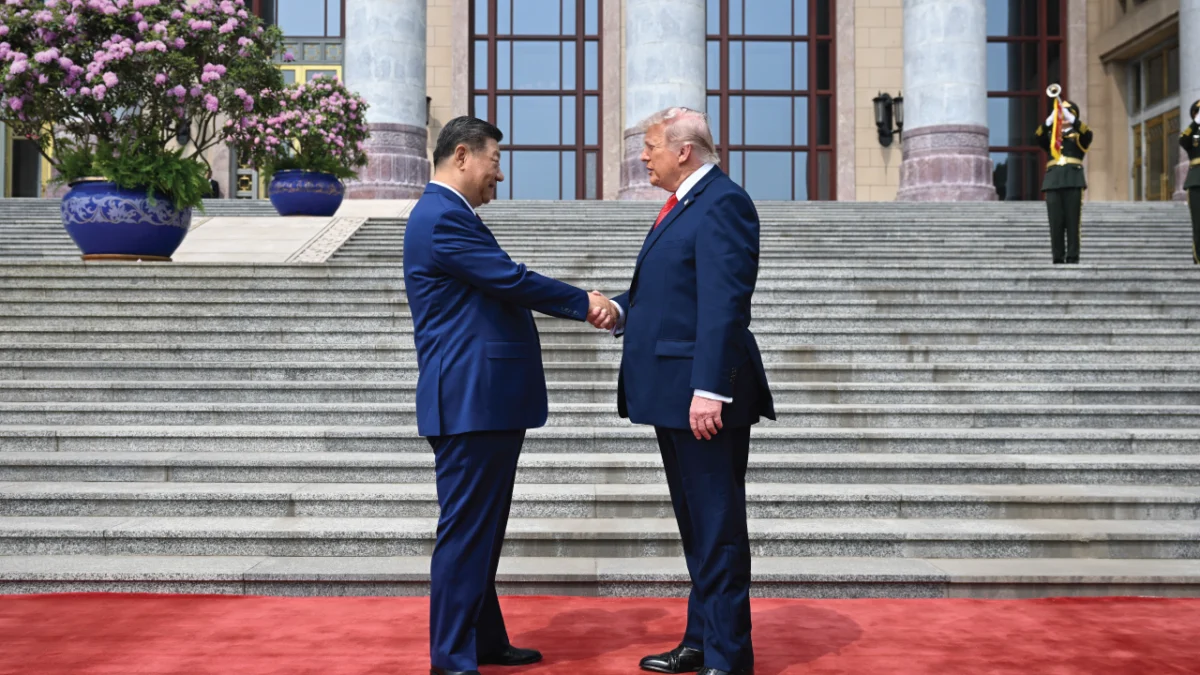
- March 2026: The Shield of the Americas summit serves as a flashpoint. President Donald Trump, in an attempt to reassert the Monroe Doctrine-adjacent philosophy of the 21st century, explicitly stated that the U.S. would not permit "hostile foreign influence" to gain a foothold in the hemisphere.
- May 2026: The conclusion of the latest Pew survey, revealing that the rhetoric of "hostile influence" may be failing to resonate with the public, who increasingly view the economic integration with China as a pragmatic necessity rather than a security threat.
Supporting Data: Ideology, Age, and the Freedom Gap
The research reveals that demographic and ideological fissures are defining how citizens interpret the rivalry between the two superpowers.
The Ideological Divide
In Brazil and Colombia, the "Superpower Cold War" is being fought along partisan lines. In Brazil, those on the ideological right are nearly twice as likely to hold a positive view of the U.S. (58%) compared to those on the left (30%). Conversely, the left in Brazil maintains a more favorable view of China (57%) than the right (40%). This suggests that the U.S.-China competition has become embedded in the domestic "culture wars" of Latin American nations.
The Generational Shift
Youth demographics tell a different story. In Mexico and Brazil, younger adults (ages 18 to 34) are markedly more optimistic about both superpowers than their older counterparts. In Mexico, 70% of younger adults view China positively, compared to only 52% for the U.S. This suggests that the younger generation is less tethered to the Cold War-era biases of their parents and more focused on the pragmatic benefits of global engagement.
The Question of Personal Freedoms
Perhaps the most significant area where the U.S. retains a lead is the perception of "respect for personal freedoms." In Argentina, Chile, Brazil, and Colombia, the U.S. government is still seen as a more reliable guardian of civil liberties than the Chinese government. However, even this lead is shrinking. Since 2018, the percentage of Latin Americans who believe the U.S. respects the personal freedoms of its citizens has declined across almost every surveyed nation. The "moral high ground" that the U.S. historically occupied is under pressure, as the gap between the two nations on this metric continues to close.
Official Responses and Diplomatic Friction
The tension is not merely academic; it is driving a series of diplomatic maneuvers. China has successfully leveraged its status as the top trading partner for South America to entrench itself in the region’s infrastructure, energy, and security sectors.
Following President Trump’s March 2026 remarks at the Shield of the Americas summit, the Chinese Foreign Ministry issued a sharp rebuttal, framing China’s engagement in Latin America as "mutually beneficial, win-win cooperation" that respects the sovereignty of host nations. This narrative appears to be landing effectively with local populations, who are increasingly wary of Washington’s "security-first" foreign policy rhetoric.
Global Implications: A Hemispheric Crossroads
The implications of this research are profound for the future of U.S. foreign policy. If Washington’s goal is to maintain its traditional hegemony in the Western Hemisphere, the current strategy is producing diminishing returns. The survey suggests that the U.S. is struggling to provide a compelling alternative to the economic partnerships offered by Beijing.
For the United States, the challenge is twofold:
- Economic Competitiveness: With China acting as the primary engine of trade for many of these nations, the U.S. cannot rely on security alliances alone to maintain influence.
- Soft Power Restoration: The decline in the perception that the U.S. respects personal freedoms—combined with the persistent narrative of interventionism—suggests that Washington is losing the "battle for hearts and minds."
As the world moves toward a more multipolar structure, Latin American nations are clearly demonstrating that they are no longer interested in choosing sides in a binary struggle. Instead, they are pursuing a pragmatic "all-of-the-above" approach, engaging with both Washington and Beijing to maximize their own national interests.
For the U.S. administration, the message from the streets of Mexico City, Bogotá, and Santiago is clear: the era of automatic regional deference is over. To regain its standing, the U.S. must pivot from a policy of containment and intervention toward one of partnership and sustained economic engagement that addresses the priorities of the modern Latin American voter. Failure to do so will likely result in the further consolidation of Chinese influence, effectively ending the era of a U.S.-led Western Hemisphere.