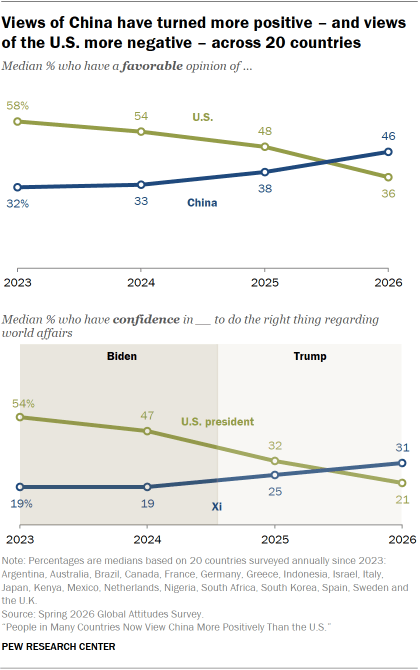
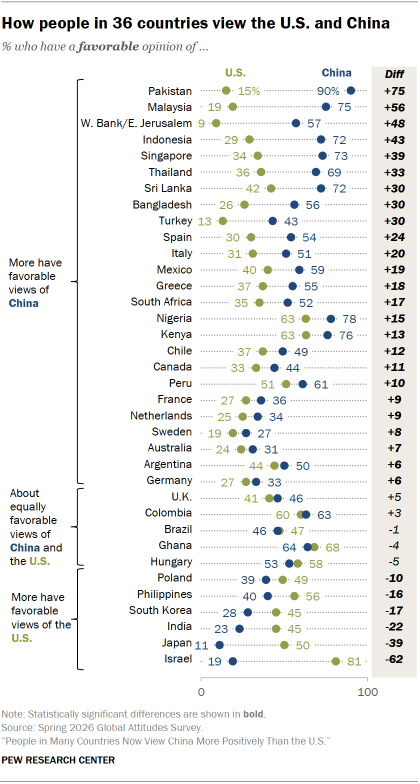
As the geopolitical landscape of 2026 continues to evolve, a dramatic transformation in international public opinion has reached a significant milestone. According to a comprehensive new report from the Pew Research Center, the United States has seen its global standing decline sharply during the first two years of Donald Trump’s second presidential term. For the first time in recent history, China is viewed more favorably than the U.S. in the majority of 36 countries surveyed.
This findings mark a departure from previous years, where the U.S. generally maintained a stronger reputation than its primary global competitor. The study, which encompasses 42,151 interviews conducted between February and May 2026, reveals that this shift is not merely the result of a rising China, but rather a dual phenomenon: improving perceptions of Beijing and a significant erosion of trust in Washington.

Main Facts: The New Global Reality
The data indicates that the traditional "soft power" advantage once held by the United States is rapidly dissipating. In the 36 nations polled—spanning Latin America, sub-Saharan Africa, the Middle East, and the Asia-Pacific—China is now viewed more favorably than the U.S. in most instances.
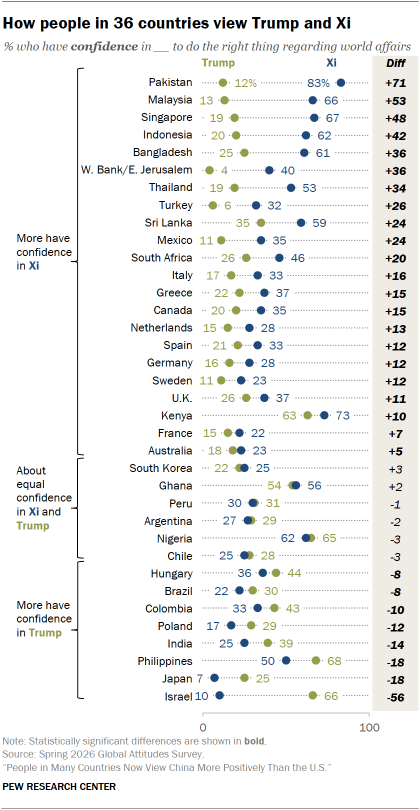
While the U.S. still maintains an edge in specific regions—namely India, Japan, the Philippines, and South Korea—the broader trend suggests that American influence is being viewed with increasing skepticism. A core component of this shift is the public perception of leadership. For the first time, global confidence in Chinese President Xi Jinping to "do the right thing regarding world affairs" has overtaken confidence in President Trump. While both leaders face significant skepticism, the net favorability of the Chinese president has become more widespread than that of his American counterpart.
A Chronology of Declining Trust
To understand the current state of international relations, one must look back at the trajectory of the last few years.
- 2023: During the latter half of Joe Biden’s presidency, the U.S. held a clear, albeit narrowing, lead in global favorability. Confidence in the American president was generally higher than in Xi Jinping across most of the surveyed regions.
- 2024: A noticeable decline in Biden’s ratings began to manifest, as global observers expressed growing concerns regarding the stability and reliability of U.S. foreign policy.
- 2025: As President Trump began his second term, the "Trump effect" on international relations became a primary driver of sentiment. Previous reports highlighted that international views of the U.S. had worsened significantly compared to the start of the decade.
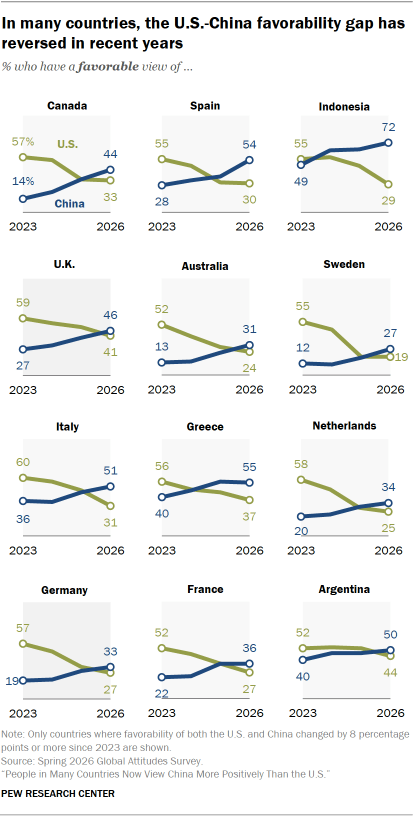
- 2026 (The Current Snapshot): The reversal is now complete in many nations. In countries like Canada, once a stalwart ally of the U.S., the favorability gap has closed or flipped. In 2023, 57% of Canadians held a positive view of the U.S. compared to just 14% for China. By 2026, those numbers have converged, with 44% viewing China favorably against 33% for the U.S.
Supporting Data: The Shrinking "Freedom Gap"
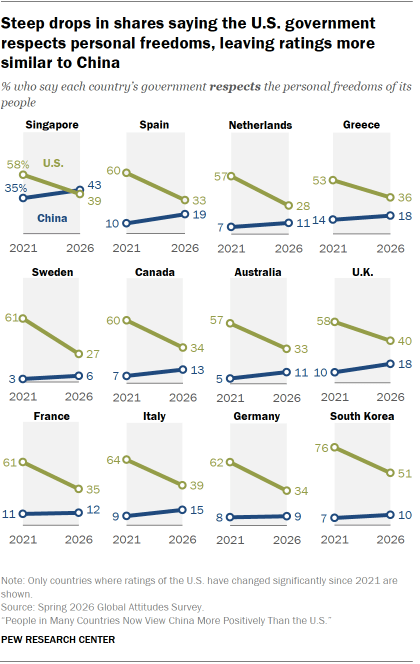
For over a decade, the strongest pillar of American soft power has been the perception that the U.S. government respects the personal freedoms of its citizens—a metric in which the U.S. historically trounced China. However, this gap is now rapidly narrowing.
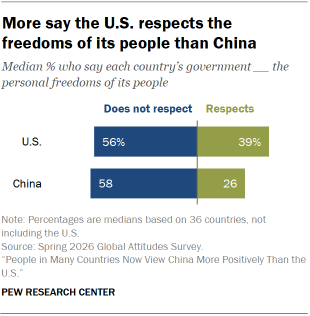
The Pew research reveals a steep, sustained drop in the percentage of global respondents who believe the U.S. government respects personal freedoms. In Sweden, for instance, this sentiment plummeted from 61% in 2021 to just 27% today. Similar double-digit declines were recorded in Germany, France, Italy, and South Korea.
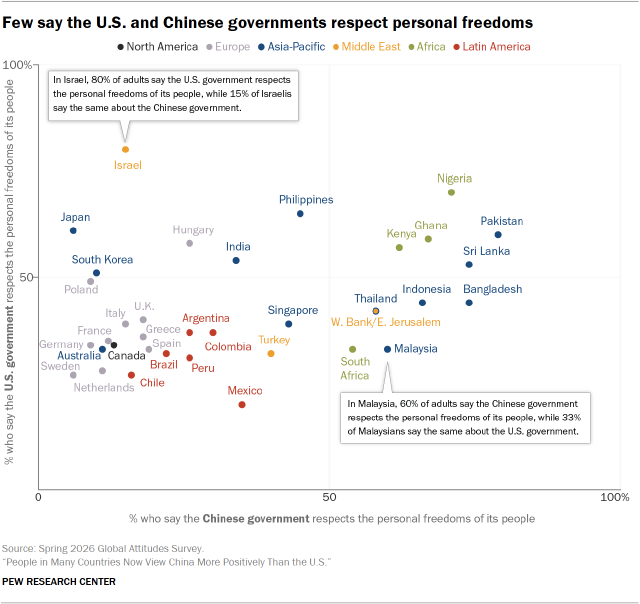
Conversely, there has been a marginal but measurable increase in the number of people who believe the Chinese government respects personal freedoms. While few in Western nations hold a high opinion of Beijing’s human rights record, the "moral clarity" once afforded to the U.S. has been clouded by domestic volatility, leading to a global perception that neither superpower is a standard-bearer for personal liberty.
Middle-Income Nations and the "Interference" Narrative
A critical segment of the research focuses on 17 middle-income countries across the Global South. In these nations, the narrative of "interference" plays a significant role in foreign policy alignment.
The data suggests a widespread perception that the United States is overly interventionist. A median of 75% of respondents in these middle-income countries believe the U.S. interferes in the affairs of other nations a "great deal" or a "fair amount." In contrast, only 45% say the same of China.
This perception directly impacts diplomatic and economic partnerships. In South Africa, for example, 72% of the population now views China as a "reliable partner," while only 46% apply the same label to the United States. Furthermore, South Africans are increasingly likely to view China as a contributor to global peace and stability—a sentiment that has grown significantly since 2023. This trend is mirrored in various Latin American and Southeast Asian nations, where China’s "non-interference" rhetoric is finding a receptive audience.
Implications for Global Diplomacy
The implications of these findings are profound for the future of the international order.
1. The Erosion of the Alliance System
The U.S. has historically relied on a network of democratic alliances to maintain global order. As public opinion in these allied countries shifts toward viewing China as a viable—or even preferred—partner, the political space for those governments to align with U.S. foreign policy priorities shrinks.
2. The Economic Competition
China’s focus on economic and infrastructure ties in middle-income countries is yielding results in the form of "soft power" capital. By positioning itself as a reliable, non-interfering partner, Beijing is effectively neutralizing the U.S. strategy of countering Chinese economic influence. The U.S. National Security Strategy of 2025, which explicitly aimed to counter China’s export dominance in these regions, appears to be running into a wall of public skepticism regarding American intentions.
3. The Future of Democratic Promotion
With the U.S. losing its status as the world’s undisputed model for personal freedom, the capacity for American leadership to advocate for human rights and democracy is diminished. When large swaths of the global population perceive that neither the U.S. nor China truly prioritizes personal liberty, the "clash of systems" becomes less about ideology and more about transactional diplomacy.
Conclusion
The 2026 Pew Research Center findings serve as a wake-up call for Washington. The shift in global opinion is not a fleeting trend but a structural change in how the world perceives the two dominant superpowers. As confidence in the U.S. wanes and the reputation of China improves, the world is moving away from a unipolar American consensus toward a more fragmented and competitive reality.
For policymakers, the challenge is no longer just about economic or military superiority; it is about restoring the fundamental belief that the United States remains a reliable, principled, and benevolent actor on the global stage. As it stands, the global public is increasingly looking elsewhere for leadership, and Beijing is successfully filling the void.