While the American experience is often viewed through the lens of political polarization or economic divide, a new, comprehensive study by the Pew-Knight Initiative reveals that where you live—urban, suburban, or rural—significantly colors how you engage with your community. While the broad rates of civic participation remain surprisingly uniform across the country, the nature of that participation diverges in ways that reflect the unique social fabric of different residential landscapes.
This analysis, which draws on data from the Pew Research Center’s American Trends Panel and an extensive Cross-Sectional Engagement Survey conducted in 2025, challenges the notion that Americans are monolithic in their civic habits. Instead, it suggests that geography acts as a subtle filter for how citizens interact with their neighbors, their faith, and their government.

The Four Pillars of American Engagement
To understand these nuances, researchers categorized U.S. adults into four distinct "engagement groups" based on 19 specific metrics ranging from news consumption to political activism and religious attendance.
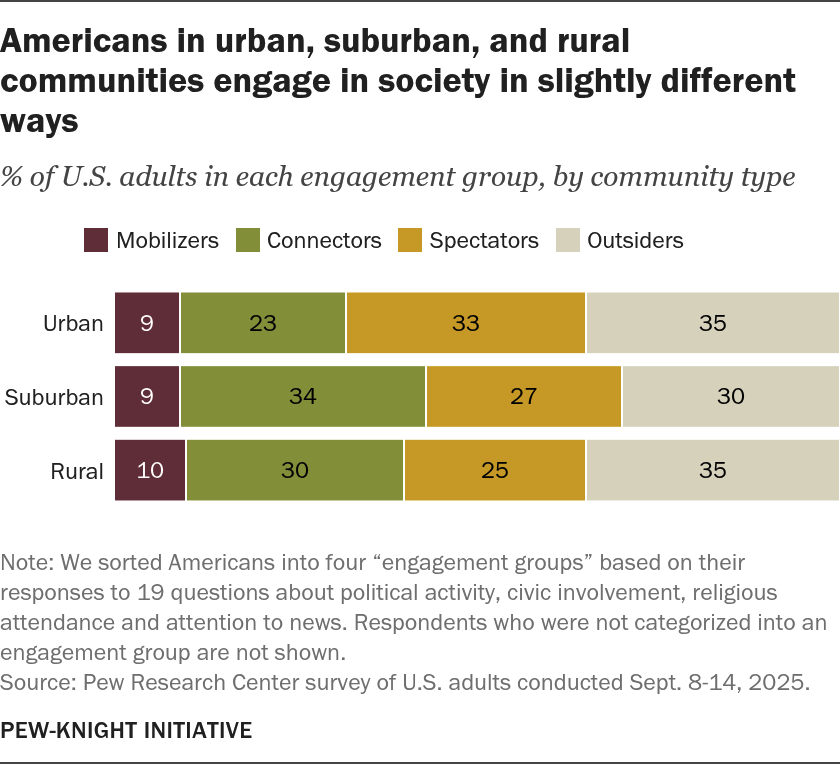
- Mobilizers: These are the engines of civic life. Though they represent a small minority of the population (roughly 9% to 10% across all locales), they are highly active in politics, news, religion, and community organizations.
- Connectors: Making up a significant portion of the population, these individuals are the social glue of their communities. They are prolific volunteers and club members, though they tend to be less interested in the high-intensity world of national politics.
- Spectators: Primarily news consumers, this group follows the issues of the day with high interest but rarely translates that awareness into active participation or community organizing.
- Outsiders: Representing roughly one-third of the population, this group is the least engaged across all categories, showing minimal activity in civic, political, or social organizations.
Chronology of the Research
The findings presented here are the result of a multi-phase research effort by the Pew-Knight Initiative:
- July 2025: Researchers initiated the Cross-Sectional Engagement Survey, a robust effort involving over 5,000 adults, designed specifically to capture the voices of those often missed by traditional polling.
- September 8–14, 2025: The Pew Research Center conducted Wave 179 of its American Trends Panel, a nationally representative survey that provided the core quantitative data for this analysis.
- Late 2025 – Early 2026: Researchers synthesized the findings to conduct a "cluster analysis," sorting participants into the four engagement profiles.
- April 2026: Public discourse surrounding regional infrastructure and local policy—such as new flood mapping in Houston—highlighted the real-world implications of community engagement, providing a backdrop for the study’s release.
- September 2026: Formal publication of the findings, mapping the intersection of geography and civic behavior.
Supporting Data: How Communities Differ
The data reveals that suburban residents are the most likely to be "Connectors," with 34% of suburbanites falling into this category compared to 23% of urban dwellers. Suburban life appears to foster a culture of local group participation and volunteerism, potentially driven by school boards, neighborhood associations, and local non-profits.
In contrast, urban areas host a higher density of "Spectators." Roughly one-third of urban residents (33%) primarily consume news without engaging in the traditional volunteer or club-based activities that define the "Connector" group.

The Rural-Urban Divide in Interaction
Perhaps the most striking finding is the modality of interaction. When Americans join groups or clubs, the setting of those interactions depends heavily on their zip code:
- In-Person Dominance: Rural Americans report that their clubs and organizations interact mostly in-person at a rate of 63%, compared to 57% in suburbs and 47% in cities.
- Digital Integration: Urban Americans are the most likely to engage with their organizations online (22%), nearly double the rate of rural residents (14%).
This suggests that while rural communities may be smaller, their civic life is deeply rooted in physical, face-to-face proximity, whereas urban life is increasingly augmented by digital connectivity.

Faith and Religious Participation
Religious life remains a primary driver of engagement for rural Americans. The data indicates that 42% of rural adults attend religious services—either in person or online—at least monthly. This is a higher rate of religious engagement than that found in suburban (37%) or urban (33%) areas. This trend is further supported by self-reported habits, such as daily prayer, which are more prevalent in rural populations.
Political Engagement: A Nuanced Landscape
While the total number of people participating in political acts is similar across regions, the type of political activity varies.

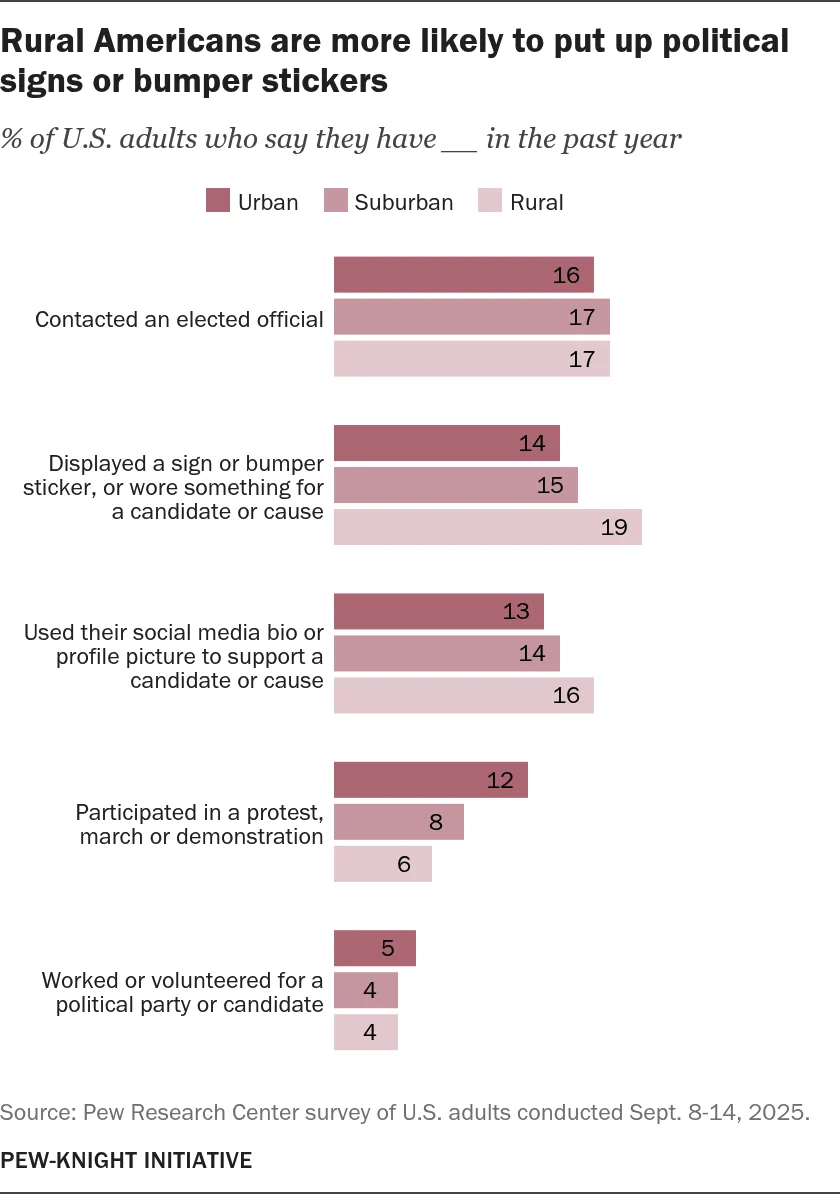
- Symbolic Participation: Rural residents are more likely to display political signs, bumper stickers, or wear campaign gear. This behavior transcends party lines and appears to be a hallmark of rural political expression.
- Activists and Protest: Urban residents are more likely to participate in protests, marches, or demonstrations. The study notes that this is partly a reflection of demographics; with a higher concentration of Democrats in urban centers, and higher protest activity among that political demographic, the urban environment becomes a natural staging ground for large-scale political demonstrations.
- Institutional Engagement: The percentage of people who contact elected officials remains steady at roughly 16% to 17% across urban, suburban, and rural lines, suggesting that when it comes to formal governance, the average American’s impulse to reach out is largely geography-blind.
Official Perspective and Implications
The Pew-Knight Initiative, a partnership between the Pew Charitable Trusts and the John S. and James L. Knight Foundation, emphasizes that these findings are not meant to suggest one lifestyle is superior to another. Instead, the goal is to provide a roadmap for organizations seeking to improve civic health.
"Understanding that a rural community relies on face-to-face, in-person gathering for its civic strength, while an urban community might leverage digital platforms, is vital for any organization—be it a news outlet or a political campaign—trying to connect with the public," said a spokesperson for the initiative.

Implications for Policy and Civic Strategy
For local policymakers, these findings carry significant weight:
- Communication Strategies: Campaigns and non-profits must recognize that a "one-size-fits-all" approach to outreach will likely fail. Digital-first strategies may resonate in urban centers but fall flat in rural areas where the personal touch of a physical meeting remains king.
- Social Infrastructure: The higher rate of "Connectors" in suburban areas suggests a robust social infrastructure that could be leveraged for public health or community safety initiatives.
- The "Outsider" Challenge: With nearly one-third of Americans across all geographies identified as "Outsiders," there is a clear, nation-wide challenge in finding ways to bring disconnected citizens into the fold. The data suggests that simply increasing news coverage or digital presence will not reach this group, as they are inherently detached from the traditional mechanisms of engagement.
As the nation moves forward, the "geography of engagement" will likely remain a critical lens through which to view American democracy. While the digital age promised to erase the distance between citizens, these findings suggest that the local environment—the actual space where one wakes up, works, and worships—still dictates the fundamental rhythms of civic life.