The traditional internet paradigm—characterized by a simple transaction of "content for traffic"—is effectively dead. For over two decades, the primary goal of online publishing was to rank high on search engines to drive clicks back to a website. However, the rise of Generative AI answer engines, such as ChatGPT, Perplexity, and Meta AI, has fundamentally altered this landscape.
Publishers are no longer merely competing for a spot in a list of blue links. They are now operating in an "agentic web," an ecosystem where artificial intelligence agents consume, synthesize, and repackage content without the user ever necessarily visiting the source. As the industry grapples with this shift, the conversation has moved away from "How much traffic will AI send us?" to "How do we control our presence in this new distribution layer?"
The Shift: From Referral Traffic to Content Distribution
In the early days of generative AI, many publishers panicked about the cannibalization of their search traffic. Today, that anxiety has evolved into a strategic pivot. Publishers are beginning to treat AI answer engines not as direct competitors for traffic, but as a mandatory distribution layer.
Success in this environment is no longer measured solely by the click-through rate (CTR). Instead, it is defined by brand authority, the frequency of citations within AI-generated responses, and the ability to monetize content that may never result in a direct page view. As brands grapple with their visibility in AI-generated answers, they are discovering that "visibility" is the new currency of the digital age.

A Chronology of the Agentic Surge
To understand the current state of the web, one must look at the rapid acceleration of non-human traffic. The evolution of this ecosystem has been swift:
- 2023: The dawn of the ChatGPT era. Publishers experiment with basic blocking tactics, primarily through
robots.txtfiles, in an attempt to protect their intellectual property. - 2024: The "Gold Rush" of AI crawling. Tech giants scramble to train their large language models (LLMs), leading to a massive increase in scraping activity.
- 2025: A year of divergence. While human traffic growth remains steady, AI-driven traffic explodes, growing by nearly 187% according to Cloudflare data. The web becomes a space where bots outnumber humans.
- Q1-Q2 2026: The era of the "Agentic Web." We see a shift from one-time scraping for training purposes to continuous, real-time indexing for RAG (Retrieval-Augmented Generation) crawlers.
The Data: The Machine-First Internet
The statistics behind this shift are staggering. A report from DataDome, which monitors a network of over 400 major companies, recorded 17.7 billion AI agent requests between April and June 2026 alone. This represents a 45% increase from the previous quarter.
The data reveals that Meta is currently the most aggressive actor in this space. Its training crawler traffic grew by 74% in Q2, but its RAG crawler—the mechanism that allows the AI to fetch real-time, current information—surged by a massive 163%.
"We’re entering a new phase of the AI web," says Jérôme Segura, VP at DataDome. "Meta is shifting from ‘scrape once for training’ to continuous indexing for real-time AI answers. As AI traffic becomes more persistent, publishers need to set guidelines for crawling and indexing, just as they have done for Google for years. It’s imperative to understand which agents access content, how often, and what they receive in return."
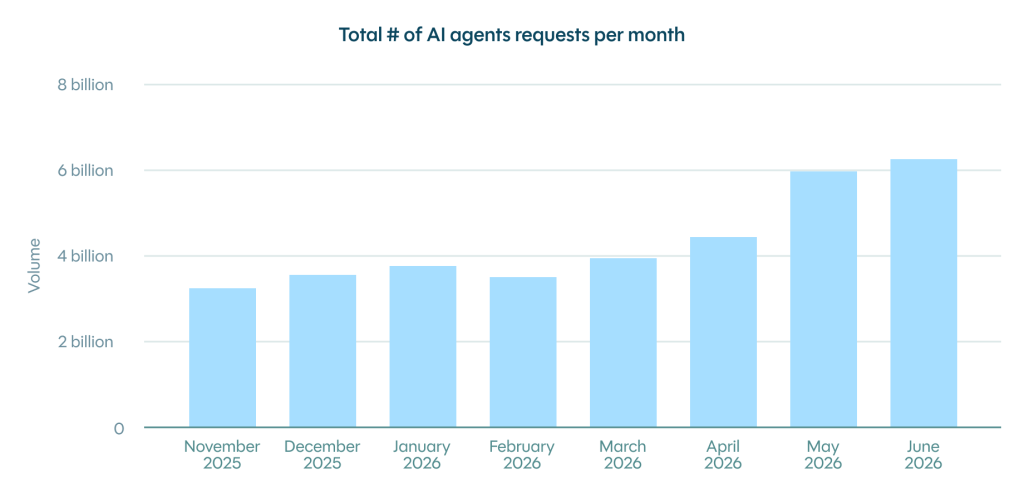
Furthermore, the Decodo/Cloudflare analysis confirms the scale of this automation: automated systems now generate 57.4% of all web requests, compared to 42.6% from human users. AI-specific traffic grew by a staggering 7,851% year-over-year, marking a permanent change in how server infrastructure is utilized.
Strategies for the Future: Building for Agents
As publishers accept that AI is not going anywhere, they are beginning to rebuild their technical infrastructure to accommodate these new "readers."
The Rise of LLMs.txt
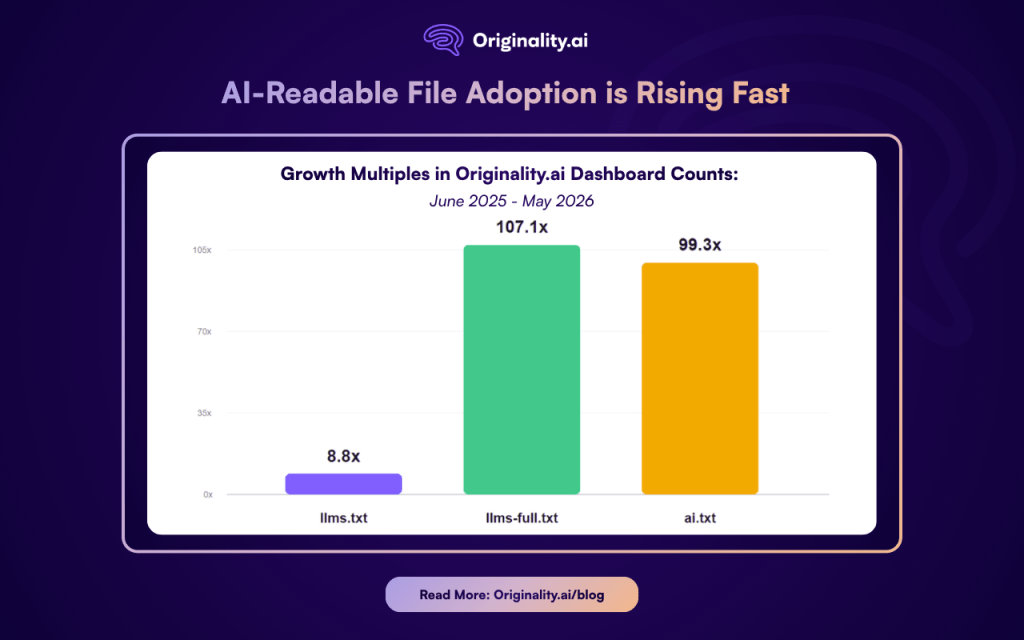
One of the most notable trends is the adoption of machine-readable formats like LLMs.txt and ai.txt. These files are designed to strip away the "noise" of modern web design—ads, pop-ups, and complex HTML—and provide AI agents with clean, structured, and metadata-rich content.
Originality.ai reports that the number of websites adopting these standards jumped from 4,088 in June 2025 to 36,120 by May 2026. This 8.8x increase indicates that publishers are desperate to regain some level of control over how their content is interpreted and used.
The Myth of "Easy" Visibility
However, there is a disconnect between adoption and utility. Ahrefs’ server-log research revealed that 97% of LLMs.txt files received zero requests in May 2026. Jon Gillham, CEO of Originality.ai, notes that while these files demonstrate a publisher’s intent to be "AI-friendly," they are currently more of a "low-cost bet" than a functional visibility strategy. Google, notably, has clarified that these files are not strictly necessary for generative AI search optimization, further complicating the decision for publishers.
Implications for Media Organizations
The most pressing challenge for publishers today is that AI visibility is an incredibly difficult game to master. Webflow’s "AEO (Answer Engine Optimization) Maturity Index" paints a sobering picture: the median company appears in only 16% of relevant AI answers, and of those, only 6% include a direct link or citation.
Technical Debt as a Barrier
Guy Yalif, chief evangelist at Webflow, points out that the primary culprits for poor AI performance are the same issues that have plagued traditional SEO for years: broken links, missing metadata, and stale content. "We are in the early days of a new medium," Yalif explains. "Publishers can, at their core, answer questions, make it really easy for the LLMs to consume their content, show up in a bunch of places, and measure the right stuff."
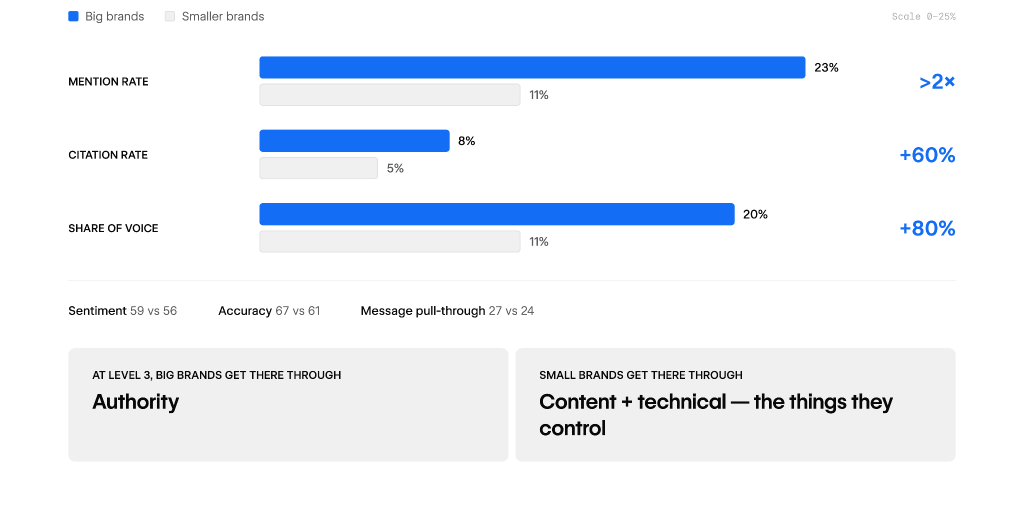
The data suggests a "rich get richer" scenario. Larger media organizations are currently performing twice as well as smaller competitors in terms of AI mention rates and are capturing 80% more of the "share of voice" in generative search results.
The Future of Traffic: Blocking vs. Negotiating
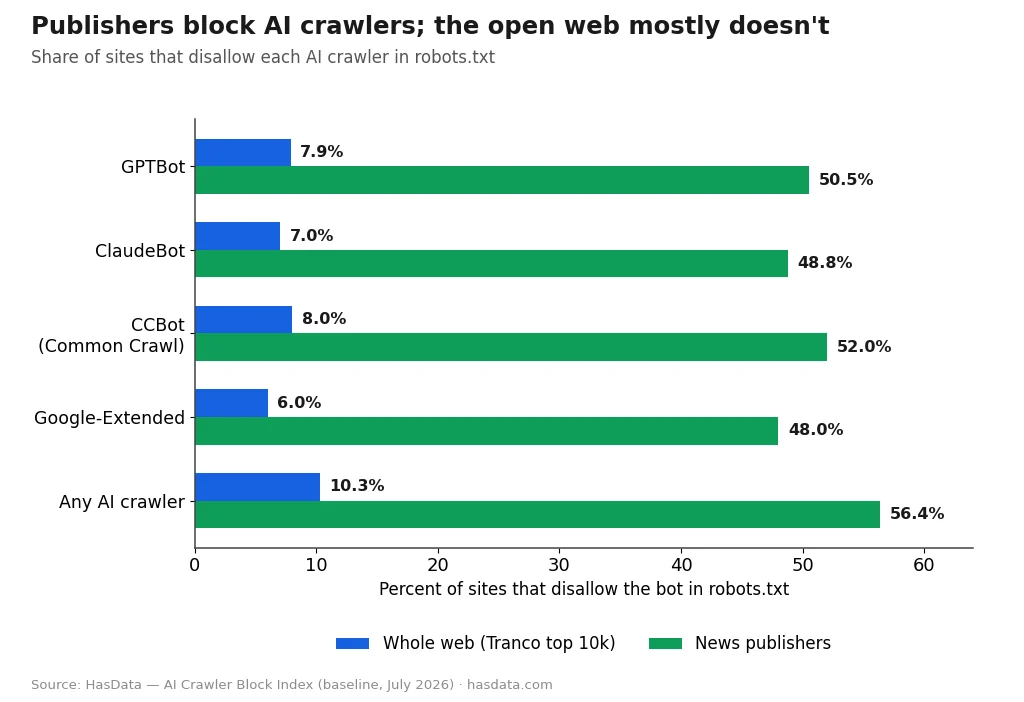
Publishers are currently caught in a "change-or-die" dilemma. While many are attempting to block AI bots—56.4% of news publishers block at least one AI crawler in their robots.txt—the effectiveness of these blocks is questionable. HasData found that 39.5% of sites that officially banned GPTBot were still serving it content during live tests.
The reality is that "polite" bots respect these walls, but aggressive or unauthorized scrapers do not. This has led to a shift in strategy. Instead of relying on ineffective barriers, forward-thinking publishers are now creating "whitelists." By negotiating direct access deals—essentially licensing their content for AI training and retrieval—publishers can turn a potential threat into a revenue stream.
As Roman Milyushkevich, CEO of HasData, concludes, "Publishers should think about proper access deals and monetization that would work for both of these categories instead of simple walls. It is becoming increasingly difficult to distinguish between helpful agent traffic and harmful scraping."
Conclusion: The Path Forward
The "agentic web" is not a temporary disruption; it is the new baseline for the digital economy. Publishers who continue to view AI solely as a source of referral traffic are likely to see their influence wane.

The successful publishers of tomorrow will be those who:
- Prioritize Quality Metadata: Ensuring that AI can correctly parse and attribute their content.
- Move Beyond
robots.txt: Recognizing that simple blocking is insufficient in an era of sophisticated crawlers. - Monetize Access: Shifting from traffic-based revenue to value-based licensing.
- Optimize for Answers: Focusing on the "AEO" maturity model—being the definitive source of information that an AI agent needs to cite to remain accurate.
As the line between human and bot traffic continues to blur, the ultimate value of a publisher will not be how many people click their links, but how essential their content becomes to the machines that now answer the world’s questions.