In a complex geopolitical landscape, the Asia-Pacific region stands as a microcosm of the global struggle to define relations with the People’s Republic of China. A new, comprehensive study from the Pew Research Center, surveying 45,658 individuals across 37 nations, reveals a stark reality: China is viewed simultaneously as a vital economic partner and a looming security threat, with perceptions diverging sharply along economic and geographic lines.
The findings, based on data collected between February and May 2026, illustrate that there is no singular “Asia-Pacific view” of Beijing. Instead, the region is characterized by a deep polarization that reflects the varying strategic, economic, and security interests of its diverse nations.
The Core Findings: A Region Split in Two
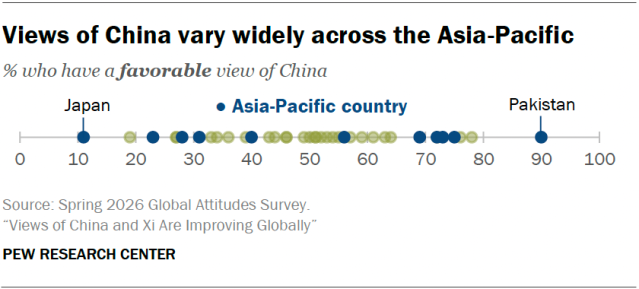
The most striking takeaway from the 2026 research is the sheer extremity of public opinion within the Asia-Pacific. In Pakistan, a staggering 90% of the population expresses a favorable view of China, signaling a deeply entrenched bilateral partnership. Conversely, in Japan, 88% of the public holds an unfavorable view, marking one of the most hostile public sentiments globally.
This divergence is not merely incidental; it is systemic. When researchers mapped these opinions against economic indicators, a clear pattern emerged: the “wealth gap” is a primary driver of geopolitical sentiment. In middle-income nations such as Indonesia, Malaysia, and Thailand, citizens are more likely to express confidence in Chinese President Xi Jinping and to offer the benefit of the doubt regarding the Chinese government’s respect for personal freedoms.
In contrast, citizens of wealthier, high-income nations like Australia, Japan, and South Korea harbor significant skepticism. In these societies, concerns regarding democratic norms, human rights, and regional security exert a much stronger influence on public perception than in their middle-income counterparts.
A Chronological Perspective: How We Got Here
The 2026 survey does not exist in a vacuum; it is the latest installment in a longitudinal effort by the Pew Research Center to track how China’s foreign policy and the "Xi Era" have reshaped the global order.
- The Early Xi Years (2012–2018): During the initial phase of President Xi’s tenure, international opinion was relatively optimistic, focused largely on China’s economic integration and its role as a "global factory."
- The Shift (2019–2022): As documented in previous Pew reports, the pandemic and increased assertive posturing in the South China Sea began to shift global sentiment. The 2022 report highlighted a marked hardening of public opinion in democratic nations.
- The Current Climate (2023–2026): By 2023, China’s foreign policy was receiving largely negative reviews across most surveyed nations. The 2026 data confirms that while there are pockets of warming, the fundamental mistrust in developed, democratic economies has become a structural feature of their foreign policy outlooks.
For over a decade, researchers have observed a steady, high-level concern regarding territorial disputes in East Asia. In Japan, the Philippines, and South Korea, the percentage of citizens who are "very concerned" about Chinese territorial claims has remained above 80% since 2014, showing a remarkable, if concerning, stability in public anxiety.

Supporting Data: Threat Assessments and Alliances
The survey utilized open-ended questions to determine how citizens perceive the "top threat" to their respective nations. The results underscore the precarious position China occupies in the regional security architecture.
The Threat Index
In the Philippines, 76% of respondents identified China as their nation’s greatest threat. This figure is perhaps the most significant indicator of the current maritime tensions in the region. Japan (53%) and Australia (52%) follow, where China is consistently named as the primary security concern.
In South Korea and India, the hierarchy of threats is more nuanced. While North Korea (43%) and Pakistan (54%) remain the primary concerns for those respective nations, China occupies a solid second-place position, being cited as the top threat by nearly a third of South Koreans and one-fifth of Indians.
The Ally Paradox
Conversely, in Southeast and South Asian nations, the narrative is markedly different. In countries like Bangladesh, Indonesia, and Thailand, China is rarely identified as a threat. In Pakistan, the alliance is ironclad, with a 75% majority declaring China their top global ally. This confirms that for many developing nations, the economic benefits of the Belt and Road Initiative and other state-to-state investments outweigh the security anxieties felt by wealthier, U.S.-aligned partners.
Official Responses and Diplomatic Implications
The data presents a profound challenge for policymakers in both Beijing and Washington. For China, the findings highlight a "popularity ceiling" in advanced economies that no amount of economic diplomacy seems capable of shattering. For the United States and its regional partners, the findings illustrate the difficulty of building a unified front against Chinese influence when the economic incentives for many regional actors remain tied to Beijing.
Regional governments have responded to these pressures in varied ways:
- The "Hedging" Strategy: Many middle-income nations have adopted a policy of strategic ambiguity, refusing to label China as a threat while simultaneously maintaining security ties with the U.S.
- The Hardening Stance: In countries like the Philippines and Japan, governments have moved to formalize defense pacts and increase military spending, directly reflecting the public’s heightened fear of territorial encroachment.
The recent decline in concern among Australians and Indians—who are now less likely to express worry about territorial disputes than they were in 2024—is a curious data point. Analysts suggest this may not indicate a decrease in the reality of the threat, but perhaps a normalization or "fatigue" regarding the constant state of regional friction.
Implications: A Future of Fragmented Alliances
As we look toward the remainder of the decade, the implications of this study are twofold.
1. The Economic-Security Divide: The report suggests that the global order is no longer defined by a simple binary between "pro-China" and "pro-West" camps. Instead, we are seeing a fragmentation where economic necessity and security concerns operate on separate tracks. A country can be heavily reliant on Chinese trade while simultaneously fearing its military expansionism.
2. The Persistence of Territorial Anxiety: The data indicates that territorial disputes are the "third rail" of regional politics. Regardless of economic fluctuations, the fear of losing sovereignty remains the most powerful motivator for public policy in East and Southeast Asia. The fact that this anxiety has persisted for over a decade suggests that it is not a temporary grievance, but a structural reality that will dictate the behavior of regional actors for years to come.
Ultimately, the Pew Research Center’s 2026 data provides a sober assessment for decision-makers. The "China challenge" is not a uniform problem; it is a nuanced, country-specific puzzle. Success for any regional power in the coming years will depend on its ability to navigate these disparate public sentiments and balance the competing demands of economic development and national security.
As the Asia-Pacific continues to serve as the global theater for the 21st century’s most significant geopolitical shifts, the voices of its citizens—from the bustling markets of Jakarta to the high-tech hubs of Tokyo—will remain the most critical, and most divided, component of the story.