WASHINGTON — Public sentiment regarding the rapid proliferation of data centers across the United States has soured dramatically, according to a comprehensive new nationwide survey released by the Pew Research Center. Driven by escalating concerns over heavy energy consumption, environmental degradation, and the localized disruption of residential life, Americans are increasingly casting a critical eye on the physical infrastructure powering the artificial intelligence boom and modern cloud computing.
The findings reveal a marked shift in public opinion between January and August 2026. A strong majority of U.S. adults now express profound discomfort with the prospect of hosting a data center in their communities, reflecting a broader cultural and political flashpoint. As local opposition groups mobilize, state legislatures debate zoning bans, and governors institute sudden moratoriums, the race to build high-capacity computing facilities is colliding head-on with grassroots anxiety.
Main Facts: A Rapid Turn Toward Skepticism
The Pew Research Center survey, conducted between July 20 and August 9, 2026, among 10,548 U.S. adults, details a broad-based hardening of public attitudes.
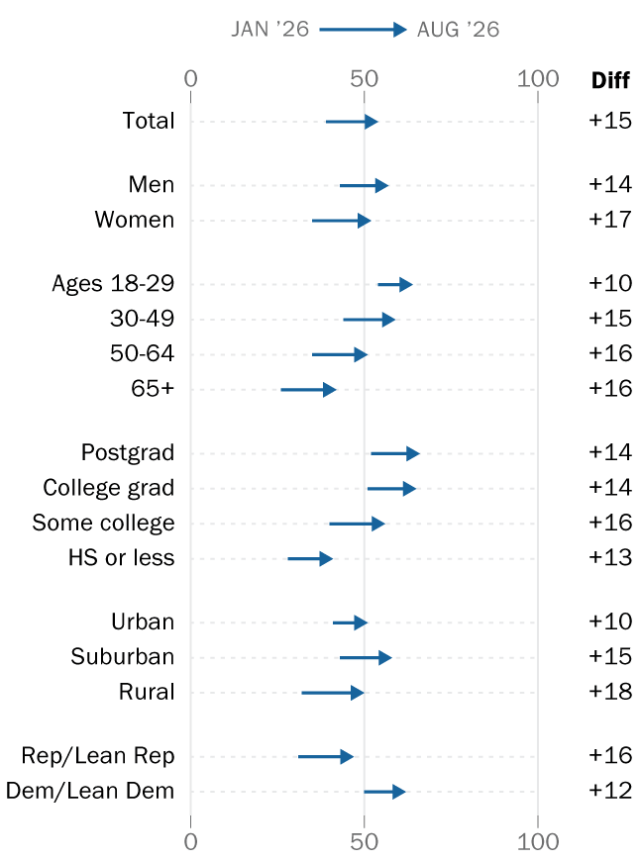
- Environmental Concerns: More than half of Americans (54%) now view data centers as "mostly bad" for the environment, a steep increase from 39% at the start of the year.
- Home Energy Costs: Half of all respondents (50%) believe these facilities are mostly bad for home utility bills, up from 38% in January. Given that data centers demand immense amounts of continuous electricity to power server racks and cooling systems, consumers are increasingly worried about grid strain driving up household costs.
- Quality of Life: Nearly half of the country (49%) states that data centers have a mostly negative impact on the quality of life for nearby residents, a significant jump from 30% earlier in the year.
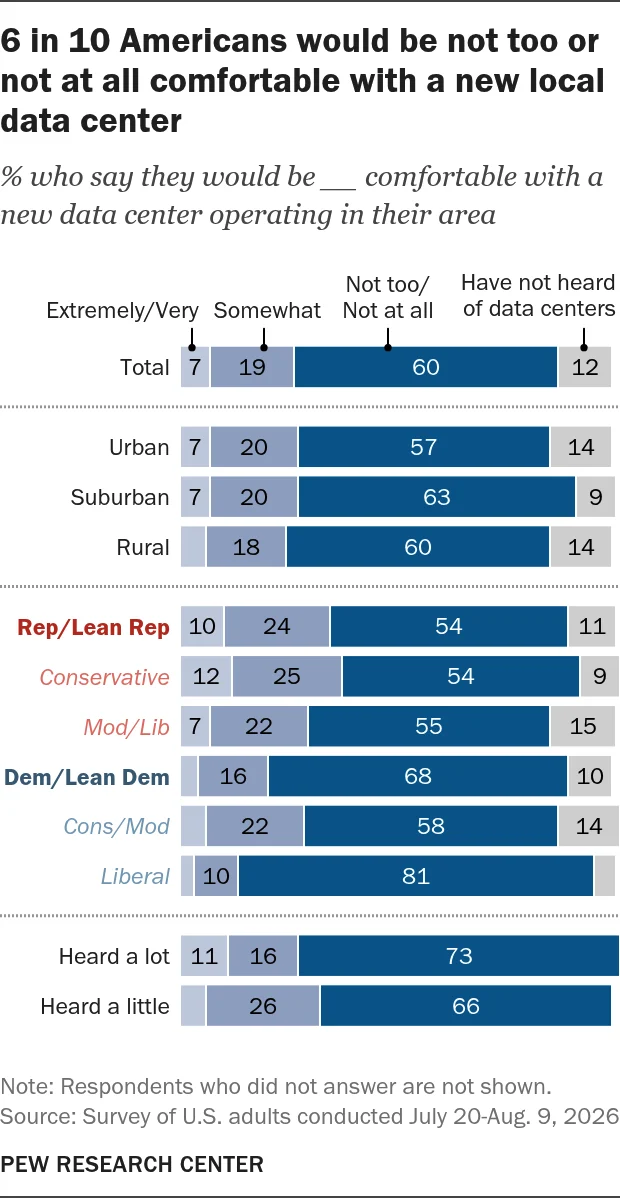
- Local Discomfort: Overall, 60% of Americans report they would be "not too comfortable" or "not at all comfortable" if a new data center began operating in their local area. By contrast, only 7% would be extremely or very comfortable, while 19% feel somewhat comfortable.
Despite the heavy footprints of these facilities, opinions remain closely split regarding their economic benefits. Roughly equal shares view data centers positively or negatively regarding local jobs (24% mostly bad vs. 22% mostly good) and local tax revenue (21% mostly bad vs. 22% mostly good), though negative sentiment in these categories has also ticked upward.

Chronology: How Public Awareness and Anxiety Evolved in 2026
The trajectory of the data center debate has accelerated rapidly over the course of 2026, transitioning from a niche technological issue to a mainstream political and environmental battleground.
- Early 2026 (January): Public familiarity with data centers was comparatively low. A full quarter of Americans (25%) reported having heard nothing at all about them, and initial skepticism—though present—was moderate. At this stage, 39% viewed them as environmentally harmful, and 30% worried about local quality of life.
- Spring 2026 (March–April): As technology companies intensified site-acquisition efforts, data center development heavily targeted rural areas due to cheaper land and available electrical interconnections. Local town halls across the American heartland began filling with concerned residents protesting zoning permits and water usage.
- Summer 2026 (July–August): Public awareness reached a milestone, with roughly 9 in 10 Americans (88%) reporting they had heard at least a little about data centers, and those saying they had heard "a lot" jumping from 25% to 35%. Simultaneously, political friction boiled over, leading to high-profile policy shifts by state executives and widespread community protests.
- Late Summer (August 2026): The Pew survey captured this peak anxiety, documenting double-digit percentage surges in negative public perception across virtually every measured demographic and geographic category.
Supporting Data: Demographic and Partisan Divides
While negative sentiment has expanded across all segments of the population, deep divides persist across political affiliations, age groups, and geographic locations.
The Partisan Split
Democrats and Democratic-leaning independents consistently express higher levels of skepticism than Republicans and Republican-leaning independents. In the August survey, 68% of Democrats said they would be uncomfortable with a new local data center, compared to 54% of Republicans. Liberal Democrats proved particularly resistant, with 81% voicing discomfort.
However, Republicans are also growing notably more wary. The share of Republicans who believe data centers negatively impact nearby quality of life surged from 24% in January to 42% in August.

Urban, Suburban, and Rural Dynamics
Geographically, opposition is remarkably uniform, with majorities in urban (57%), suburban (63%), and rural (60%) areas expressing discomfort with prospective local facilities. This is especially consequential given that the vast majority of newly planned data centers are slated for rural locations, where local residents have seen negative environmental views jump from 32% to 50% since January.
| Topic / Area | Jan 2026 (% Mostly Bad) | Aug 2026 (% Mostly Bad) | Point Change |
|---|---|---|---|
| The Environment | 39% | 54% | +15 |
| Home Energy Costs | 38% | 50% | +12 |
| Quality of Life Nearby | 30% | 49% | +19 |
| Local Jobs | 15% | 24% | +9 |
| Local Tax Revenue | 12% | 21% | +9 |
Official Responses: Diverging Political Strategies
The sharp turn in public opinion has forced elected officials at all levels of government to reevaluate their stances on digital infrastructure, creating stark divisions within and between political parties.
At the federal level, President Donald Trump has maintained a vocal, supportive posture toward data center construction, viewing the infrastructure as vital to maintaining American technological dominance in artificial intelligence and economic competitiveness.
Conversely, state-level leaders are increasingly feeling the heat from constituents. In Texas, a state that previously welcomed massive technological expansion, Gov. Greg Abbott instituted a statewide moratorium on new data center approvals in August 2026 following public outcry over grid stability and water resources.
Democratic governors have similarly adjusted their approaches. Pennsylvania Gov. Josh Shapiro signed an executive order establishing stricter oversight protocols for data center operations, while Illinois Gov. JB Pritzker moved to suspend certain state tax breaks for data centers, urging a more cautious, deliberate approach to local development. Local municipal leaders across the country are likewise leveraging zoning ordinances and public hearings to pump the brakes on rapid builds.
Implications: The Future of the AI Infrastructure Boom
The growing chasm between national technological ambitions and local public sentiment poses a profound challenge for the tech industry and policymakers alike. As artificial intelligence models demand unprecedented computational power, the physical constraints of the electrical grid and water supplies are becoming glaringly apparent to everyday citizens.
If public discomfort continues to harden into organized political resistance, tech firms may face extended legal battles, tougher environmental regulations, and costly delays in scaling their operations. Furthermore, the politicization of energy consumption—linking data centers directly to rising home utility bills—risks alienating consumers who might otherwise support technological advancement.
For decision-makers navigating the remainder of the decade, the core dilemma will be balancing the economic and strategic imperatives of the digital age against the very real, immediate concerns of local communities demanding protection for their environment, wallets, and quality of life.