In the rapidly evolving landscape of global content delivery and edge computing, Luxembourg-based Gcore has emerged as a formidable force. Recently, the privately held infrastructure provider pulled back the curtain on its financial performance, revealing a period of aggressive expansion and operational maturity. With a reported $140 million in revenue for the 2025 fiscal year, Gcore is signaling that it has moved beyond the "startup" phase and is now a critical pillar of the global internet backbone.
This surge in financial performance, bolstered by a 55% month-over-month growth in CDN revenue throughout 2025, highlights a broader industry shift. As streaming demands skyrocket and the complexity of low-latency delivery increases, Gcore has positioned itself as a primary beneficiary of the "great reshuffling" of the CDN market—a period defined by provider consolidation and the migration of enterprise traffic to more agile, high-performance networks.
The Financial Trajectory: A Study in Hyper-Growth
To understand Gcore’s current standing, one must look at the data. The company ended 2023 with just under $76 million in revenue, a figure that represented a 60% growth rate over the preceding two-year window. By the close of 2025, that revenue had ballooned to $140 million, demonstrating a sustained upward momentum that is rare in the capital-intensive infrastructure space.
Key Financial Benchmarks
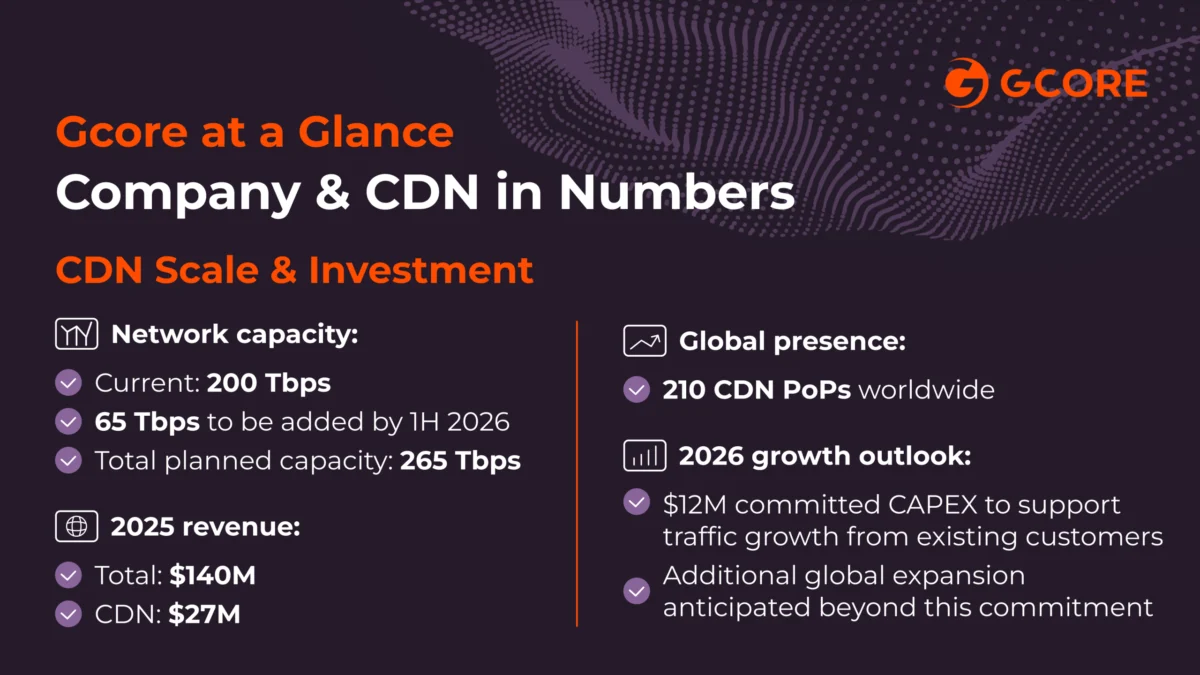
- Total 2025 Revenue: $140 Million
- CDN-Specific Revenue: $27 Million
- CDN Growth Rate (Nov 2024–Nov 2025): ~55% month-over-month
- Growth Context: Revenue grew nearly 60% between 2021 and 2023, accelerating further into 2025.
Perhaps most impressively, Gcore reports that both the company as a whole and its CDN business segment are cash-flow positive. In an era where many infrastructure players are burning through venture capital to subsidize growth, Gcore’s ability to scale while maintaining profitability is a testament to its operational efficiency and its strategic decision to invest in a proprietary caching engine capable of achieving ~0.9 Gbps per server core.
Chronology of Expansion: From 2014 to the Present
Founded in 2014, Gcore has spent the last decade building out its global footprint. While its early years were focused on establishing foundational compute and storage capabilities, the company’s recent trajectory suggests a pivot toward high-performance, edge-centric services.
2014–2022: The Foundational Years
The company spent nearly a decade refining its infrastructure, focusing on the integration of CDN services with edge computing. By embedding compute directly into the delivery network, Gcore attracted high-profile enterprise clients, including DAZN and Microsoft. During this period, the company focused on building a global presence that could handle the immense data throughput required for live sports and interactive media.
2023–2024: Capital Injection and Market Consolidation
In 2024, Gcore secured a $70 million Series A funding round. This infusion of capital served as a catalyst for the growth seen in 2025. The timing was fortuitous: the CDN market began to see several major legacy providers exit or scale back operations. As enterprise customers sought more reliable, cost-effective alternatives, Gcore was ready to absorb this influx of traffic.
2025–2026: The Age of Optimization
By the end of 2025, Gcore had reached a network capacity of 200 Tbps across 210 Points of Presence (PoPs). Looking toward the first half of 2026, the company has already earmarked $12 million in customer-backed commitments to expand its network further, with an ambitious target to add another 65 Tbps of capacity.
Supporting Data: Mapping the Global Traffic Flow
Gcore’s geographic footprint is a clear indicator of its strategic focus on high-demand markets. According to the company’s internal traffic data, the distribution of its global delivery is highly balanced, with a heavy emphasis on Western markets while maintaining significant reach in emerging regions.
Regional Traffic Breakdown
- North America: 29.4% (The primary engine of growth)
- Europe: 27.3% (A stable, mature market base)
- Asia: 13.5%
- South America: 13.3%
This geographical distribution suggests that Gcore’s infrastructure is particularly well-suited for global enterprises that require consistent performance across fragmented internet ecosystems. By maintaining 210 PoPs, the company minimizes the "last mile" latency that often plagues streaming and gaming services.
Technical Prowess: Powering the Modern Web
Gcore’s competitive edge is derived from its support for modern delivery protocols. The platform offers comprehensive support for:
- Streaming Standards: HLS/DASH and their low-latency variants (LL-HLS/LL-DASH).
- Real-Time Transport: WebRTC, which is becoming the industry standard for interactive media and low-latency conferencing.
- Advanced Protocols: QUIC and gQUIC, which optimize transport layer performance in congested networks.
- Compute-Integrated Delivery: GPU-accelerated encoding, allowing Gcore to offer compute-at-the-edge capabilities that traditional static CDNs cannot match.
Official Responses and Strategic Outlook
While the company remains privately held, its leadership has been transparent about the drivers behind its growth. A recurring theme in the company’s communications is the "redistribution" of traffic. As major legacy CDN providers have shifted their business models or exited specific regions, Gcore has positioned itself as the logical destination for displaced enterprise traffic.
Despite an aggressive price-reduction strategy in certain regions over the past two years, the company’s total revenue increased significantly. This indicates a high level of "price elasticity" in the market—as Gcore lowered its costs, the volume of traffic from large-scale customers grew at a rate that more than compensated for the margin compression.
"Streaming is currently our fastest-growing CDN segment," a company representative noted. The convergence of high-demand live events—such as those managed by their client DAZN—and the rising popularity of interactive video has forced Gcore to iterate its caching engine to handle higher throughput per core, effectively lowering the cost-per-bit for their end-users.
Implications for the CDN and Infrastructure Market
Gcore’s rise carries significant implications for the broader infrastructure sector.
1. The Death of the "One-Size-Fits-All" CDN
The traditional CDN model, characterized by vast, monolithic networks, is being challenged by specialized, edge-compute-heavy providers. Gcore’s success proves that enterprises are moving away from general-purpose providers in favor of partners that offer GPU-accelerated encoding and low-latency transport protocols like WebRTC as part of their standard suite.
2. Infrastructure as a Competitive Moat
By investing $12 million in network expansion for 2026, Gcore is establishing a barrier to entry. The ability to deploy 65 Tbps of additional capacity in six months is not a capability shared by smaller startups. This scale allows them to negotiate favorable peering agreements and provide the redundancy that enterprise-grade clients demand.
3. The Future of Edge Computing
Gcore’s trajectory highlights that the future of content delivery is not just "delivery." It is about compute. By integrating compute at the edge, Gcore is effectively blurring the line between a CDN and a distributed cloud provider. As AI-driven content generation and personalized streaming become the norm, the ability to process data at the edge—rather than backhauling it to a centralized data center—will become the primary differentiator for the next generation of infrastructure providers.
Conclusion: Looking Ahead at the NAB Show
As Gcore continues to scale, its presence at industry-defining events like the NAB Show Streaming Summit will be closely watched by competitors and customers alike. The company has moved from being a niche player in European infrastructure to a global competitor capable of handling the most demanding traffic loads on the internet.
For those tracking the industry, the narrative is clear: the combination of deep technical expertise in edge compute, a lean and profitable business model, and the ability to capture market share during industry consolidation has made Gcore a firm to watch in 2026. Whether they can maintain their current trajectory will depend on their ability to integrate further AI-driven optimizations into their network and continue scaling their capacity to meet the relentless demand for global, low-latency streaming.
As the industry converges in Las Vegas, the spotlight will be on whether Gcore can sustain its momentum or if the larger, public cloud-native competitors will move to stifle this new wave of infrastructure innovation. For now, the numbers speak for themselves: Gcore is no longer just playing in the edge space—it is actively shaping it.