
As the United States approaches Grandparents Day—observed annually on the first Sunday following Labor Day, falling this year on September 13—the institution of grandparenthood remains a cornerstone of the American family experience. It is a stage of life that, for the vast majority of older Americans, represents a significant transition, blending traditional caregiving roles with modern communication technology and evolving household structures.
New data from the U.S. Census Bureau’s 2025 Survey of Income and Program Participation (SIPP) and recent studies from the Pew Research Center provide a comprehensive portrait of this demographic. Currently, two-thirds of U.S. adults aged 65 and older hold the title of grandparent, serving as a vital bridge between generations.
The Demographics of Grandparenthood: A Milestone of Aging
The likelihood of becoming a grandparent is inextricably linked to the progression of age. Data reveals that while grandparenthood is a relatively rare experience for those in their 30s—affecting fewer than 1% of that cohort—the prevalence increases dramatically with each passing decade.
By the time Americans reach their 50s, 27% have become grandparents. This figure jumps to 51% for those in their 60s, 68% for those in their 70s, and peaks at 74% among individuals aged 80 to 90. The average age of a U.S. grandparent in 2024 stood at 68, suggesting that for most, this role is embraced during a period of life often characterized by retirement and increased leisure time.
The Scope of the Family Tree
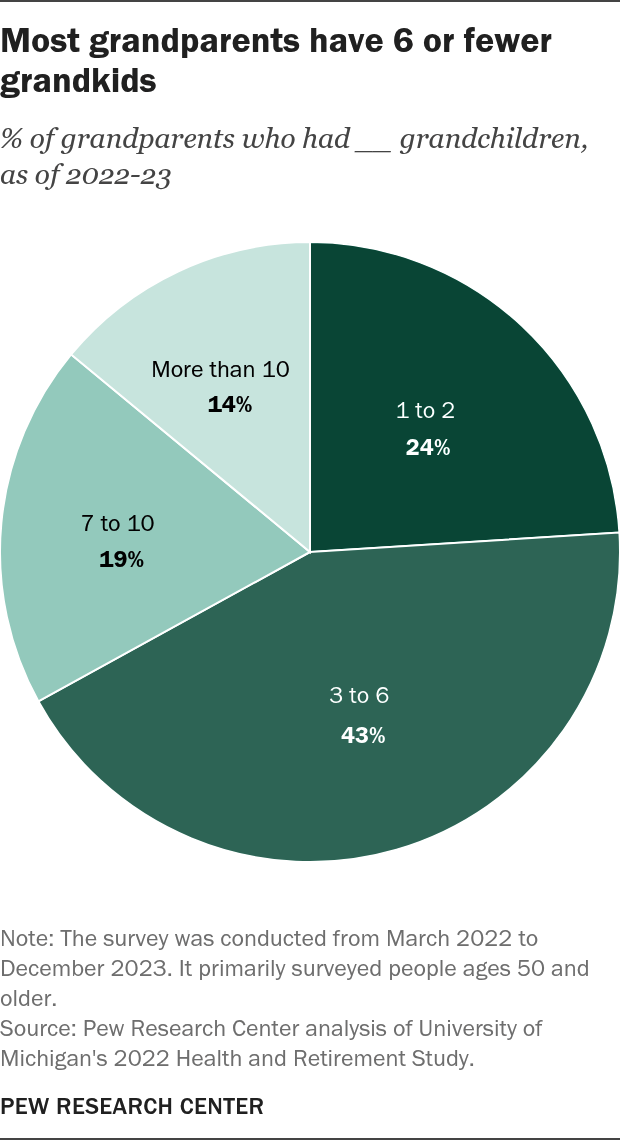
According to the University of Michigan’s Health and Retirement Study (HRS), which focuses on individuals aged 50 and older, the average American grandparent oversees a family branch of six grandchildren. The distribution of family size among this group is varied: 24% of grandparents have one or two grandchildren, while 43% fall into the "three to six" category. Larger families are also represented, with 19% of grandparents reporting seven to 10 grandchildren, and 14% boasting a family tree that includes more than 10.
Caregiving in the Modern Era
One of the most profound ways grandparents contribute to family stability is through direct caregiving. The HRS data from 2022 and 2023 indicates that 21% of grandparents spent 100 hours or more over a two-year period providing care for a grandchild or great-grandchild. While this averages out to approximately one hour per week, the impact of this support—whether providing childcare for working parents or fostering emotional bonds—cannot be understated.
It is essential, however, to contextualize these figures. The data collection period occurred during and immediately following the height of the coronavirus pandemic. During this time, public health recommendations frequently limited in-person contact, meaning these statistics likely serve as a floor rather than a ceiling for current caregiving trends. As society has returned to more frequent face-to-face interaction, the role of the grandparent as a caregiver may be even more robust than this snapshot suggests.

Multigenerational Living and Household Dynamics
The American household is undergoing a quiet transformation, with multigenerational living becoming increasingly common. In 2024, 8% of children in the United States lived in a home where a grandparent was the head of the household.
This living arrangement is diverse in its structure. Nearly half (48%) of these children live in households led by two married grandparents. Another 43% reside with a grandmother who does not have a spouse present, while 9% live with a grandfather without a spouse present. These figures highlight the critical role that grandparents play as primary providers and stabilizing forces in the lives of their grandchildren, often stepping in to fill gaps in support systems.
Connectivity in the Digital Age
The stereotype of the "distant" grandparent is being dismantled by technology. A September 2025 survey by the Pew Research Center found that seven out of ten grandparents aged 65 and older maintain contact with their grandchildren at least a few times a month. This communication includes a hybrid of traditional and modern methods, such as in-person visits, telephone calls, and text messaging.
The frequency of this connection is high: 15% of grandparents are in touch with their grandchildren on a daily basis, and 27% communicate a few times a week. Furthermore, when asked about their outlook on the future, many older adults expressed significant excitement about their upcoming years, with many citing the prospect of continued, meaningful interaction with their grandchildren as a primary driver of their optimism.
The Emotional Fabric: Closeness and Demographic Variance
Beyond the logistical metrics of hours spent and frequency of calls, the emotional bond between generations remains strong. A June 2025 survey revealed that 36% of U.S. adults who have living grandparents consider themselves "extremely" or "very" close to them, with an additional 27% describing the relationship as "somewhat" close.
Interestingly, this closeness shows notable variation across racial and ethnic lines. Black Americans are significantly more likely to report a deep connection with their grandparents, with 49% identifying as extremely or very close. This compares to 36% for Hispanic adults, 34% for Asian adults, and 32% for White adults. These disparities suggest that cultural traditions and family structures play a major role in how intergenerational intimacy is cultivated and maintained across different communities.
Implications for Social Policy and Future Research
The data surrounding grandparenthood serves as more than just a collection of facts; it offers critical implications for policymakers and social researchers. As the population continues to age, the reliance on grandparents for childcare and emotional support will likely remain a pillar of economic and social stability.
The Economic Ripple Effect
When grandparents provide 100 or more hours of care, they effectively subsidize the workforce participation of their own children. In a landscape where childcare costs are a primary concern for young families, the "grandparent dividend" is an essential component of the American economy. Policymakers must consider how programs like the Social Security system or elder care initiatives intersect with these caregiving responsibilities.
The Digital Divide
While 70% of grandparents are staying in touch through various media, 30% are in contact less frequently. Bridging this gap—through improved digital literacy programs for seniors or better access to communication technologies—could have profound effects on the mental health and social isolation levels of the elderly.
Future Research Directions
The inclusion of younger respondents in future surveys, and a more granular look at how geographic distance influences the ability to provide care, remain essential areas for study. Furthermore, as the generation currently becoming grandparents shifts to include those with more diverse digital fluency and different professional backgrounds, the very definition of "grandparenting" will continue to evolve.
Conclusion
As we look toward Grandparents Day, it is clear that the role of the grandparent is far more active, connected, and vital than ever before. From the 8% of children living under a grandparent’s roof to the millions of grandparents who maintain daily digital connections with their families, this demographic is a bedrock of American society.
Understanding these dynamics—not just as static data points, but as the living, breathing reality of millions of families—allows us to better appreciate the invisible threads that hold families together across generations. As our society continues to navigate the complexities of aging, one thing remains certain: the wisdom, support, and presence of our grandparents are not just relics of the past, but active ingredients in the health of our future.