In an era defined by hyper-partisanship and a fractured media landscape, the question of how Americans participate in public life has become a central concern for sociologists and political scientists alike. A groundbreaking new study from the Pew-Knight Initiative offers a comprehensive, multi-dimensional portrait of the U.S. electorate. By moving beyond traditional metrics that view voting or news consumption in isolation, researchers have identified four distinct "engagement groups" that reveal how citizens interact with their communities, their government, and the news.
The findings suggest that engagement is not merely a binary state of "active" or "inactive." Instead, it is a complex tapestry of behaviors—ranging from religious participation and community volunteering to political advocacy and news habits—that, when clustered, reveal deep-seated differences in how Americans perceive the state of their nation.

The Four Pillars of Public Engagement
To understand the modern American public, the Pew Research Center conducted a cluster analysis based on 19 distinct measures of participation. This analysis resulted in four primary personas, each representing a unique approach to civic life:
- Mobilizers: Representing the most active segment of the population, this group "does it all." They are highly involved in political, civic, religious, and news-gathering activities. They are the engine of local and national discourse.
- Connectors: While highly involved in community building, group affiliations, and charitable giving, this group is notably less focused on direct political agitation than the Mobilizers. They represent a bridge between purely local civic action and broader societal participation.
- Spectators: As the name implies, this group occupies a middle ground. They follow the news with high levels of interest but remain largely on the sidelines when it comes to direct participation in civic or political activities.
- Outsiders: This group is the least engaged across all metrics. They report the lowest levels of voting, volunteering, and news consumption. They are effectively detached from the traditional mechanisms of public life.
Chronology of the Research and Methodology
The data underpinning this analysis were drawn from two rigorous surveys conducted throughout 2025. The primary data source, the Cross-Sectional Engagement Survey, was fielded between July 9 and December 5, 2025, reaching a robust sample of 5,393 adults. This survey was designed to be inclusive, offering participants the ability to respond via paper, telephone, or online platforms—an essential step to capture the "Outsider" population who are often missed by digital-only polling.
To deepen the analysis, the team utilized the American Trends Panel (ATP) Wave 179, conducted in September 2025 with 5,195 respondents. This allowed researchers to map the identified engagement groups against specific levels of civic knowledge, attitudes toward political institutions, and emotional responses to the state of the country. By aligning the clusters, the research provides a longitudinal snapshot of how these behaviors influenced, and were influenced by, the intense political environment surrounding the 2024 presidential election cycle.
Supporting Data: The Link Between Engagement and Interest
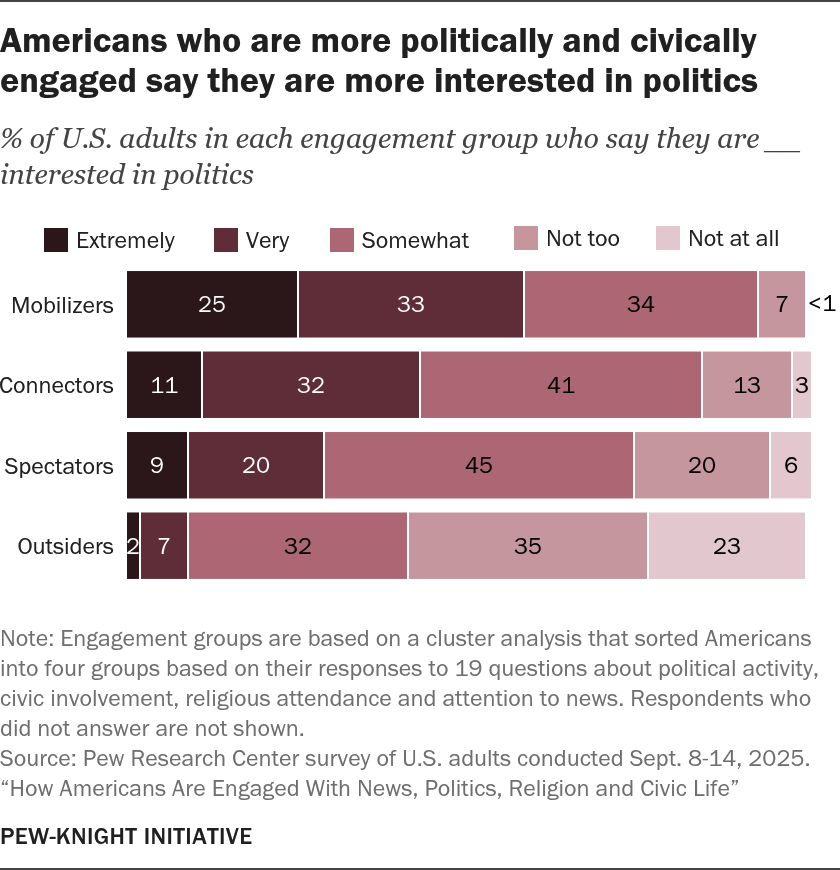
The data reveals a stark, linear correlation between a person’s level of engagement and their stated interest in politics. Among the highly active "Mobilizers," 58% report being "extremely" or "very" interested in politics. In contrast, that figure drops to just 9% among "Outsiders."

This interest gap is a defining characteristic of the American public. While some might assume that political interest is purely a product of party affiliation, the study suggests that the "engagement group" is a stronger predictor of interest than partisan identity. Within each cluster, Democrats and Republicans show remarkably similar levels of political interest, suggesting that the habit of engagement may be a precursor to—or a result of—a sustained focus on political life.
Emotional Responses to the State of the Nation
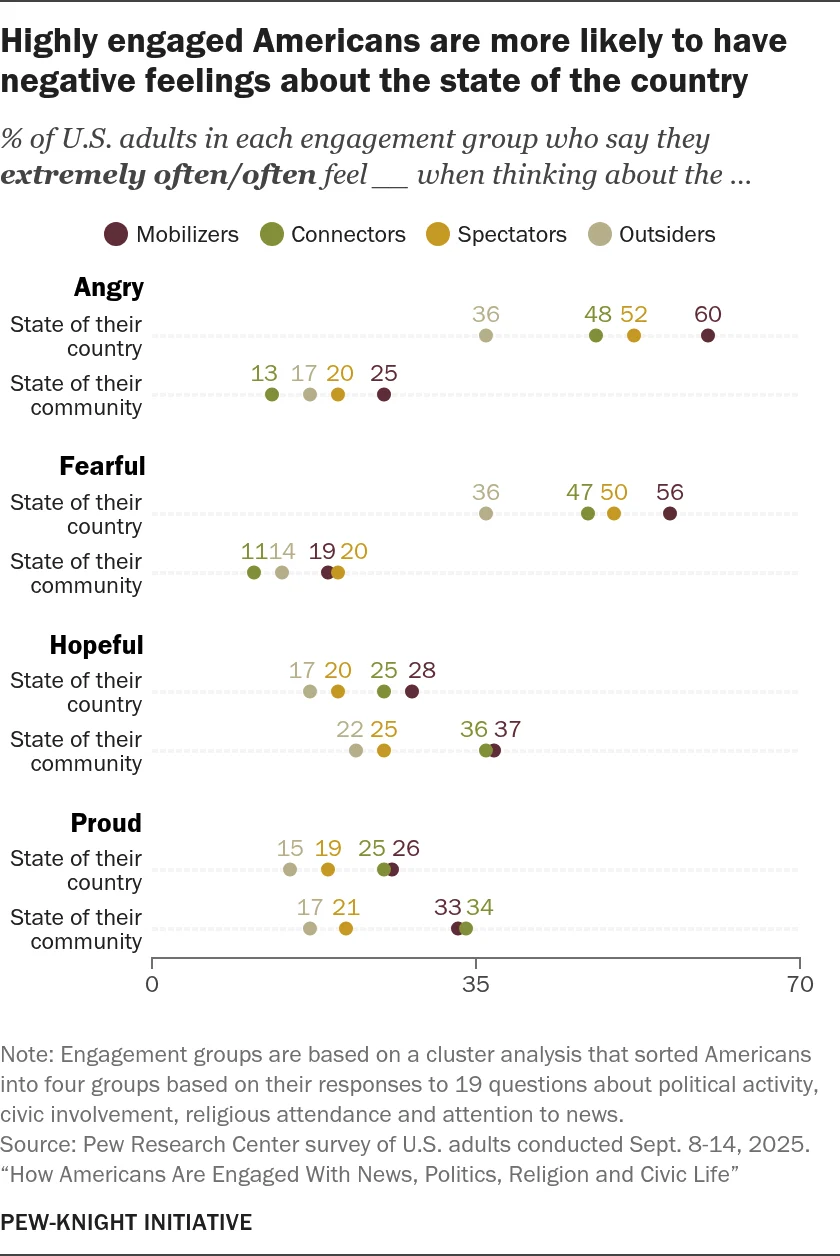
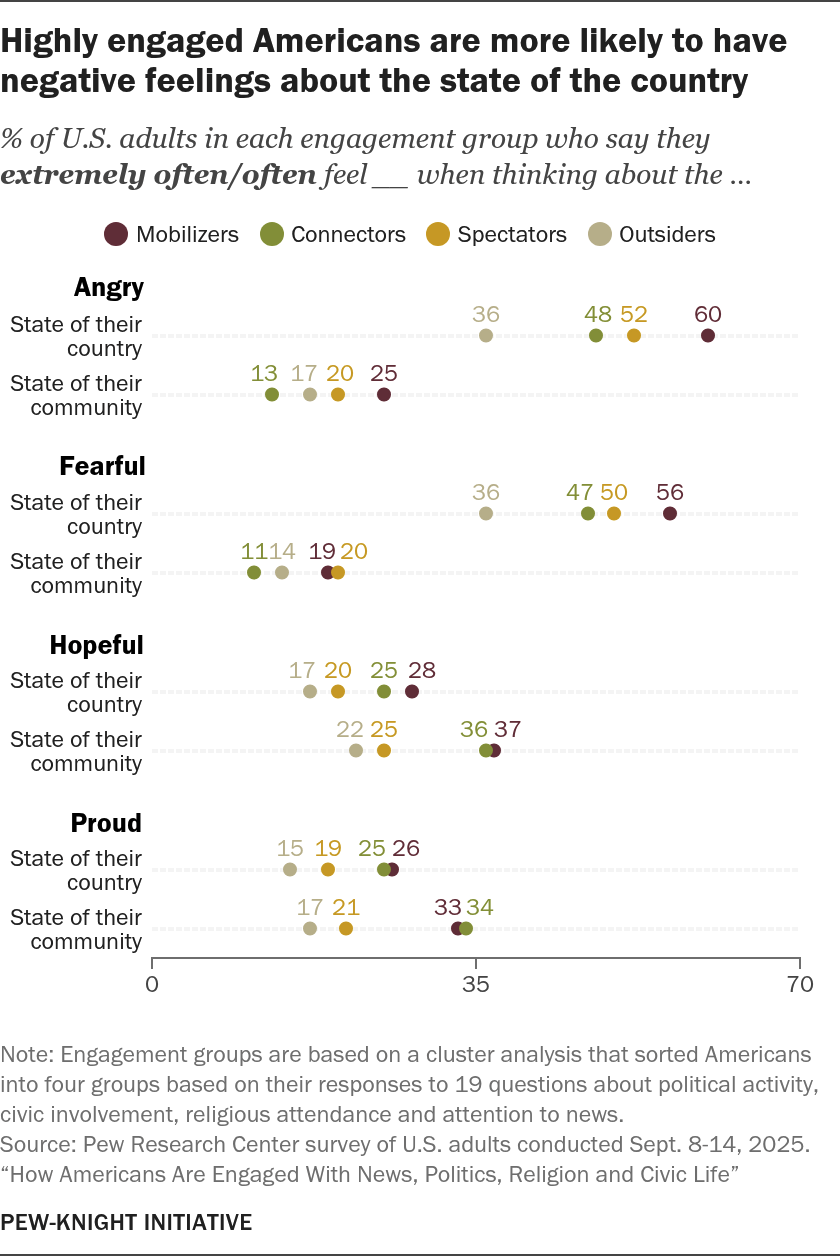
One of the most revealing aspects of the research is how different groups process the current state of the country emotionally. Across all four groups, Americans are more likely to report feeling "angry" or "fearful" than "hopeful" or "proud" when contemplating the national landscape.
However, the intensity of these feelings varies significantly by group:
- Mobilizers are the most likely to report feeling "angry" about the state of the country (60%).
- Outsiders, perhaps due to their detachment from news and political systems, report lower levels of both negative and positive emotions regarding the nation (36% report feeling angry).
Notably, the trend shifts when the focus moves from the "state of the country" to the "state of the local community." Across all four groups, negative emotions are significantly muted at the local level. This suggests a "proximity effect," where Americans feel a greater sense of agency and connection to their immediate surroundings than they do toward the federal government.

Official Perspectives: The Trust Deficit
The study highlights a profound crisis of confidence in federal institutions. Regardless of their level of engagement, roughly only one-in-five Americans express trust in the federal government to "do what is right" most of the time. This cross-group consistency underscores a systemic lack of faith that appears to transcend participation levels.
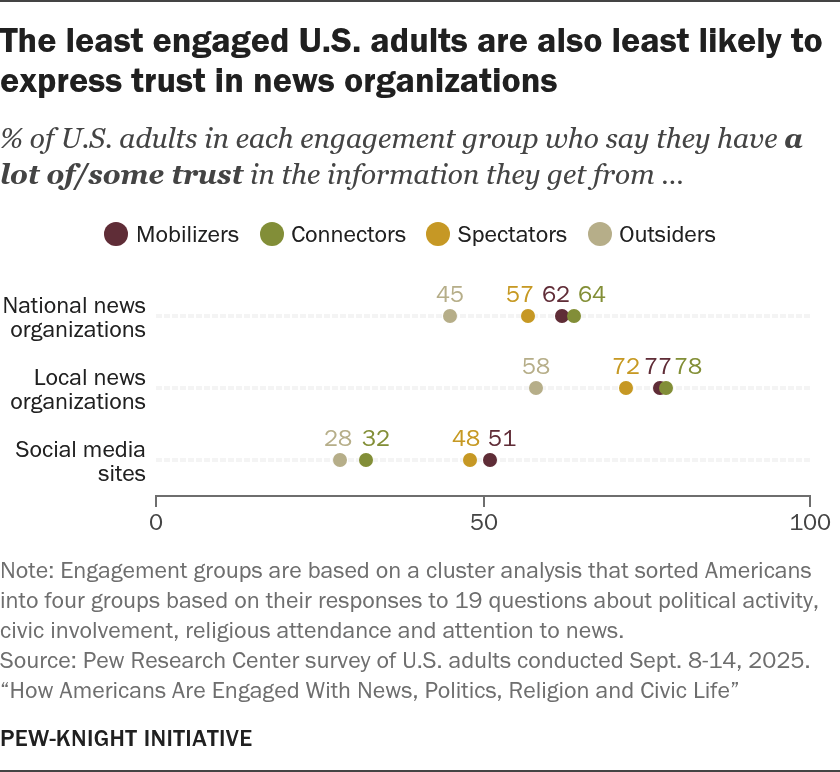
However, trust in news organizations reveals a more nuanced pattern. While Mobilizers and Connectors maintain relatively higher trust in national news outlets (62% and 64%, respectively), Outsiders are significantly more skeptical, with only 45% expressing any level of trust.

A particularly striking finding is the shared skepticism regarding media fairness. Across all four engagement groups, majorities—ranging from 72% to 82%—believe that news organizations "tend to favor one side" when covering political and social issues. This skepticism is not limited to the "Outsider" group; even the most highly engaged citizens, who rely most heavily on the news, are profoundly critical of its impartiality.
Implications for the Future of Civic Life
The existence of these four groups presents significant challenges and opportunities for policymakers, community leaders, and the media.
1. The "Outsider" Barrier
The "Outsider" group represents a segment of the population that has effectively opted out of the civic contract. Because this group is less likely to participate in surveys, their specific grievances are often underrepresented in public policy discussions. Engaging this group will require more than traditional "get out the vote" campaigns; it necessitates addressing the underlying causes of their detachment, which likely include feelings of alienation from both the political class and the media.
2. The "Mobilizer" Burden
Mobilizers are the lifeblood of civic participation, but their high levels of anger and fear suggest they are also the group most susceptible to political burnout and hyper-polarization. As they drive the political discourse, their emotional volatility risks further polarizing the Connectors and Spectators who are watching from the sidelines.

3. The Media’s Credibility Gap
The universal belief across all groups that the media favors one side is a red flag for the health of the public square. If even the most active, well-informed citizens view the news with skepticism, it becomes increasingly difficult to establish a shared set of facts upon which to base democratic debate. The data suggests that transparency and local-level reporting may be the only pathways to restoring a modicum of trust, as trust in local news remains consistently higher than trust in national organizations.
4. Local vs. National Dynamics
The disconnect between feelings about the country versus feelings about the community offers a potential roadmap for improvement. Because citizens feel more "hopeful" and "proud" regarding their local communities, there is an opening for community-based initiatives to serve as a bridge to broader civic engagement. By starting at the local level—where trust is higher—organizations may be able to slowly re-integrate "Outsiders" and "Spectators" into the broader democratic process.
Conclusion
The Pew-Knight Initiative’s research serves as a mirror to the current state of the American psyche. It moves us away from the simplistic narrative that Americans are either "engaged" or "apathetic." Instead, it shows us a population that is selectively engaged, deeply skeptical, and emotionally taxed by the national political climate.
Understanding these clusters is not just an academic exercise; it is a necessity for anyone seeking to bridge the widening gaps in American society. By recognizing that different segments of the public have fundamentally different relationships with the institutions of democracy, we can begin to craft more targeted, effective, and inclusive strategies for strengthening civic life in the years to come. The challenge ahead is not merely to get more people to vote or read the news, but to address the profound lack of trust and the sense of alienation that currently keeps millions of Americans on the fringes of public life.