The mobile landscape is undergoing its most significant structural shift since the introduction of the smartphone. With the highly anticipated release of the iPhone Duo, Apple has officially entered the foldable market, introducing a device that challenges the standard 16:9 and 21:9 aspect ratios that have governed digital content consumption for over a decade. As the device reaches the hands of early adopters, a pressing question emerges for streaming platforms, content owners, and developers: Is it time to re-encode the global video library?
The Hardware Paradox: A New Geometry for Media
The iPhone Duo arrives with a unique dual-screen architecture. Featuring a 7.6-inch primary folding display and a 5.4-inch outer cover screen, the device presents a "square-like" aspect ratio that deviates sharply from the traditional widescreen cinema standards.
Technically, the resolution sits in a "2K+" category. It lacks the standard 4K or high-definition benchmarks users have come to expect, landing instead in a sweet spot that prioritizes folding ergonomics over raw pixel density. For content creators, this creates a dilemma: do you letterbox your content, losing valuable screen real estate, or do you re-encode and crop your masters to fill the unique canvas of the iPhone Duo?
Industry analysts suggest that re-encoding entire legacy libraries is a non-starter due to the prohibitive costs of cloud compute and storage. However, for "tentpole" content—the top 1% of blockbuster movies and trending TV shows—the incentive to optimize is high. Furthermore, live broadcast sectors, particularly news and sports highlights, are already exploring how to leverage the square-like real estate to provide more immersive, data-rich viewing experiences.
Chronology: The Path to the iPhone Duo
The journey to the iPhone Duo was not a sudden pivot but a multi-year trajectory of strategic research and development.
- Early 2022: Initial patents filed by Apple suggest a dual-hinge mechanism, fueling years of speculation regarding an "iPhone Fold."
- Late 2023: Supply chain leaks from Asia indicate Apple has begun sourcing ultra-thin glass and specialized OLED panels from primary display partners.
- July 2026: A pivotal report from Nikkei Asia surfaces, suggesting that Apple has significantly bolstered its production targets. Citing internal shifts in supply chain confidence, the report notes a jump in production orders from 7–8 million units to a robust 10 million units, signaling a massive bet on foldable adoption.
- September 2026: The official unveiling of the iPhone Duo. Apple confirms partnerships with key streaming services, including Netflix, to optimize the iOS experience for the new form factor.
Supporting Data: The Fragmentation Challenge
The challenge facing content owners is one of fragmentation. Unlike the relatively standardized smartphone market, the foldable category is currently defined by a lack of uniformity. Every major manufacturer has approached the foldable display with different physics, resulting in a chaotic landscape of screen dimensions.
Content encoded for a Samsung Galaxy Fold, for example, is inherently incompatible with the iPhone Duo. Without a universal standard for foldable aspect ratios, content delivery networks (CDNs) are forced to manage an increasingly complex matrix of encoding profiles.
| Manufacturer | Device Model | Primary Screen Aspect Ratio | Optimization Requirement |
|---|---|---|---|
| Apple | iPhone Duo | Near-Square (Custom) | High |
| Samsung | Galaxy Z Fold Series | 23.1:9 (Folded) / 5:4 (Open) | High |
| Pixel Fold | 17.4:9 | Moderate | |
| Others | Various | Varied | High |
This fragmentation acts as a barrier to entry. For a streaming service, deciding whether to optimize for the iPhone Duo depends heavily on the "critical mass" of the install base. If the 10-million-unit projection holds true, the iPhone Duo may become the primary catalyst that forces the industry to settle on a unified "foldable-friendly" encoding standard.
Official Responses and Strategic Partnerships
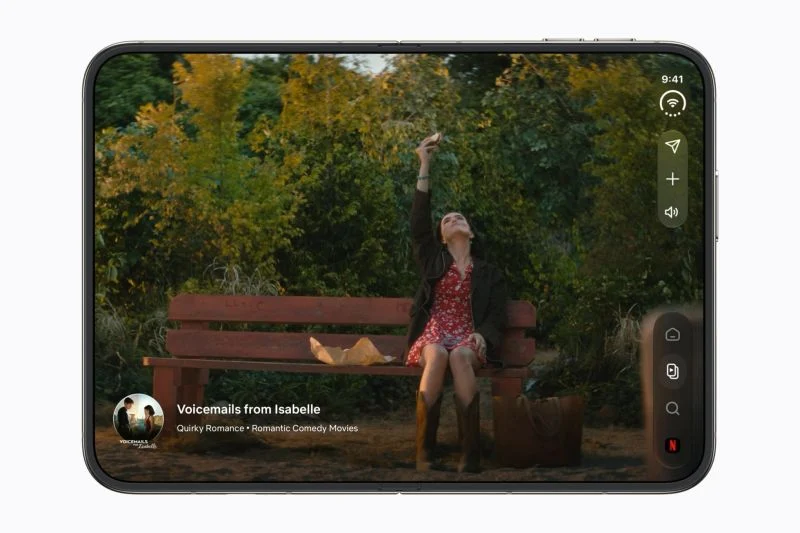
Apple’s approach to the iPhone Duo has been one of controlled ecosystem expansion. Rather than forcing developers to guess, Apple has worked directly with major industry players like Netflix to define the "Duo Experience."
In a statement regarding the new app design, an Apple spokesperson noted: "The iPhone Duo provides a transformative canvas. With the redesigned Netflix app, users can seamlessly transition from scrolling through discovery clips on the outer display to an expansive, captivating cinematic experience the moment they unfold the device."
However, the response from the streaming giant itself has been more guarded. While Netflix has confirmed that the interface—specifically the player controls and navigation menus—has been completely overhauled to accommodate the larger screen, the company has remained silent on whether it will re-encode its library for the unique aspect ratio. For now, users can expect traditional widescreen content to be presented with the standard black bars, unless they opt for a "zoom-to-fill" feature that sacrifices the edges of the frame.
To incentivize adoption, Apple is bundling the device with three months of free Apple One services for new and returning subscribers, a clear move to ensure that the device’s media-consumption capabilities are tested immediately by the widest possible user base.
Implications for the Future of Streaming
The introduction of the iPhone Duo forces a fundamental shift in the economics of video delivery. As we look forward, the implications for the industry are three-fold:
1. The Cost of Encoding
Content owners are currently at a crossroads. The costs associated with re-encoding are not limited to computing power; they include metadata tagging, quality assurance testing, and managing fragmented library assets. We expect to see a surge in demand for AI-driven, automated encoding solutions that can intelligently crop and reframe content to fit non-standard aspect ratios without human intervention.
2. The Rise of "Adaptive Content"
The future may lie in "adaptive content" rather than static re-encoding. By utilizing the sensor data from the iPhone Duo, apps may eventually serve dynamic overlays that utilize the extra screen space for real-time statistics (in sports), actor information, or interactive story branches. Instead of fighting the aspect ratio, the industry may pivot toward using the extra space for context rather than video pixels.
3. The "Platform-First" Mentality
If the iPhone Duo proves successful, Apple’s dominance in the mobile market will essentially set the standard for what a "foldable" experience should look like. Smaller manufacturers will likely be forced to adjust their hardware specifications to align with the iPhone Duo’s display dimensions, simply to ensure that apps developed for iOS function correctly on their hardware.
Conclusion: A New Standard or a Niche Experiment?
The iPhone Duo represents a bold leap, but its success depends on the "Chicken and Egg" dilemma of content. Consumers will not buy a premium foldable device if their favorite movies don’t look right on the screen; content owners will not invest in expensive re-encoding workflows until there is a massive installed base of users.
For now, the industry is in a "wait-and-see" period. As the first 10 million units hit the market, the performance of the device will be monitored closely by stakeholders in Silicon Valley and Hollywood alike. If the iPhone Duo can convince the average consumer that a square-ish screen is the new standard for luxury media consumption, the era of the 16:9 widescreen hegemony may finally be coming to an end.
The next six months will be the most critical in the history of mobile video. Will we see a mass migration to new aspect ratios, or will the "Duo" remain a niche luxury for those who prioritize the novelty of the fold over the purity of the director’s original vision? The answer lies in the hands of the consumers who will decide whether this hardware shift is a revolution—or merely a fold.