The promise of "cord-cutting" was built on a foundation of simplicity, flexibility, and, most importantly, affordability. When the first wave of live linear streaming services—often called "skinny bundles"—hit the market, they were marketed as the ultimate antidote to the bloated, contract-heavy world of traditional cable. Yet, in 2024, the reality of the streaming landscape has shifted dramatically.
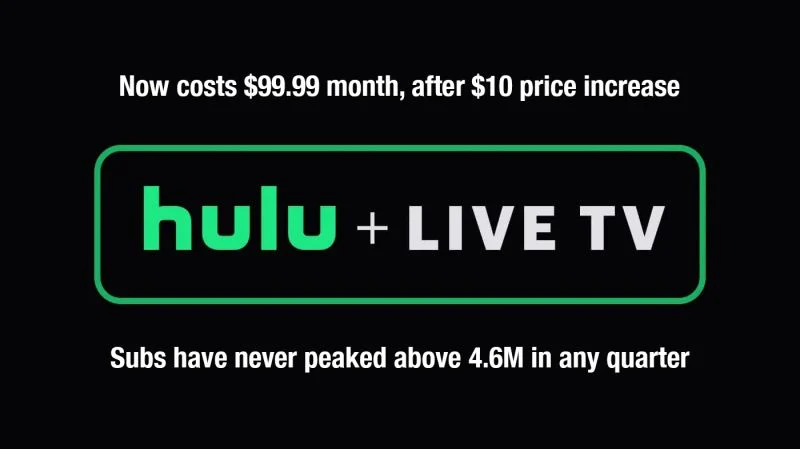
Hulu + Live TV, once the poster child for the streaming revolution, has officially crossed a psychological and financial threshold: its base package now commands a monthly fee of $100. For many consumers, this figure represents a turning point, raising the question of whether streaming services have effectively become the very thing they set out to destroy.
Main Facts: The New Cost of Connectivity
Disney’s recent pricing adjustments have sent ripples through the streaming industry. The standard Hulu + Live TV plan, which provides access to a suite of linear channels alongside the Hulu library, has seen its price climb by $10, bringing the monthly cost to a triple-digit figure. For users who prefer an ad-free experience, the Hulu + Live TV Premium (SVOD) bundle has also surged, now reaching a staggering $109.99 per month.
These increases are not isolated incidents; they are part of a broader trend of price hikes across the entire direct-to-consumer (DTC) sector. However, at $100 per month, Hulu + Live TV has entered a price bracket that makes it directly competitive—and in some cases, more expensive—than traditional pay-TV bundles. The value proposition of "cutting the cord" to save money has been severely compromised, leaving subscribers to wonder if the convenience of a streaming interface is worth the premium.
Chronology: From $40 Disruption to $100 Reality
To understand the current frustration, one must look at the trajectory of Hulu + Live TV since its inception.
The Early Days (2017)
When Hulu + Live TV officially launched in May 2017, the market was primed for a change. With a starting price of just $40 per month, it offered a compelling alternative to cable. At the time, consumers were tired of two-year contracts, equipment rental fees, and the opaque pricing structures of major cable providers. Hulu provided a clean, app-based experience that allowed users to stream news, sports, and entertainment on their own terms.
The Era of Incremental Creep
In the years that followed, the "skinny bundle" began to bloat. As Disney sought to include more networks, regional sports channels, and on-demand libraries, the costs associated with carriage fees rose. Between 2017 and 2024, the service underwent multiple price hikes. What was once a $40 entry point saw steady, aggressive climbs, jumping to $45, $55, $65, and eventually breaking the $75 barrier.
The $100 Threshold
The most recent increase, pushing the service to $100, marks the end of an era. In just nine years, the cost of the service has more than doubled. While cable prices have remained relatively stagnant or even seen deflationary pressure through "skinny" cable offerings, streaming services have consistently moved in the opposite direction, testing the price elasticity of their user base.
Supporting Data: Stagnation in the Streaming Pool
The financial growth of the service stands in stark contrast to its subscriber growth. Data suggests that the aggressive pricing strategy may be cannibalizing the service’s own reach.
The Four-Year Plateau
Looking back at the first quarter of 2021, Disney reported that Hulu + Live TV had reached 4 million subscribers. As of the fourth quarter of fiscal year 2025, that number had crawled to only 4.4 million. In the intervening four years, the subscriber base effectively flatlined, never once exceeding the 4.6 million mark in any given quarter.
The Diminishing Returns of Price Hikes
Economically, Disney has opted for a strategy of "maximizing average revenue per user" (ARPU) over the pursuit of sheer volume. By raising prices, they have managed to keep revenue steady despite stagnant growth, but this approach has clear limits. With the latest price hike, the risk of "churn"—subscribers canceling the service in favor of cheaper alternatives or returning to free, ad-supported streaming television (FAST) services—has reached an all-time high.
Official Responses and Strategic Ambiguity
Disney’s communication regarding its live linear strategy has become increasingly opaque. The company has moved away from breaking out Hulu + Live TV subscriber numbers in its public financial filings, instead opting to aggregate them with other entities, such as Fubo.
This lack of transparency has fueled industry speculation. Analysts argue that this move is intended to mask the stagnation of the Hulu live product while Disney navigates a complex transition. With the appointment of Alisa Bowen—formerly the President of Disney+—as the new CEO of Fubo, the industry is reading the tea leaves. Many believe this signals a long-term plan to wind down the Hulu + Live TV product, potentially migrating its remaining user base to Fubo. By consolidating its live linear efforts into one platform, Disney could streamline its operations and reduce the overhead associated with maintaining two distinct, competing infrastructures.
Implications: The Future of the "Skinny Bundle"
The implications of these price hikes go far beyond a single streaming service. They represent a fundamental shift in the economics of home entertainment.
The "Cable-fication" of Streaming
The industry has arrived at a point of irony where streaming services have essentially replicated the flaws of the traditional cable bundle. By bundling dozens of channels—many of which the average user never watches—streaming services have inadvertently recreated the "bloated" model that early cord-cutters sought to escape. The lack of true "a la carte" pricing remains the industry’s greatest failure.
The Rise of Consumer Fatigue
With Netflix, Disney+, Max, and Hulu all increasing prices simultaneously, consumers are reaching a point of "subscription fatigue." The average household is now juggling a complex web of recurring payments. When a single service hits the $100 mark, it is no longer an "extra" expense; it becomes a major line item in a family budget, inviting the same level of scrutiny that cable bills faced a decade ago.
The Potential for Market Consolidation
If Disney does indeed move to merge or sunset its live linear offering in favor of a partnership with Fubo, it will mark a significant turning point in the streaming wars. It suggests that the market for live linear streaming is reaching a point of saturation and consolidation. Smaller players may be forced out, and the "Big Tech" streamers may find that the live linear model is simply too expensive to maintain in a world where audiences are increasingly shifting toward on-demand, algorithmic-driven content.
Conclusion: A Turning Point for Cord-Cutters
The $100 price tag for Hulu + Live TV is more than just a number; it is a signal that the "Golden Age of Cheap Streaming" is firmly in the rearview mirror. As Disney and other media conglomerates grapple with the high cost of content licensing and the need for profitability, the consumer is left holding the bill.
For the cord-cutter of 2017, the dream was simple: pay less, watch more, and stay free of contracts. Today, that dream is being replaced by the reality of a fragmented, expensive, and increasingly complex digital marketplace. Whether Hulu + Live TV survives this transition or becomes a footnote in the history of media, the lesson for the industry is clear: the current model of perpetual price increases is unsustainable. As the subscriber base remains stagnant, Disney must decide whether it wants to lead the future of television or become a cautionary tale of how high-end pricing can alienate the very audience it was built to capture.