Twenty-five years have passed since the morning of September 11, 2001—a day that fundamentally altered the trajectory of the 21st century. As the "Tribute in Light" once again illuminates the New York City skyline, the nation pauses to reflect on the terrorist attacks that claimed nearly 3,000 lives and reshaped American foreign policy, civil liberties, and the national psyche.
A new study by the Pew Research Center, conducted in late August 2026, reveals that while the visceral memory of that day remains etched in the minds of older generations, a significant demographic shift is underway. For the millions of Americans born after 2001, 9/11 is no longer a lived experience; it is a historical event, taught in classrooms and documented in archives.
The Persistence of Memory: The Generation Gap
The survey of 5,166 U.S. adults highlights a stark divide in how Americans relate to the events of that Tuesday morning. Among adults who were alive when the planes struck the Twin Towers, the Pentagon, and a field in Shanksville, Pennsylvania, the recall remains remarkably sharp.
Eighty-three percent of adults born before 2001 report they can recall exactly where they were or what they were doing the moment they heard the news. This figure rises to 93% among those who were at least 10 years old at the time, underscoring the "flashbulb memory" phenomenon—a psychological state where traumatic, high-impact events are permanently burned into the consciousness of those who witness them in real-time.
Conversely, the landscape of memory is changing. Ten percent of the current U.S. adult population was born after the attacks. For these young adults—those aged 18 to 24—the narrative of 9/11 is inherited rather than witnessed. According to the research, 60% of these young adults first learned about the attacks through schoolwork or formal instruction. Only 16% report learning about it from family or friends, suggesting that the institutionalization of the event as a historical milestone has become the primary conduit for the next generation’s understanding of the tragedy.
A Chronology of the Day That Changed Everything
To understand the gravity of the 25-year milestone, one must revisit the timeline of September 11, 2001, a day that began in routine and ended in unprecedented chaos.
- 8:46 a.m. EDT: American Airlines Flight 11 crashes into the North Tower of the World Trade Center in New York City.
- 9:03 a.m. EDT: United Airlines Flight 175 strikes the South Tower, confirming to the world that the nation is under coordinated attack.
- 9:37 a.m. EDT: American Airlines Flight 77 crashes into the Pentagon in Arlington, Virginia.
- 9:59 a.m. EDT: The South Tower of the World Trade Center collapses.
- 10:03 a.m. EDT: United Airlines Flight 93 crashes in a field near Shanksville, Pennsylvania, after passengers and crew fight back against the hijackers, preventing a potential strike on the U.S. Capitol or White House.
- 10:28 a.m. EDT: The North Tower of the World Trade Center collapses.
In the weeks that followed, the United States was enveloped in a mixture of profound grief and intense patriotism. The immediate aftermath was characterized by a rare moment of national unity, followed by the rapid launch of the "War on Terror," beginning with the invasion of Afghanistan in October 2001.

Supporting Data: The Statistics of Remembrance
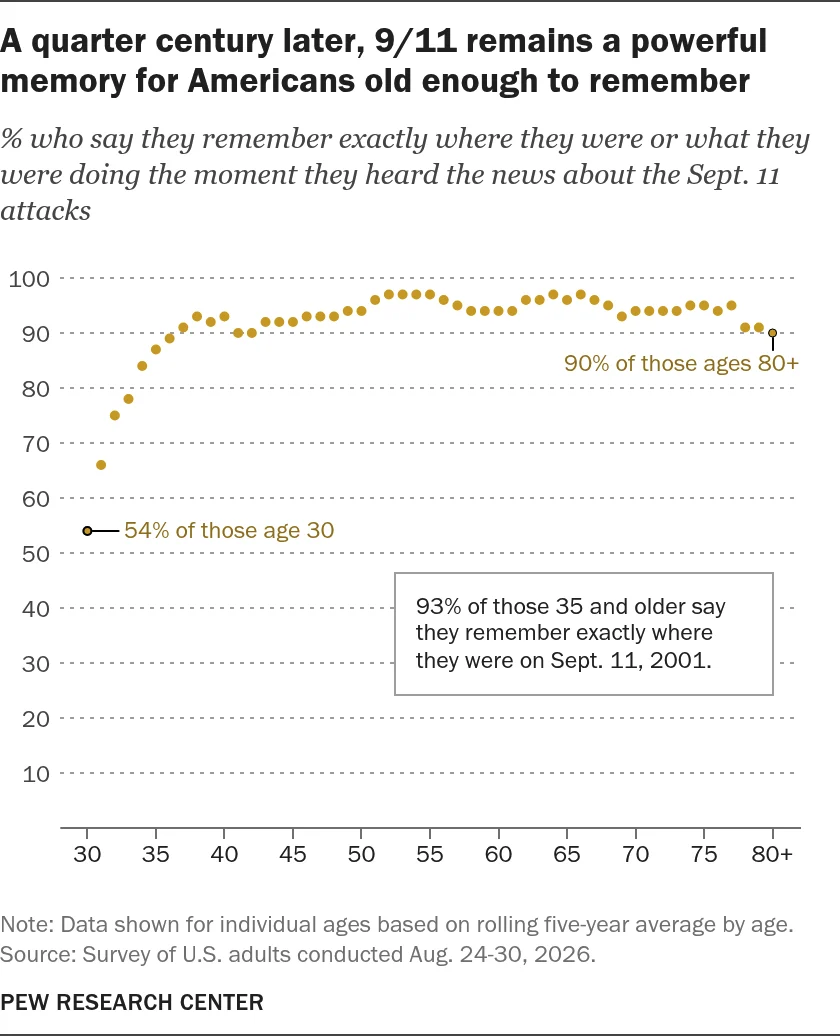
The Pew Research Center’s data illustrates a correlation between age and the vividness of memory. Using a rolling five-year average, the survey demonstrates that the capacity to recall the specific circumstances of that day peaks among those who were in their mid-to-late teens or older in 2001.
For individuals currently aged 50 to 60, the percentage of those who claim a precise memory of the event hovers between 94% and 97%. This cohort was entering adulthood or established in their careers when the attacks occurred, making the event a foundational element of their adult perspective.
As we look at the data for those aged 30 to 35, the numbers show a sharper decline. For a 30-year-old, the share who remember the day is 54%. By the time we reach the youngest cohorts, the data reflects a transition from "lived memory" to "historical literacy." The survey confirms that while the event remains a cornerstone of American identity, the personal connection to the trauma is naturally diluting as the demographic clock moves forward.
Official Responses and the Legacy of Unity
In the immediate wake of the attacks, the U.S. government underwent a tectonic shift. The creation of the Department of Homeland Security, the passage of the USA PATRIOT Act, and the subsequent wars in Afghanistan and Iraq were all direct consequences of the 9/11 tragedy.
However, the "rally ’round the flag" effect, which saw approval ratings for the government and a sense of shared national purpose spike in late 2001, proved to be fragile. Longitudinal studies conducted by the Pew Research Center over the last two decades indicate that this unity was, in many ways, fleeting.
The political polarization that defines the mid-2020s stands in stark contrast to the national atmosphere of late 2001. While the attacks remain a potent symbol of American resilience, the political consensus that followed has fractured. Today, debates continue regarding the long-term efficacy of the post-9/11 military interventions, the balance between national security and privacy, and the evolving place of Muslim Americans in the national fabric—a topic explored in depth in related reports from the Center.
Implications for a New Generation
The challenge for the next 25 years will be maintaining a nuanced understanding of 9/11 in a world where it is increasingly distant. As classrooms shift from "witness-led" education to "textbook-led" education, the emotional weight of the day may diminish, even as its geopolitical consequences remain.

The survey findings suggest that educators, parents, and historians have a responsibility to bridge this gap. Because 60% of young adults rely on school curricula to define their understanding of the attacks, the way the history is framed—balancing the tragedy of the loss of life with the broader global repercussions—will shape the country’s collective memory for the remainder of the century.
Furthermore, the research underscores that 9/11 is not merely a date on a calendar; it is a lens through which we view our contemporary policies on immigration, defense, and civil rights. The "memory" of 9/11 is not just about where one was when the towers fell; it is about how one perceives the subsequent evolution of the American state.
Conclusion: A Nation Defined by Its Response
As the country marks this quarter-century mark, the focus is shifting from the raw trauma of the event to the long-term integration of the day into the American narrative. The 9/11 attacks forced a nation to reconcile with its own vulnerability, and the legacy of that reconciliation continues to drive political and social discourse.
Whether through the lens of those who watched the smoke rise on live television or those who study the archival footage of the collapse, the impact of September 11 remains undeniable. It was the day the world changed, and for the United States, it remains a defining point of reference—a moment that tested the core of the nation’s democratic values and left an indelible mark on its trajectory.
As we look toward the future, the challenge remains to ensure that the lessons learned from 9/11—regarding unity, security, and the preciousness of human life—are carried forward, even as the personal memories of that day inevitably begin to fade.
For more information on the research methodology, detailed responses, and the specific survey questions utilized for this analysis, please refer to the Pew Research Center archives.