
By Business and Technology Desk
Published: August 2026
Main Facts: The New Landscape of AI Adoption
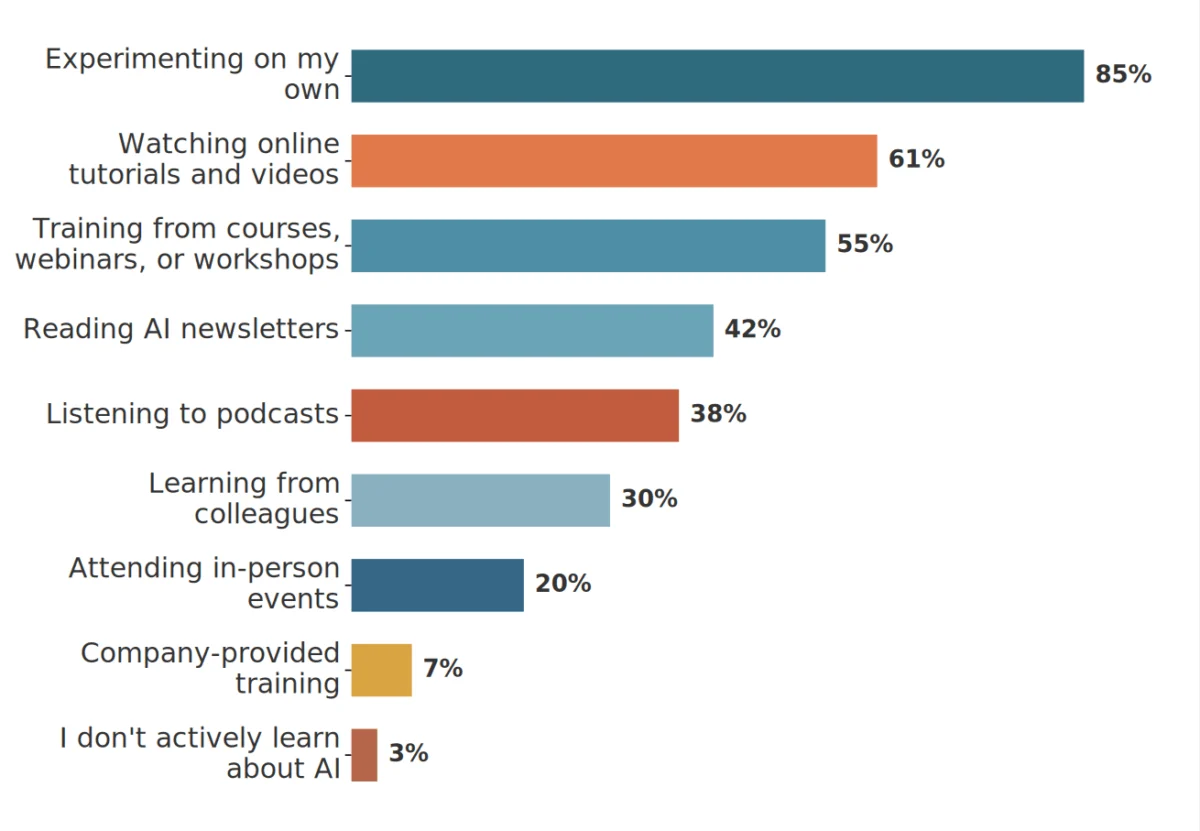
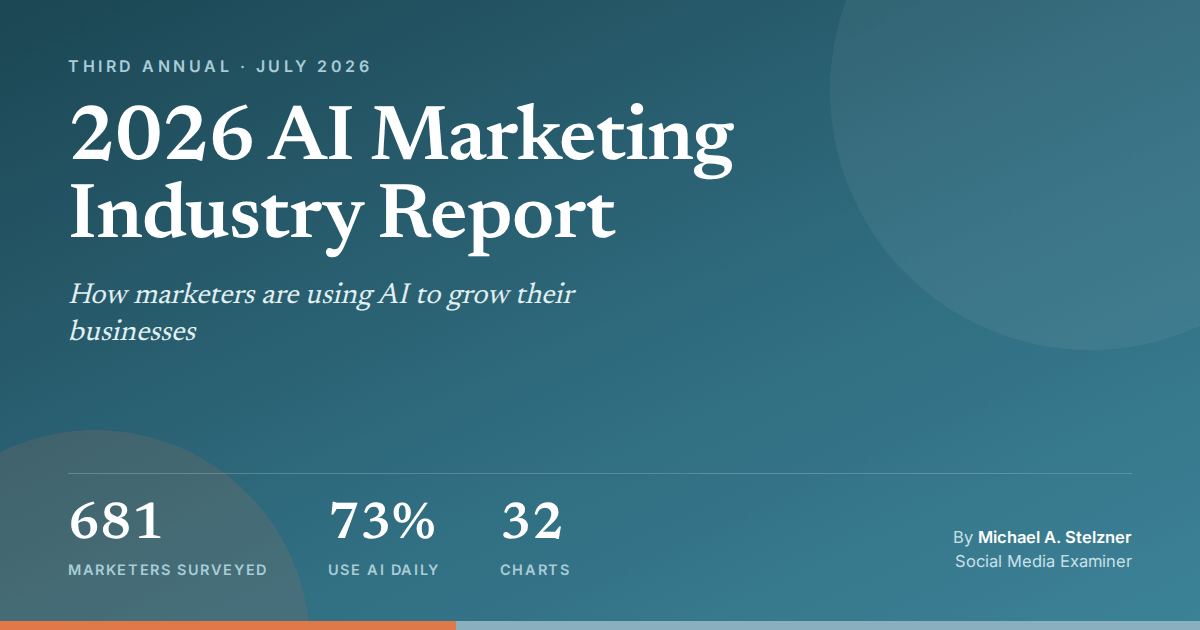
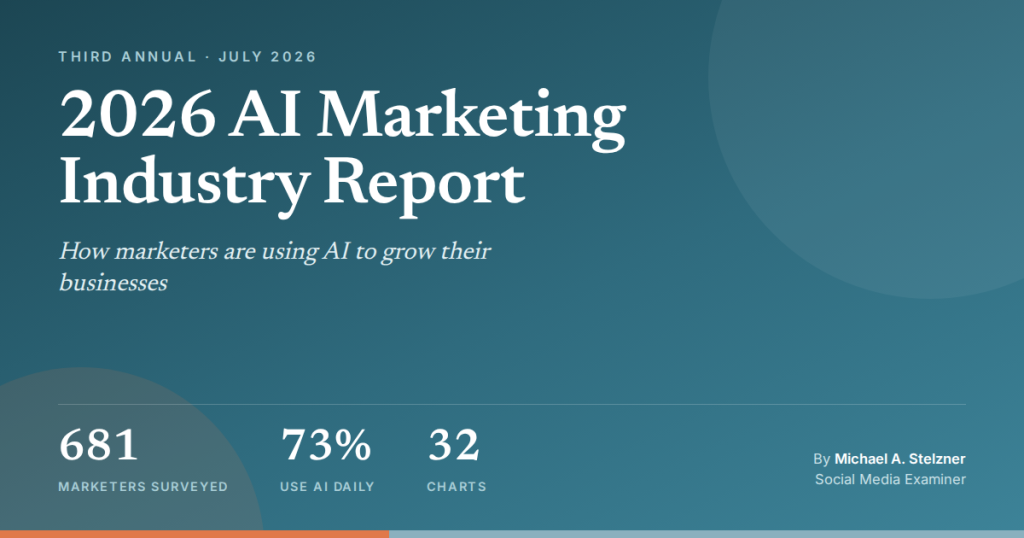
The narrative surrounding artificial intelligence in business has officially shifted from speculative corporate hype to fundamental operational reality. According to the newly released 2026 AI Marketing Industry Report by Social Media Examiner, daily AI utilization among marketers has surged dramatically. Two years ago, roughly one-third of marketing professionals incorporated AI into their daily workflows. Today, that figure stands at a staggering 73%.
Crucially, this research provides a rare glimpse into the engine room of modern commerce. Sixty percent of the survey respondents represent small businesses with ten or fewer employees. Far from being an exclusive domain for enterprise-level organizations with dedicated innovation budgets, AI has become the everyday toolkit for lean teams and solopreneurs.
The data reveals a stark transformation in professional habits:
- 90% of marketers now use AI at least on a weekly basis.
- Only 7% rarely or never interact with AI tools—a steep drop from 23% in 2024.
- 84% report that their usage has increased over the past year.
- 78% expect their reliance on AI to continue growing.
Despite these soaring figures, the report uncovers intriguing paradoxes, ranging from self-funded experimentation to a severe measurement gap in proving return on investment (ROI). As the window for early adoption narrows, the study maps out five critical insights defining the trajectory of small business marketing in 2026.
Chronology: The Accelerated Evolution from Novelty to Necessity
To understand where artificial intelligence stands today, it is vital to trace its rapid ascension over a remarkably brief timeline.
- Late 2022 to 2023 (The Generative Explosion): Public-facing large language models introduced a wave of experimentation. Businesses viewed AI primarily as a novel tool for drafting emails, brainstorming blog topics, or generating quick social media captions. Adoption was sporadic, driven largely by tech enthusiasts rather than systematic corporate strategies.
- 2024 (The Foundation Era): Formal industry metrics began tracking widespread usage. At this stage, daily adoption hovered around 37%. Nearly a quarter of marketers actively avoided AI or treated it with extreme skepticism, viewing it as an unproven utility laden with accuracy and copyright risks. Free tiers of software dominated market engagement.
- 2025 (The Integration Phase): Companies began moving past the novelty stage. Paid tiers replaced free software options as professionals realized basic outputs required advanced customization. Budget allocations shifted, and businesses began treating AI text and image generation as standard elements of content creation workflows.
- 2026 (The Operational Norm): Daily usage spiked to 73%. The industry transitioned from simple text generation to multimedia creation (video and audio) and looked toward autonomous agents. AI is no longer a peripheral experiment; it is deeply embedded in the operational infrastructure of modern small businesses.
Supporting Data: Five Eye-Opening Findings from the 2026 Report
The extensive survey—comprising 32 analytical charts and comprehensive year-over-year tracking—details five distinct pillars defining the current state of marketing technology.
1. AI Isn’t a "Nice-to-Have" Anymore—It’s the New Normal
The normalization of artificial intelligence is complete. With 90% of marketers interacting with AI weekly and 73% daily, the technology has achieved foundational status. The narrative that businesses can opt out of AI and remain competitive is obsolete.
However, the data offers reassurance to latecomers: the momentum is still accelerating. With 84% noting expanded usage over the last 12 months and 78% anticipating further integration, the door remains open for proactive businesses. Yet, analysts warn that the strategic window to establish a competitive advantage through basic AI literacy is rapidly closing.
2. The Death of Corporate Training and Big Budgets
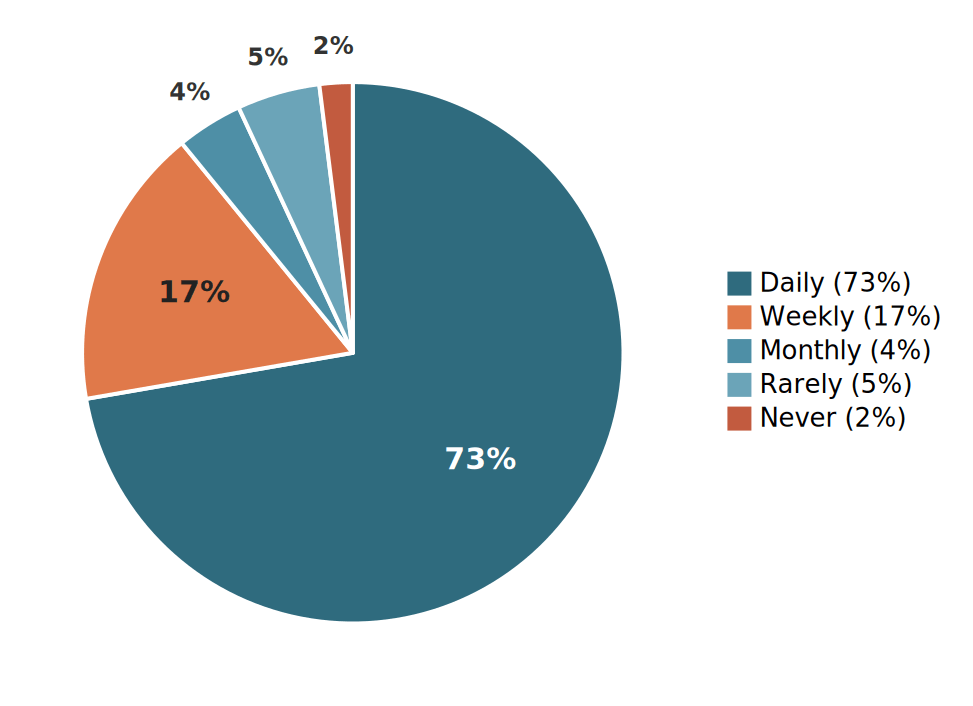
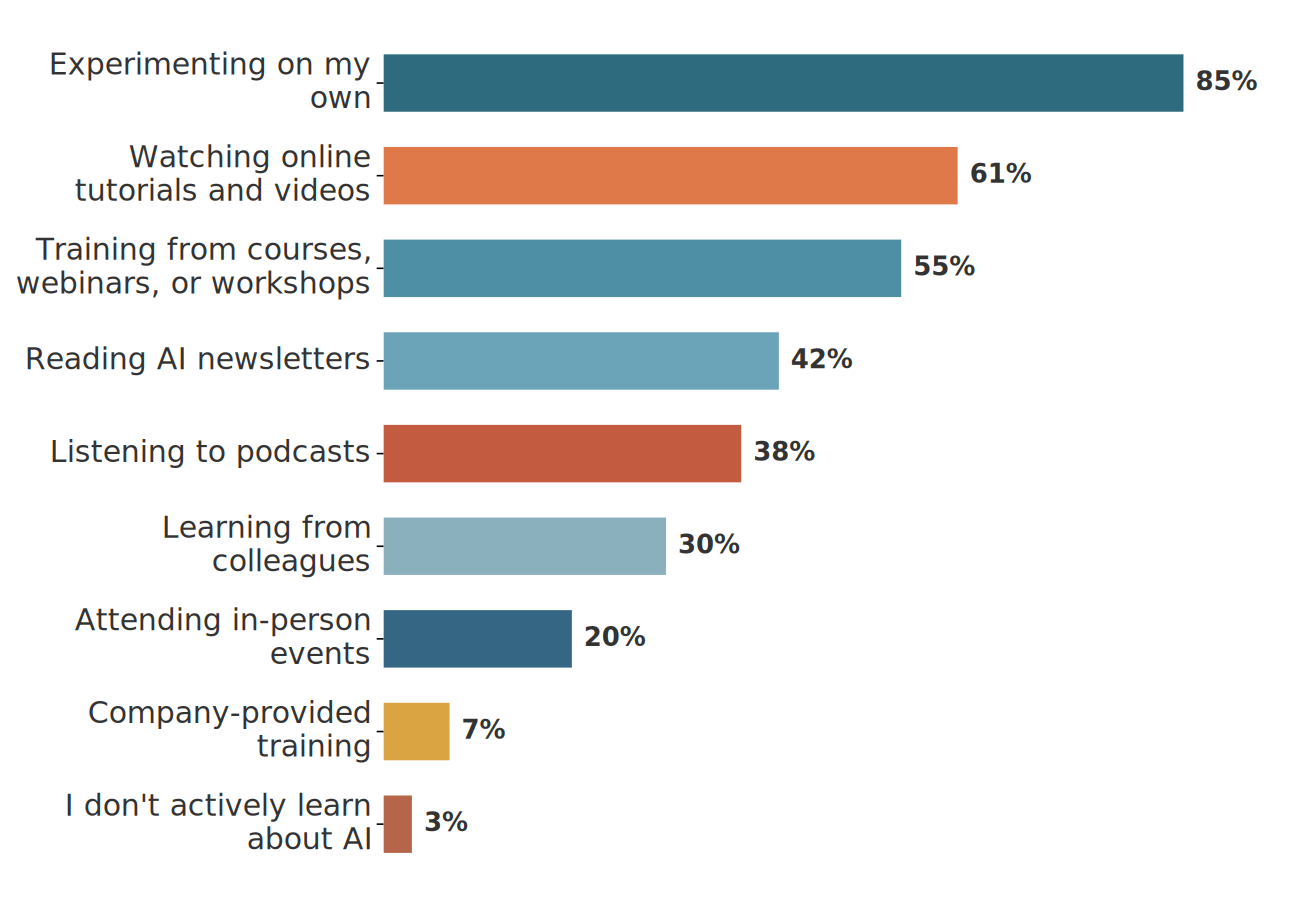
One of the most profound revelations of the 2026 report concerns how professionals acquire AI proficiency and fund their tools. Corporate America has largely abdicated formal training responsibilities: 85% of marketers learn AI entirely through self-directed experimentation, while a mere 7% receive structured training from their employers.
Financial backing follows a similar pattern. Free tiers are rapidly vanishing, with 85% of respondents paying for AI tools out of pocket or via operational funds—including 53% who spend their own personal money. When asked who drives AI adoption within their organizations, 55% of respondents answered simply: "Me." For small business owners, this decentralized, bootstrap approach is second nature. Enterprise organizations are effectively mirroring the self-reliant habits long practiced by small teams.
3. The Great Measurement Gap: Feeling Value Without Proof
While qualitative sentiment surrounding AI is overwhelmingly positive, a glaring metric disconnect persists.
- 86% of marketers agree that AI saves them time.
- 86% confirm that the technology significantly boosts their daily productivity.
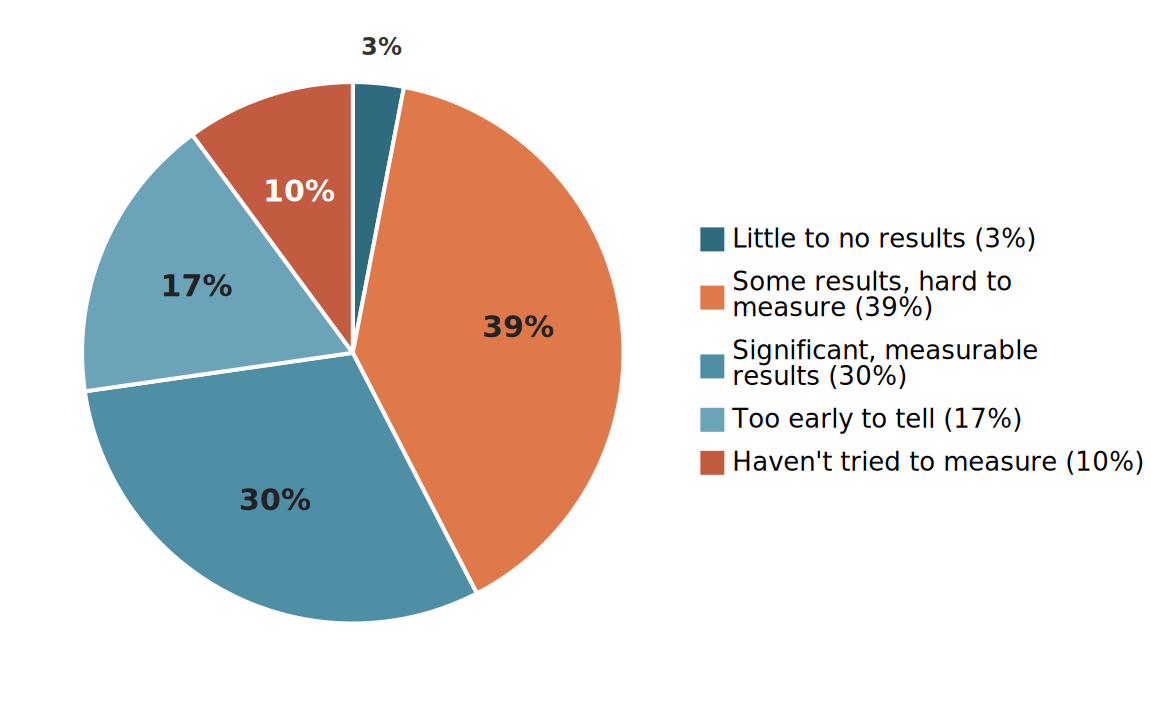
Yet, when asked to provide hard metrics proving these gains, only 30% could point to measurable, significant results. Another 39% report observing positive outcomes but admit they cannot quantify them, while 10% have made no attempt to measure AI’s impact.
This absence of rigorous tracking points to a major strategic opportunity. Small business owners who implement basic tracking frameworks—such as logging hours saved per week or measuring shifts in content output volume—will instantly surpass the 70% of competitors operating purely on intuition.
4. AI Video: The Largest Untapped Frontier in Marketing
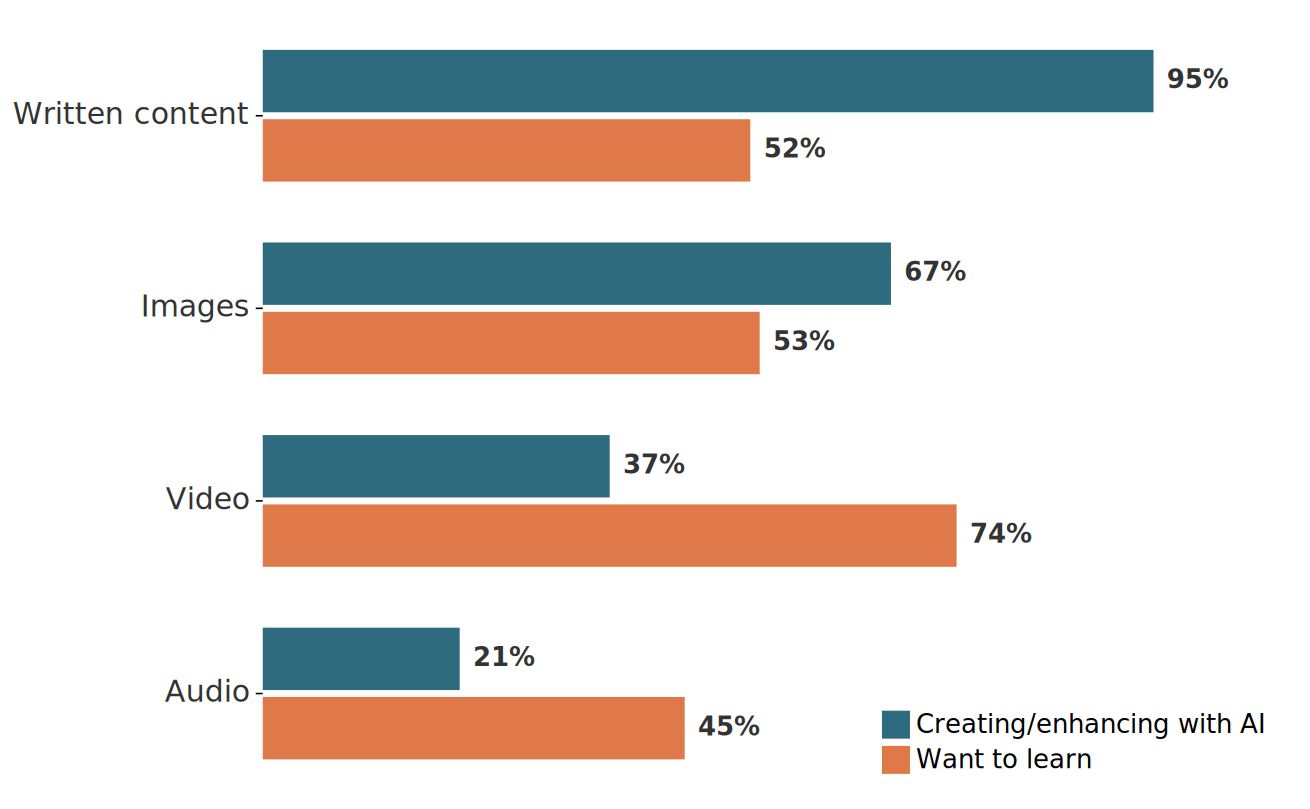
While written content generation has achieved near-universal saturation (95% adoption), multimedia formats present an entirely different picture. Only 37% of marketers currently use AI for video creation, making it one of the least adopted major formats.
Simultaneously, video represents the single most desired skill for future learning, with 74% of marketers expressing eagerness to master AI video generation. This creates a massive 37-point gap between demand and execution—the widest divergence measured in the report. Although image creation has surged (growing from 39% in 2024 to 67% in 2026), video remains the next great battlefield. Early movers willing to experiment with basic AI video tools stand to capture outsized attention in crowded digital markets.
5. Autonomous AI Agents: The Coming Revolution for Small Teams
Introduced as a fresh metric in the 2026 survey, AI agents—systems designed to execute complex, multi-step workflows autonomously without constant human prompting—represent the next paradigm shift.
Currently, only 11% of marketers use agents regularly, with 24% experimenting. However, interest is explosive: 44% plan to adopt agents soon, bringing total current or planned usage to 79%. Furthermore, learning how to deploy AI agents ranks as the #1 educational priority for marketers (74%).
For small business owners, the implications are profound. Autonomous agents capable of managing email sequences, parsing deep analytics, or handling routine customer service inquiries offer the operational leverage of a much larger workforce without the associated overhead costs.
Official Responses and Expert Insights
Michael Stelzner, founder of Social Media Examiner and the driving force behind the 2026 report, emphasized that the research was deliberately designed to cut through industry noise and provide actionable intelligence.
"We surveyed marketers to find out how they’re actually using AI. Not the hype. Not the headlines. The real story," Stelzner noted. "Since 60% of our respondents come from businesses with 10 or fewer people, this isn’t enterprise research. This is your world."
Stelzner highlighted that the tension between perceived value and difficult measurement should encourage, rather than deter, independent business owners.
"If you start tracking how AI impacts your output—even something as simple as hours saved per week or pieces of content produced—you’ll be ahead of 70% of marketers who can’t do that yet. You’ll also make much smarter decisions about where to invest your limited time and money," he explained.
Industry analysts reviewing the broader data spectrum also point to the platform shifts highlighted in the report, noting a dramatic migration in user preference away from legacy systems like early iterations of ChatGPT toward more versatile models like Anthropic’s Claude, as professionals demand higher accuracy, nuanced tone matching, and advanced reasoning capabilities.
Implications for Small Businesses: Actionable Takeaways
The transition of artificial intelligence from a speculative hobby to a core operational utility carries deep implications for the small business community.
- Embrace Self-Directed Upskilling: Waiting for formal industry standards or corporate training is a dead end. The most successful AI practitioners are those who allocate brief, consistent blocks of time to experiment directly with platforms.
- Implement Accountability and Metrics: Because nearly 70% of businesses fail to quantify AI’s exact financial or time-saving impacts, establishing a simple internal audit—tracking task completion times before and after AI integration—will instantly clarify where software subscriptions deliver genuine ROI.
- Seize the Video and Agent Advantage: With widespread hesitation surrounding AI video generation and autonomous agents, early adopters who push past the learning curve today will secure a commanding lead over competitors who remain paralyzed by complexity.
As the 2026 data proves, artificial intelligence has ceased to be a futuristic corporate experiment. For small businesses operating with tight margins and lean headcounts, it has become the definitive differentiator between stagnation and scalable growth.