The arrival of Apple’s long-anticipated foldable device, the iPhone Duo, has sent shockwaves through the mobile hardware industry. With its distinctive square-like aspect ratio and a dual-screen configuration featuring a 7.6-inch internal display and a 5.4-inch outer cover screen, the device promises to redefine mobile consumption. However, for content owners and streaming platforms, the device presents a complex logistical challenge: How do you fit cinematic content into a form factor that refuses to conform to standard 16:9 or 21:9 expectations?
As the industry grapples with this new hardware, the question is no longer just about software optimization—it is about the fundamental encoding of video libraries.
The Core Conflict: Aspect Ratios and Encoding Efficiency
For decades, the video industry has optimized its workflows around the standard widescreen television format. Whether it is 1080p HD or 4K UHD, the goal has always been to fill a rectangular canvas. The iPhone Duo, however, disrupts this paradigm with a display resolution that falls into the "2K+" category—a hybrid territory that sits somewhere between high-end tablet resolution and standard smartphone density.
The Re-encoding Dilemma
The central debate among streaming executives is whether to re-encode existing libraries specifically for the iPhone Duo. Re-encoding, while technically feasible, is an immense undertaking. It involves massive computational costs, storage overheads, and CDN distribution adjustments.
"I cannot imagine content owners re-encoding their entire back catalogs," says one industry insider. "The return on investment simply isn’t there for a library of 10,000 titles. However, we are likely to see a tiered strategy."
Under this tiered approach, platforms like Netflix, Disney+, and Apple TV+ would prioritize their "tentpole" content—new releases and high-performing series—for specialized encoding. By creating custom profiles for the iPhone Duo’s unique aspect ratio, they could eliminate the "letterboxing" or "pillarboxing" that currently haunts users of other foldable devices.
Chronology of the iPhone Duo Launch
The path to the iPhone Duo was not paved overnight. It was a multi-year effort shrouded in the typical Apple secrecy.
- Q1 2024: Industry rumors intensify regarding Apple’s patent filings for "flexible display technology." Supply chain analysts identify key component shipments to Apple’s primary manufacturing hubs.
- January 2025: Leak reports from Nikkei Asia suggest that Apple has finalized the internal design for a dual-display handset, codenamed "Project Duo."
- July 2026: A pivotal shift occurs. Reports surface indicating that Apple has significantly raised its production targets, moving from an initial 7–8 million units to 10 million, signaling high confidence in the device’s market penetration.
- September 2026: Official unveiling of the iPhone Duo. The device is showcased with an emphasis on its "seamless transition" between the 5.4-inch outer display and the 7.6-inch folding interior.
- Post-Launch (Present): Software partners, led by Netflix, begin the rollout of app updates designed to leverage the device’s "Clip" functionality and specialized interface controls.
Supporting Data: The Fragmentation Problem
One of the most significant obstacles to widespread adoption of foldable-specific content is the lack of standardization across the industry. Currently, there are five major foldable devices on the market, and—remarkably—no two share the same display dimensions.
| Manufacturer | Device Type | Internal Display Aspect Ratio |
|---|---|---|
| Apple | iPhone Duo | ~1:1 (Square-like) |
| Samsung | Galaxy Fold Series | ~5:4 |
| Pixel Fold | ~6:5 | |
| OnePlus | Open | ~10:9 |
| Huawei | Mate X Series | Variable |
This fragmentation is a nightmare for content delivery networks. Because content encoded for a Samsung Galaxy Fold cannot be repurposed for the iPhone Duo without loss of quality or aspect ratio cropping, content owners are hesitant to commit. Without a universal standard for foldable aspect ratios, the burden of "custom-fitting" media falls squarely on the streaming platforms themselves.
Production Targets vs. Market Reality
While Apple’s internal target of 10 million units is aggressive, industry analysts remain cautious. "Hitting 10 million units would make the iPhone Duo the most successful foldable launch in history," notes an analyst at a leading tech research firm. "But until we see verified sell-through data, we have to look at these numbers as aspirations rather than historical facts."
Official Responses and Strategic Partnerships
Apple has been proactive in courting "pre-release partners" to ensure the iPhone Duo does not launch as an empty ecosystem. Netflix, at the forefront of this partnership, has been working closely with Apple’s software engineers to refine the iOS user experience.
The Netflix Integration
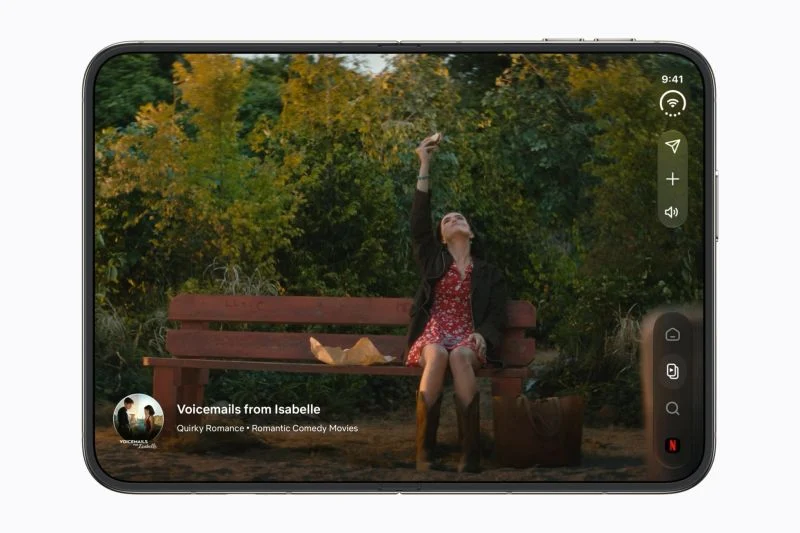
Apple’s official documentation regarding the new Netflix app emphasizes a "multi-modal" experience. According to the company: "Users can scroll through Clips on the outer display or open up the iPhone Duo to get a captivating experience on the large screen."
However, the "captivating experience" remains somewhat vague regarding long-form content. While the player controls have been redesigned—likely to move volume and scrubbing functionality to the "hinge" area—there is no official word on whether Netflix will introduce a specific "Duo-optimized" stream bitrate or resolution profile.
The Incentive Strategy
To jumpstart adoption, Apple is bundling the device with three months of Apple One for "new and qualified returning subscribers." By subsidizing the cost of the ecosystem, Apple is clearly attempting to lower the barrier to entry, hoping that a large user base will force content owners to stop asking "if" they should optimize their libraries, and start asking "how fast."
Implications for the Future of Media Consumption
The success of the iPhone Duo will serve as a bellwether for the future of mobile entertainment. If the device captures a significant portion of the premium smartphone market, we may see a fundamental shift in how directors and cinematographers frame their shots.
The "Live" Opportunity
While movies and TV shows are static, live content is dynamic. Sports highlights and live news stations are prime candidates for early optimization. Because these feeds are often generated in real-time, it is easier for broadcasters to implement a "Duo-friendly" feed that captures the action in a square frame, rather than forcing a 16:9 feed to scale down.
The Long-Term Forecast
If content owners do not adapt, we risk a "degraded experience" era where mobile users are forced to accept black bars or aggressive zoom-and-crop features. This would be a departure from the "Retina" philosophy that has defined Apple’s display quality for over a decade.
We are currently in a "wait and see" phase. Content owners are monitoring the sales trajectory of the iPhone Duo with surgical precision. If the device hits the 10-million-unit mark, it will no longer be a niche product; it will be a standard. At that point, the cost of re-encoding libraries will transition from an "optional upgrade" to a "competitive necessity."
As the industry moves forward, one thing is certain: the era of the universal rectangular screen is under threat. The iPhone Duo is not just a new phone—it is an invitation for the entire media ecosystem to think outside the rectangle.
Closing Thoughts
As we continue to observe the market, the most critical question remains: Will the consumer demand for a perfect, full-screen experience be enough to motivate the multi-billion dollar streaming industry to overhaul its technical architecture?
The iPhone Duo is a powerful piece of engineering, but its true impact will be measured not in pixels, but in the willingness of creators to adapt their vision to a new, evolving canvas. Whether the industry rises to the challenge or settles for the status quo of letterboxing will define the next five years of mobile media.
We will continue to update this report as Apple releases further details on developer tools and as content owners begin to reveal their strategies for the iPhone Duo.