
In the high-stakes arena of global content delivery, where the difference between a seamless stream and a buffering catastrophe is measured in milliseconds, the traditional Content Delivery Network (CDN) model is undergoing a radical transformation. For decades, the industry has operated under a "build-it-and-they-will-come" philosophy, often characterized by heavy capital expenditure (CapEx) on proprietary hardware and massive, rigid infrastructure footprints.
Netskrt Systems, however, has emerged as a disruptive force, challenging this capital-intensive status quo. By pivoting toward a software-defined, agile architecture, Netskrt has successfully secured a foothold in the most demanding segments of the market: tier-one live sports broadcasting. From the high-traffic corridors of Thursday Night Football on Prime Video to the global stage of the Super Bowl on Peacock, Netskrt is proving that profitability and massive scale are not mutually exclusive.
Main Facts: The Anatomy of a Lean CDN
At the core of the Netskrt value proposition is a departure from the "hardware-heavy" legacy of the CDN world. While traditional competitors have often burned through massive amounts of cash to grow capacity, Netskrt has optimized its operations through pure software Points of Presence (POP) instances.
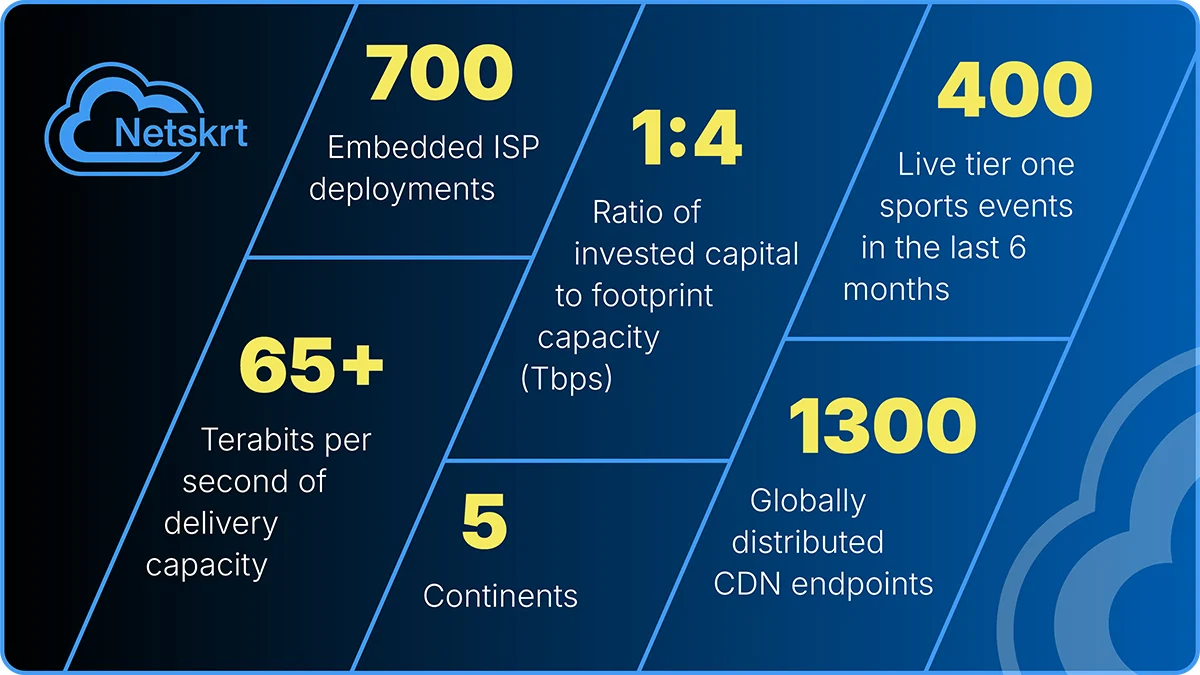
This strategic pivot allows the company to operate under the aggressive pricing umbrellas set by global streaming platforms—platforms that demand massive bandwidth at razor-thin margins. By minimizing the underlying cost of delivery, Netskrt has achieved a level of financial efficiency that is rare in the infrastructure space. As of early 2026, the company reports a steady-state capacity of 65 Tbps, with a roadmap to reach 150 Tbps by the end of the year.
Unlike legacy providers that require months of lead time to procure and install hardware, Netskrt’s software-defined approach allows it to instantiate capacity in 24 to 48 hours—or even minutes, when leveraging cloud-based spot instances. This is not merely a technical convenience; it is a financial strategy that allows the company to balance its infrastructure investments dynamically between CapEx (for persistent demand) and OpEx (for seasonal, spiky demand).
Chronology of a Market Disruptor
The evolution of Netskrt from a niche player to a critical component of the global streaming backbone has been marked by a deliberate, methodical expansion.
- Foundation and Philosophy: From its inception, Netskrt focused on the architecture of the "edge." The company recognized early on that the internet’s bottlenecks were not in the core, but in the last mile—the final connection to the consumer.
- The Rise of Live Streaming: As global streaming services shifted from Video-on-Demand (VOD) to high-stakes live sports, the demand for stable, low-latency delivery skyrocketed. Netskrt leveraged this shift, positioning itself as the infrastructure partner for major broadcasters who needed reliability without the astronomical costs of traditional CDN buildouts.
- Expansion of Geographic Footprint: Over the last 18 months, Netskrt has aggressively expanded its reach. Moving beyond its North American roots, the company has established a robust presence in South America, Europe, and key markets across the Asia-Pacific (APAC) region.
- The 2026 Milestone: The current fiscal year represents a turning point for the firm. With roughly $30 million in invested capital, Netskrt is poised to demonstrate a capital-to-revenue ratio exceeding 1:1, a metric that highlights its operational maturity.
Supporting Data: The Efficiency Gap
To understand why Netskrt’s model is garnering attention, one must look at the financial architecture of modern CDNs. Historically, the CDN industry has been plagued by high capital intensity. Providers have often been forced to tie up massive amounts of liquidity in hardware that remains underutilized during off-peak hours.
Capital and Capacity Metrics
Netskrt’s internal data suggests a stark contrast to industry norms:
- Capital-to-Revenue Ratio: Netskrt expects to cross the 1:1 threshold in 2026.
- Capital-to-Capacity Ratio: The company is targeting a 1:4 ratio, meaning every dollar of capital invested is effectively supporting four units of capacity.
- Infrastructure Distribution: Approximately 50% of Netskrt’s capacity is embedded directly into last-mile ISP networks, ensuring that content resides as close to the viewer as possible. The remaining 50% is distributed across mid-tier and global-tier nodes to maintain a balanced traffic flow.
These numbers are particularly compelling because the company has achieved this with a relatively modest $30 million in total capital—a fraction of the funding seen by major industry incumbents. By utilizing bare-metal, virtual machines, and containerized environments, Netskrt effectively detaches its revenue generation from the constraints of physical inventory.
Official Responses and Strategic Rationale
Netskrt’s leadership emphasizes that their success is not purely the result of software innovation, but of a "stratified infrastructure" strategy. When asked about the challenges of managing such a diverse network, the company notes that their technology is capable of real-time "repositioning"—a process where live-streaming POPs are dynamically relocated based on real-time network conditions.
"Executing this is more than just a business strategy," a company representative stated. "It requires a CDN technology capable of positioning and repositioning content in response to a complex array of real-time conditions."
The company’s partnership model further supports this. By collaborating with large-scale network and bare-metal suppliers like Lumen, Netskrt can "spin up" capacity at massive scales without the burden of owning every individual node. This partnership-first approach allows Netskrt to focus on the intelligence of the network—the routing and orchestration software—rather than the commoditized aspects of hardware procurement.
The ISP Perspective: Understanding the Bottlenecks
Recognizing that its success is inextricably linked to the health of the broader internet, Netskrt recently conducted a comprehensive study involving 55 global Internet Service Providers (ISPs). The study, which explored the impact of major live events on network performance, highlighted the ongoing friction between streaming demand and infrastructure limits.
The survey results suggest that ISPs are increasingly looking for partners who can help them manage "spiky" traffic without compromising the quality of service for other network users. Netskrt’s software-defined edge, which resides deep within the ISP, serves as a buffer that helps mitigate the sudden surges associated with events like the Super Bowl or major international soccer matches.
Implications for the Streaming Industry
The implications of Netskrt’s model for the wider media and technology landscape are profound. As the world moves toward an era of hyper-personalized and ultra-high-definition live streaming, the traditional CDN cost structure is becoming unsustainable.
1. The Death of the "Hardware-Only" CDN
The rise of Netskrt signals a broader shift toward software-defined networking (SDN) at the edge. Legacy providers that rely on massive, proprietary server farms may find themselves struggling to match the price points of more agile competitors.
2. Democratization of Content Delivery
By reducing the capital barrier to entry, Netskrt’s approach could potentially democratize high-quality streaming. As the cost of delivery drops, smaller streaming platforms—or even niche creators—may find it easier to compete with the global giants, provided they can access the same optimized delivery infrastructure.
3. The Future of Live Sports
Live sports have long been the "killer app" for the internet. If Netskrt can consistently deliver 4K or 8K streams to millions of concurrent viewers at a fraction of the traditional cost, it creates an opportunity for broadcasters to improve their margins while simultaneously enhancing the fan experience.
4. A New Financial Standard
By making its capital-to-revenue and capital-to-capacity ratios public, Netskrt is setting a new benchmark for the industry. Investors and stakeholders will likely begin to demand similar transparency from other infrastructure providers, potentially forcing a move toward greater operational efficiency across the entire CDN sector.
Conclusion: A Blueprint for the Future
Netskrt Systems has successfully transformed the "CDN problem" from a hardware challenge into a software challenge. By blending a flexible, cloud-native architecture with a deep, last-mile presence, the company has managed to satisfy the most demanding clients in the world while maintaining a lean, capital-efficient balance sheet.
As the company moves toward its goal of 150 Tbps capacity by the end of 2026, the industry will be watching closely. If Netskrt continues its current trajectory, it will serve as the definitive blueprint for how modern infrastructure companies can navigate the volatile, high-growth, and low-margin environment of the digital age. The era of the "sledgehammer" approach to capital spending is fading; in its place, the software-defined, intelligent edge is rising to take its place.