The relationship between the American public and the federal government has long been a barometer for the nation’s political health. In a comprehensive new study released by the Pew Research Center, survey data collected from 5,062 U.S. adults between September 28 and October 4, 2026, provides a granular look at how citizens currently perceive 12 major federal agencies. While some institutions continue to enjoy broad, cross-partisan support, others have become lightning rods for ideological disagreement, reflecting the deepening polarization of the American political landscape.
The findings reveal a complex picture: while Americans maintain a generally favorable view of the government’s service-oriented bodies, agencies associated with law enforcement, immigration, and public health are increasingly viewed through a partisan lens.

Main Facts: The Popularity Divide
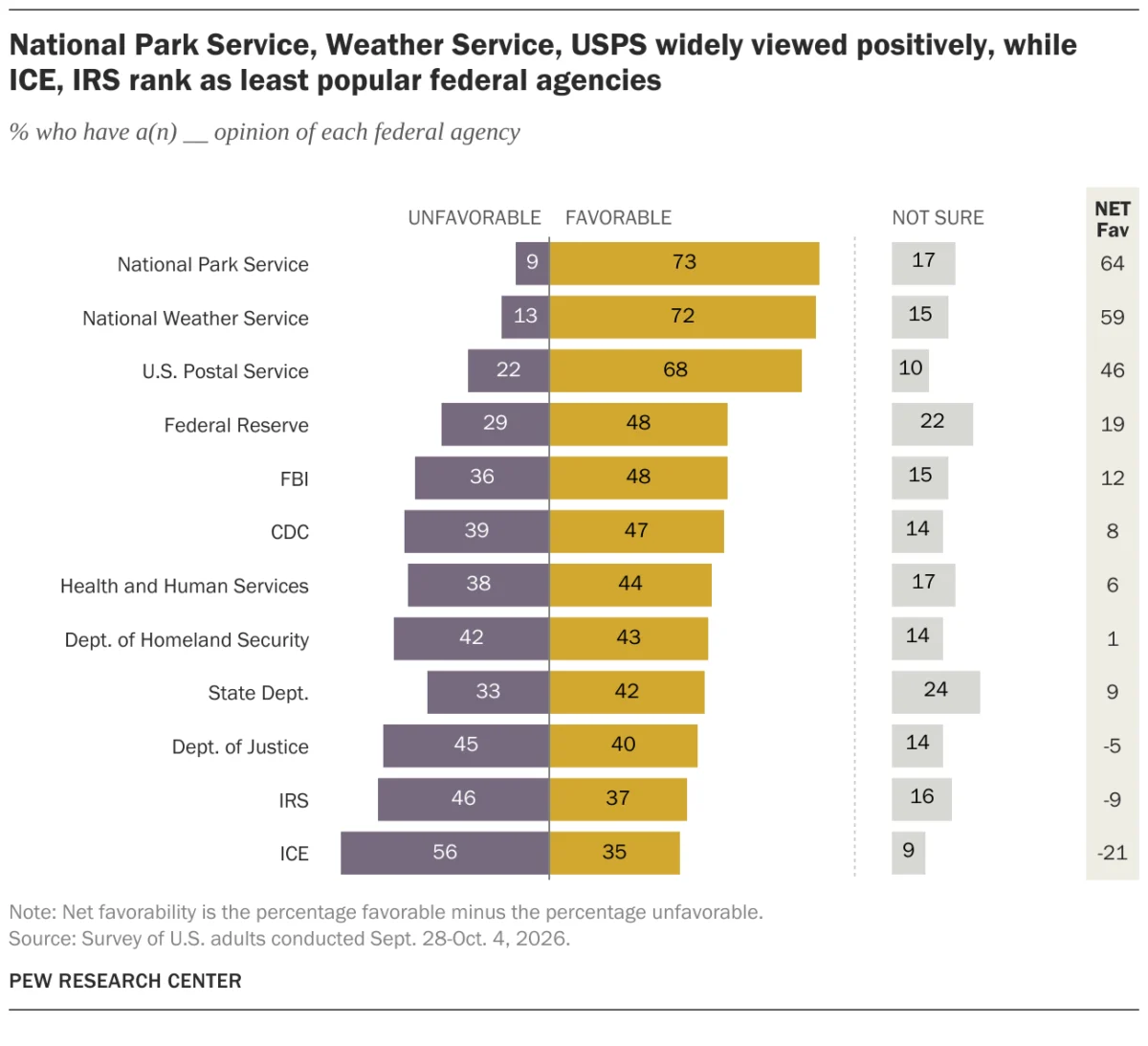
At the top of the public’s favorability list are agencies that provide tangible, non-controversial services to the populace. The National Park Service (NPS), the National Weather Service (NWS), and the U.S. Postal Service (USPS) remain the "gold standard" of federal popularity. Two-thirds or more of the American public view these three entities favorably.
The National Park Service leads the pack with a 73% favorability rating and a net favorability of +64. The National Weather Service follows closely at 72% favorability. The U.S. Postal Service maintains a robust 68% favorability. These figures suggest that when a federal agency is perceived as providing a direct, universal benefit—whether through leisure, safety, or logistics—it can transcend the intense partisan bickering that characterizes modern Washington.

Conversely, the bottom of the list is dominated by agencies involved in national security and law enforcement. Immigration and Customs Enforcement (ICE) holds the distinction of being the least popular agency in the survey, with 56% of Americans expressing an unfavorable opinion and only 35% viewing it favorably. The Internal Revenue Service (IRS) and the Department of Justice (DOJ) also face significant headwinds, with net favorability ratings of -9 and -5, respectively.
A Chronology of Declining Consensus
The 2026 data does not exist in a vacuum; it is the fourth measurement in a series of online surveys conducted by Pew on the American Trends Panel. Over the past four years, the trend lines for several agencies have shifted dramatically.
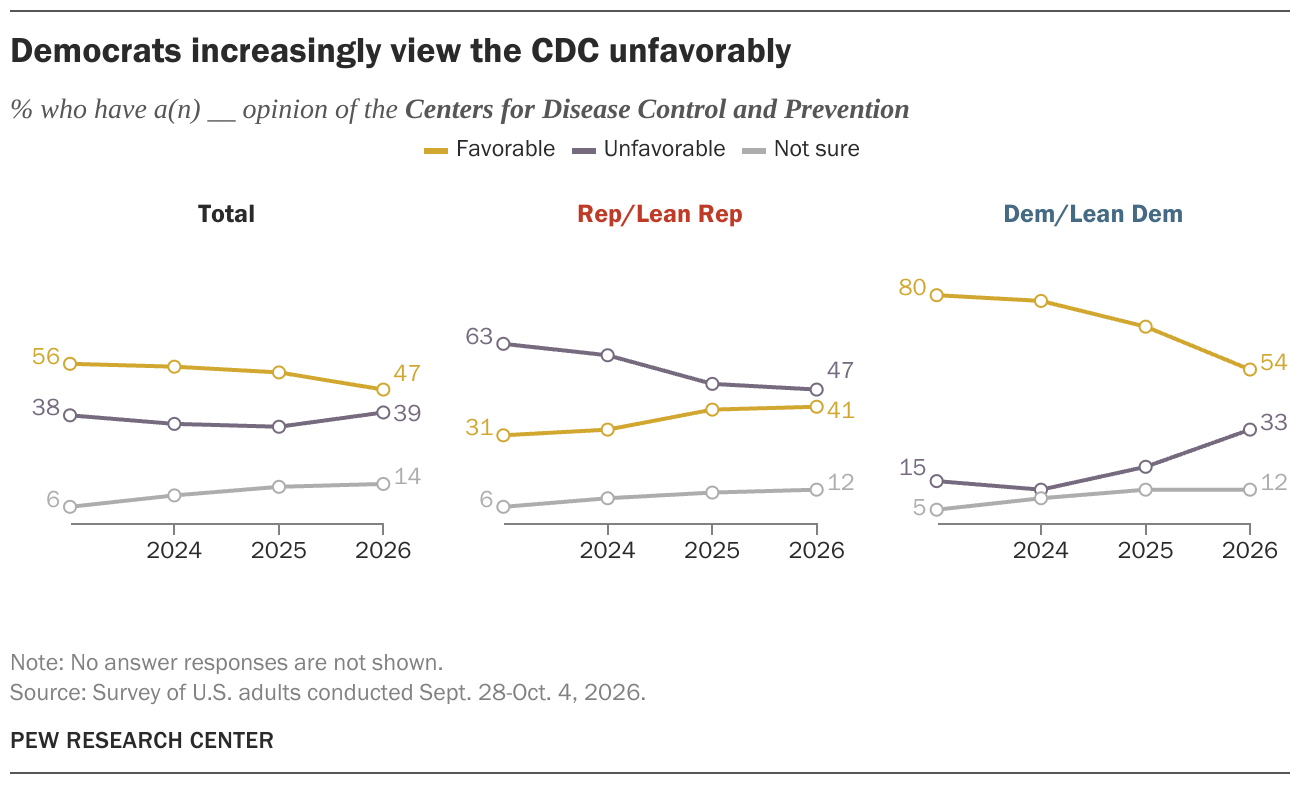
In 2023, the Department of Homeland Security (DHS) saw a 51% favorability rate among the total population. By 2026, that number has slipped to 43%. A more pronounced shift is visible in the public’s perception of the Centers for Disease Control and Prevention (CDC). In 2023, the CDC enjoyed a 56% favorability rating. By late 2026, that support had eroded to 47%, driven largely by a sharp decline in confidence among Democratic respondents.
Similarly, views of the FBI have remained somewhat stagnant in the aggregate (48% favorability), but the internal composition of those views has undergone a radical transformation. In 2023, the FBI was viewed more favorably by Democrats than Republicans. By 2026, the roles had reversed, with Republicans expressing significantly higher approval for the bureau than their Democratic counterparts.

Supporting Data: The Partisan Chasm
The most striking aspect of the 2026 research is the sheer scale of the partisan divide. While majorities in both parties can agree on the merits of the National Park Service, they are miles apart on the necessity and effectiveness of other federal departments.
The ICE Paradox
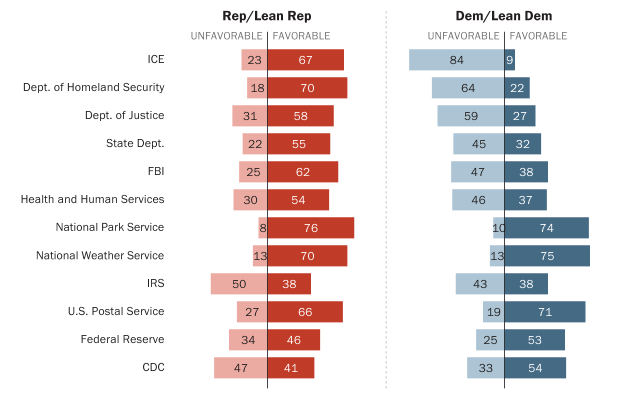
The partisan gap regarding ICE is perhaps the most extreme in the federal government. Among Republicans and those leaning Republican, 67% hold a favorable view of the agency. Among Democrats and Democratic leaners, that number plummets to 9%. This 58-point gap is not merely a reflection of differing policy priorities, but evidence of a fundamental disagreement over the role of immigration enforcement in the United States.

Shifting Allegiances: Justice and the FBI
The Department of Justice and the FBI provide a compelling study in political realignment. Republican support for the DOJ has surged from 51% in 2025 to 58% in 2026. During the same period, Democratic support for the DOJ dropped to 27%. The FBI shows a similar trajectory: Republican favorability rose to 62%, while Democratic favorability fell to 38%. This shift reflects the evolving nature of political discourse, where trust in law enforcement institutions is increasingly tied to the political party in power and the specific investigations being conducted.
Public Health and the Federal Reserve
The CDC and the Federal Reserve have also seen their support bases shift. The CDC, which historically enjoyed overwhelming support from Democrats, saw its favorability among that group fall from 69% in 2025 to 54% in 2026. The Federal Reserve, traditionally seen as a technocratic institution removed from politics, is also seeing a narrowing of support among Democrats, while Republican sentiment has warmed slightly.

Official Responses and Methodology
The Pew Research Center acknowledges that the transition from telephone-based polling to online panel-based surveys complicates direct historical comparisons. Telephone respondents often provided answers differently than those who can select "Not sure" on a digital screen. However, the consistent nature of the partisan gaps suggests that these trends are robust and not merely artifacts of survey methodology.
In its report, the Center emphasizes that the agencies viewed most favorably in 2026 were also the most popular during the pre-pandemic era, suggesting that while partisan intensity is growing, the baseline appreciation for service-oriented government remains intact.

Implications for the Future of Governance
The implications of these findings are profound for the future of American governance. When the public views federal agencies through a purely partisan lens, the ability of those agencies to perform their duties is inevitably compromised.
- The Erosion of Non-Partisan Expertise: When law enforcement and public health agencies are seen as political actors, their capacity to enforce the law or manage public health crises is diminished by a lack of institutional trust. The shift in favorability toward the DOJ and FBI suggests that Americans are increasingly viewing these institutions as "arms" of a political movement rather than neutral arbiters of justice.
- The "Service Gap": The high popularity of the National Park Service and the U.S. Postal Service provides a potential blueprint for government reform. If the government can successfully pivot toward "service-first" models, it may be able to rebuild the public trust that has been lost in more controversial sectors.
- Institutional Stability: The divergence in partisan sentiment—particularly the trend of Democrats becoming more critical of the CDC and the State Department—suggests that no agency is immune to the volatility of modern politics. As these institutions move toward a future defined by partisan scrutiny, the challenge for federal leadership will be to maintain operational efficacy in an environment where nearly half the country may be predisposed to distrust their mission.
Ultimately, the 2026 data serves as a warning. The federal bureaucracy, designed to function as a steady hand for the nation, is becoming a reflection of the country’s fractured political identity. As the gap between how different political tribes view these essential pillars of government continues to widen, the task of achieving national consensus on policy—or even on the fundamental role of the state—becomes increasingly difficult.
The data from this study is a testament to the resilience of "service-oriented" agencies, but it also underscores a sobering reality: in an era of intense political tribalism, even the most essential functions of government are no longer insulated from the crossfire of American political life.