Main Facts
The American media ecosystem is undergoing a profound structural transformation, driven by intersecting pressures of technological disruption, shifting public trust, and evolving consumption habits. At the center of this transition are legacy publishers attempting to stabilize declining revenues through artificial intelligence, independent digital creators capturing the attention of younger demographics, and ongoing research into how news consumption correlates with civic participation.
Prominent among the legacy media shifts is McClatchy, the parent company behind major metropolitan publications like the Miami Herald and the Kansas City Star. Facing severe financial headwinds characterized by shrinking website traffic and a dwindling base of paid subscribers, McClatchy has moved toward an "AI-native operating model." This strategic pivot—designed to offset significant newsroom staff reductions made earlier in the year—has intensified labor tensions and brought the ethical debate surrounding automated journalism to the forefront of the industry.
Simultaneously, new data from the Pew Research Center highlights a deep skepticism among the American public regarding the integration of artificial intelligence into reporting. Furthermore, research from the Pew-Knight Initiative demonstrates a distinct link between where citizens consume their news and how actively they participate in public life. Outlets focusing heavily on politics tend to attract audiences with disproportionately high levels of civic involvement, a dynamic that political strategists are already factoring into long-term electoral planning, particularly looking ahead to the 2028 presidential primary cycle.
Chronology of Events and Industry Shifts
To understand the current state of modern journalism, it is necessary to examine the timeline of technological adoption, economic pressures, and sociological research that has shaped the industry leading up to late 2026.
- 2024: Public forecasting regarding artificial intelligence reveals deep-seated consumer anxiety. Pew Research Center surveys indicate that Americans are five times more likely to predict negative rather than positive outcomes regarding AI’s impact on the news industry over the ensuing two decades, with a majority anticipating widespread job losses.
- Early 2025 (March 10–16): The Pew Research Center conducts a comprehensive survey of U.S. adults regarding news consumption habits, trust, and civic engagement indicators, forming the foundational dataset for subsequent Pew-Knight Initiative analyses.
- Late 2025: Public opinion polls reveal that 56% of Americans feel less confident in the accuracy and credibility of a news article upon discovering that artificial intelligence was utilized in its production, compared to just 7% who report feeling more confident.
- May 2026: McClatchy’s internal integration of artificial intelligence tools sparks high-profile disputes with newsroom reporters, leading to byline strikes and fierce debates over editorial integrity and labor rights.
- November 2026: McClatchy officially informs its employees that its traditional business model is unsustainable, announcing a deeper institutional commitment to an AI-driven operating framework to salvage its operations following earlier staff cuts.
- Mid-November 2026: The Pew-Knight Initiative releases a landmark cross-analysis matching news diet surveys with civic engagement metrics, revealing that political news consumers are significantly more active in public life than the general population. Concurrently, political analysts note that Democratic hopefuls for the 2028 presidential nomination are increasingly bypassing traditional press corridors to court independent media networks and digital creators.
Supporting Data and Research Findings
Quantitative insights from the Pew Research Center and related academic initiatives paint a clear picture of an audience wary of technological shortcuts yet deeply stratified by civic habits.
Public Sentiment on Artificial Intelligence in Journalism
The friction between corporate publishing imperatives and audience expectations is starkly illustrated by consumer polling:
- 59% of Americans predicted in longitudinal studies that the rise of artificial intelligence would lead directly to a reduction in journalism and reporting jobs over a 20-year horizon.
- 56% of adults state that learning artificial intelligence was involved in drafting or editing a news article diminishes their confidence in the reporting.
- Only 7% of the public report that AI involvement increases their confidence in news content, signaling a severe trust deficit that publishers must navigate as they automate operations.
Civic Engagement and News Audiences
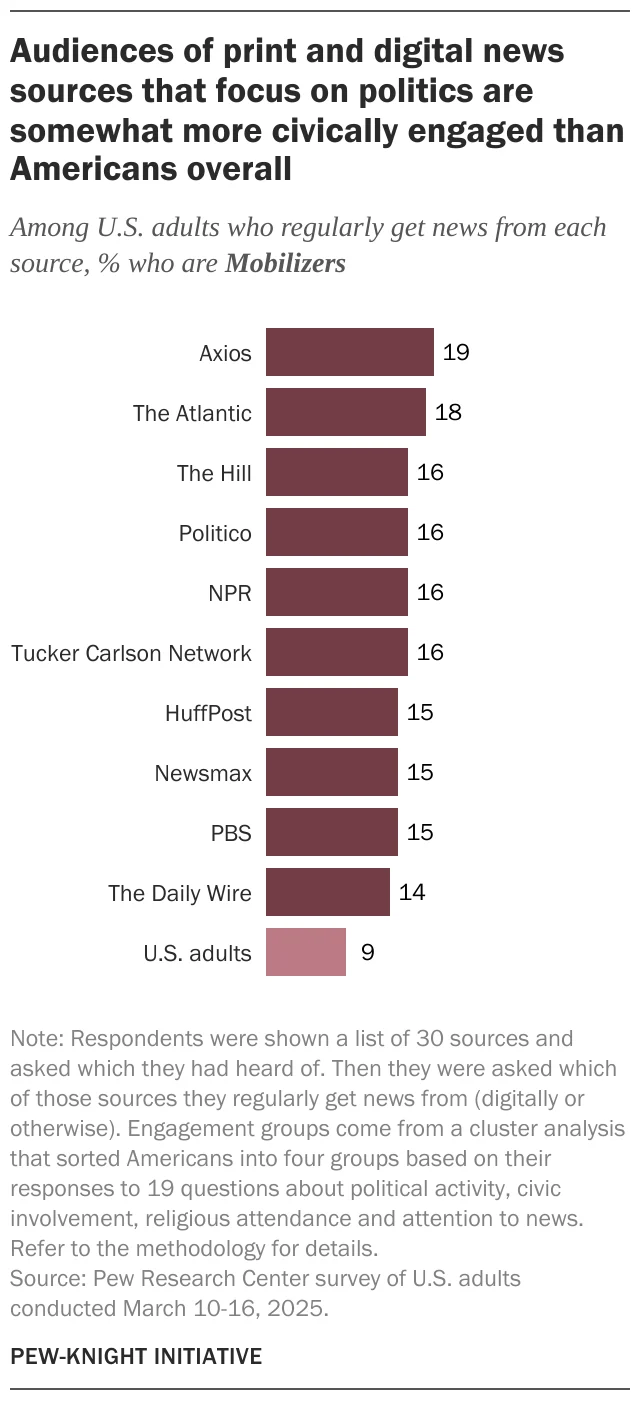
The Pew-Knight Initiative’s analysis of 30 national news sources categorizes the American public into four distinct civic groups through cluster analysis based on 19 separate indicators—including political activity, community involvement, religious attendance, and overall news attentiveness.
The most active group, designated as "Mobilizers," accounts for just 9% of the total U.S. adult population. However, this demographic is heavily overrepresented among the regular audiences of prominent digital and print news organizations that focus heavily on politics:
- Axios: 19% of its regular audience consists of Mobilizers.
- The Atlantic: 18% are Mobilizers.
- The Hill: 16% are Mobilizers.
- Politico: 16% are Mobilizers.
- NPR: 16% are Mobilizers.
- Tucker Carlson Network: 16% are Mobilizers.
- HuffPost: 15% are Mobilizers.
- Newsmax: 15% are Mobilizers.
- PBS: 15% are Mobilizers.
- The Daily Wire: 14% are Mobilizers.
Generational Shifts in Trust and Media Consumption
Demographic divides within political coalitions further complicate the media landscape. Data from 2026 highlights a growing trust gap among younger political participants:
- Younger Democrats (ages 18 to 49) exhibit lower levels of trust in traditional national news organizations compared to older members of the party.
- Younger Democrats are markedly more likely to place their trust in information sourced directly from social media platforms and digital commentators.
- 36% of adults aged 18 to 49 report getting news from podcasts at least sometimes, compared to 25% of those aged 50 and older, illustrating a structural migration away from legacy print and broadcast formats toward on-demand audio and independent streaming.
Official Responses and Stakeholder Perspectives
The convergence of algorithmic newsrooms and shifting audience loyalty has drawn reactions from corporate executives, labor representatives, and political figures alike.
Corporate leadership at media conglomerates facing acute financial strain argue that the adoption of AI-native operating models is not a matter of preference, but of survival. With digital advertising revenues fluctuating and print subscriptions continuing their secular decline, executives at publishers like McClatchy maintain that automated tools provide a necessary mechanism to maintain output levels despite drastically reduced newsroom headcounts. They contend that AI handles repetitive administrative and drafting tasks, allowing remaining human journalists to focus on core investigative reporting.
Conversely, newsroom employees and labor organizations have fiercely contested this narrative. Journalists argue that substituting human reporters with automated algorithms degrades editorial quality, erodes public trust, and violates the fundamental compact between a publication and its readership. The byline strikes and public disputes seen earlier in the year reflect a broader anxiety among working journalists who view uncurated artificial intelligence as an existential threat to both their livelihoods and the democratic watchdog function of the press.
Meanwhile, political strategists are responding to the erosion of legacy media dominance by shifting their outreach strategies. As independent media outlets, independent digital operations (such as Zeteo and More Perfect Union), and prominent livestreamers (such as Twitch political commentator Hasan Piker) accumulate massive, highly engaged audiences, potential candidates for the 2028 presidential nomination are actively courting these alternative platforms. Recognizing that younger voters consume information through podcasts and independent digital video rather than evening broadcasts or metropolitan dailies, political campaigns are treating non-traditional media as essential battlegrounds for primary engagement.
Broader Implications for the Future of Media and Politics
The simultaneous evolution of newsroom automation and audience fragmentation carries profound implications for American democracy, the economy of information, and the practice of journalism.
As legacy publications lean further into artificial intelligence to survive economic contraction, they risk alienating an already skeptical public. The data is unambiguous: consumers associate AI-generated content with lower reliability and diminished trust. If publishers sacrifice human oversight in pursuit of operational efficiency, they may accelerate the very audience attrition they are attempting to prevent.
At the same time, the migration of civic-minded audiences—and younger generations in particular—toward independent digital platforms, podcasts, and streaming networks signals a permanent decentralization of the public square. While independent media offers new avenues for deep political engagement and reaches demographics that have tuned out traditional newsrooms, it also presents challenges regarding verification, editorial standards, and the shared factual baseline required for democratic discourse.
Ultimately, the transformation of outlets like McClatchy and the electoral realignment toward independent media demonstrate that the American information ecosystem has reached a critical inflection point. How publishers balance economic realities with audience trust, and how political movements adapt to decentralized media consumption, will define the character of public discourse for the foreseeable future.