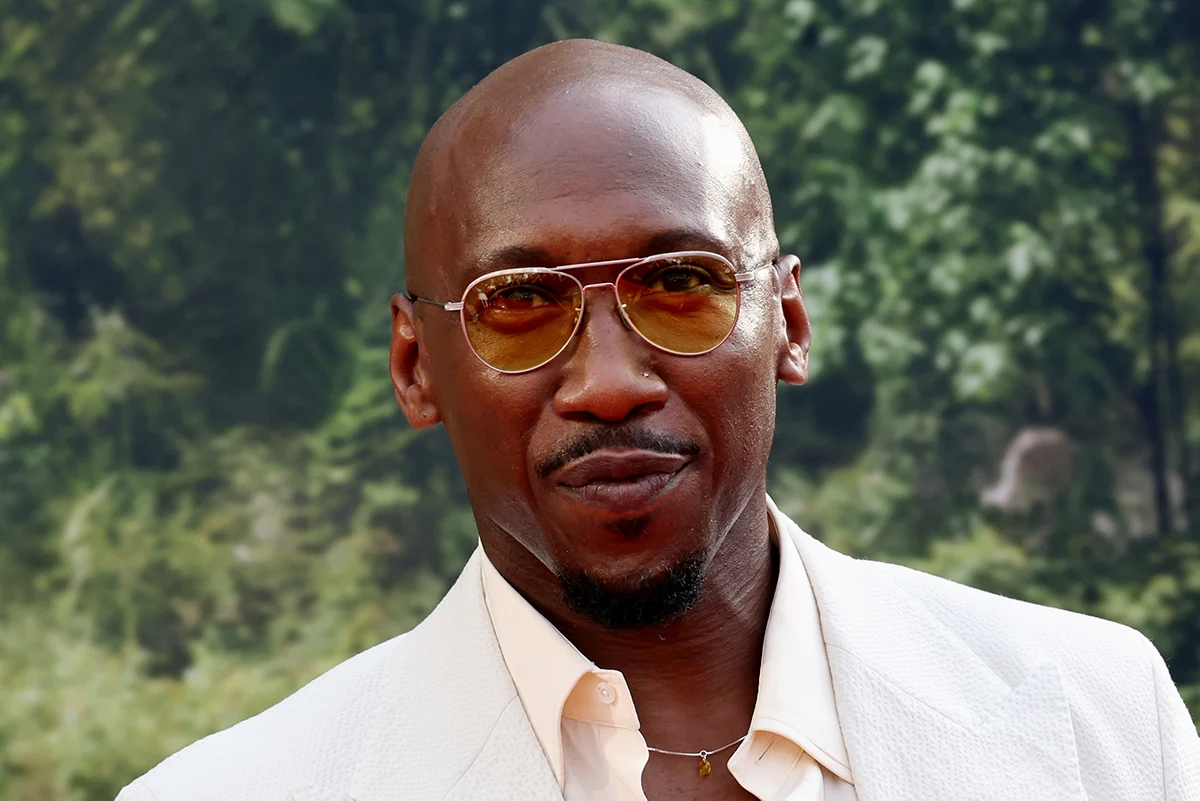
LOS ANGELES — Two-time Academy Award winner Mahershala Ali has peeled back the glittering veneer of Hollywood prestige, offering a refreshingly blunt assessment of what an Oscar actually means for a career in the modern entertainment landscape. During a candid appearance on the 7PM in Brooklyn podcast, hosted by NBA icon Carmelo Anthony and media personality Kazeem “Kaz” Famuyide, Ali dismantled the long-held industry myth that prestigious hardware serves as a golden ticket to unending opportunities.
Instead, the acclaimed actor revealed that industry accolades do little to shield even the most celebrated talent from the harsh realities of a risk-averse studio system, systemic hurdles, and a severe deficit of quality scripts. The conversation arrived as Ali continues to navigate a diverse career encompassing independent cinema—such as his recent collaboration with director Bassam Tariq on Your Mother Your Mother Your Mother—and the high-profile turbulence of unmade tentpole projects like Marvel Studios’ long-stalled Blade adaptation.
Main Facts: The Illusion of Validation and the Material Drought
At the core of Ali’s discussion with Anthony and Famuyide was a provocative question: Do awards actually validate whether someone is a “good actor”? According to Ali, the metric is entirely disconnected from artistic merit.
“There’s more good actors than there is good material,” Ali told the hosts. “It’s not even that all these people are competing for these same spots. It’s just that out of all the material made, there’s only a handful of them that check certain boxes.”
Ali, who secured Best Supporting Actor Oscars for his searing performances in Barry Jenkins’ Moonlight (2016) and Peter Farrelly’s Green Book (2018), emphasized that personal achievement takes a backseat to executive greenlight processes.
"The vast majority of projects that get greenlit, there are not roles for me in those," he explained. "You gotta think that way, you know what I mean? So, it doesn’t matter if I got 17 Oscars. If someone is not writing something for you or greenlighting something with you in mind, you’re like everybody else waiting and looking and searching."
When Famuyide pressed the actor on whether winning an Oscar acts as a true validator for Black actors within the industry, Ali dismissed the notion as superficial industry chatter.
"It’s kind of just talk. It doesn’t translate to anything real," Ali said. "You don’t want to find yourself in a situation where, oh, that’s ‘the diversity project.’ You just want to do great material as a Black person. You’re not thinking of yourself as this exotic other, per se. You just are living your life."
Chronology: From Academy Gold to Development Purgatory
To understand Ali’s current industry critique, it is necessary to trace the timeline of his historic rise, his pivot toward producing, and his recent professional crossroads:
- February 2017: Mahershala Ali wins his first Academy Award for Best Supporting Actor for his role as Juan in Moonlight, marking a historic milestone as the first Muslim actor to win an Oscar.
- February 2019: Ali captures his second Best Supporting Actor Oscar for his portrayal of jazz pianist Don Shirley in Green Book, solidifying his status as one of Hollywood’s most reliable and revered dramatic actors.
- July 2019: During Marvel Studios’ landmark panel at San Diego Comic-Con, Kevin Feige shocks the industry by announcing that Mahershala Ali will star as the vampire hunter Eric Brooks / Blade in a brand-new Marvel Cinematic Universe film.
- 2019–2024: The Blade project enters a protracted development cycle, plagued by multiple writer changes, shifting director attachments (including Bassam Tariq and Yann Demange), and repeated release date delays.
- September 2024: Ali stars in director Bassam Tariq’s indie drama Your Mother Your Mother Your Mother, which premieres to critical attention.
- Late 2024–2025: Following the quiet shelving of Blade and candid post-mortems from both Ali and Feige, Ali uses public forums—such as his 7PM in Brooklyn appearance—to reflect on the structural failures of major studio systems and the realities of indie filmmaking.
Supporting Data: The Math of Hollywood’s Output
Ali’s observations regarding the scarcity of quality material are supported by broader industry statistics. Over the last decade, the total number of scripted television series and feature films produced annually fluctuated dramatically due to the streaming boom, the COVID-19 pandemic, and subsequent labor strikes by the WGA and SAG-AFTRA. However, volume has rarely equated to diversity or depth of characterization for actors of color, particularly in mid-budget and prestige spaces.
- The Development Pipeline: While actors have the agency to produce their own projects, Ali noted that self-generation is a grueling “three to five-year journey” minimum.
- The Blockbuster Dependency: Major studios increasingly rely on established intellectual property (IP), leaving fewer resources for original dramatic storytelling where actors like Ali traditionally thrive.
- The Representation Gap: Studies from institutions like the UCLA Hollywood Diversity Report consistently demonstrate that while lead roles for actors of color have increased incrementally, sustained parity in complex, non-stereotypical material remains an uphill battle across studio pipelines.
Official Responses: Anatomy of a Marvel Meltdown
The stark contrast between independent creative freedom and corporate studio mechanics was further illuminated by the post-mortem of Marvel’s Blade reboot. Bassam Tariq, who served as the film’s original director before exiting the project, recently opened up to The New Arab and interviewer Hanna Flint about the structural impossibility of making the film under studio constraints.
"It was funny and strange to start casting and building without a proper script," Tariq confessed. "You’re sitting there and explaining to actors what their role will be, and they just have to believe you. That’s also very dangerous because if the text comes and it doesn’t add up to what you were saying, your credibility gets completely shot. All I have is my integrity, and I’ve been thinking about that a lot."
Tariq emphasized that acting as an intermediary for corporate decision-makers ultimately untenable: "If you’re the bearer of bad news to your actors, but you’re not the one making any of these decisions — and it’s actually coming from a corporate entity — that’s not a great way to be a director… I learned I was losing credibility with my actors, and it wasn’t a healthy way to operate as a filmmaker. Life’s too short to make shit films, so that was my big lesson: I have to have full control over my script."
Marvel Studios President Kevin Feige previously admitted his deep disappointment regarding the film’s collapse, describing himself in interviews as feeling "like a gigantic loser and failure." Ali echoed this sentiment during an interview with GQ, validating Feige’s raw assessment.
"To this day, I don’t know why it didn’t happen," Ali said. "I just know that it was—Kevin, he said it was the biggest failure of his career and I agree."
Implications: A Paradigm Shift for Hollywood Talent
Mahershala Ali’s candid breakdown of his career and the Blade debacle carries profound implications for the future of talent relations in Hollywood.
First, it signals a growing weariness among elite actors regarding the hollow promises of prestige branding. When a two-time Oscar winner openly states that awards do not translate to tangible career security or an abundance of compelling roles, it challenges the industry’s foundational narrative that meritocracy rules supreme in Tinseltown.
Second, the public unraveling of Blade underscores the perils of the modern tentpole development model. Studios pushing pre-announced release dates before a finished screenplay is locked risk alienating top-tier filmmakers and talent, damaging studio credibility, and burning through millions of dollars in developmental waste. Tariq’s refusal to compromise his directorial integrity for a corporate apparatus draws a sharp line in the sand for how independent artists choose to engage with massive corporate entities.
Finally, Ali’s perspective champions a return to substance over spectacle. By pivoting toward nimble, character-driven projects like Your Mother Your Mother Your Mother, Ali demonstrates that true artistic fulfillment lies not in waiting for a broken corporate machine to validate one’s existence with gold statues or superhero capes, but in pursuing grounded, meaningful storytelling on one’s own terms.