As the 2026 midterm election cycle accelerates and primary contests heat up across the nation, American voters are grappling with a fundamental question that could define the next two years of governance: Should their congressional representatives prioritize the aggressive pursuit of party-aligned policy goals, or should they focus on finding common ground with the opposition, even at the cost of ideological concessions?
According to a new report from the Pew Research Center, the American electorate is deeply conflicted. While voters on both sides of the aisle express an urgent desire for results, the strategy to achieve those results—whether through uncompromising advocacy or legislative bridge-building—remains a point of significant internal contention within both the Republican and Democratic coalitions.
The Core Dilemma: Purity vs. Pragmatism
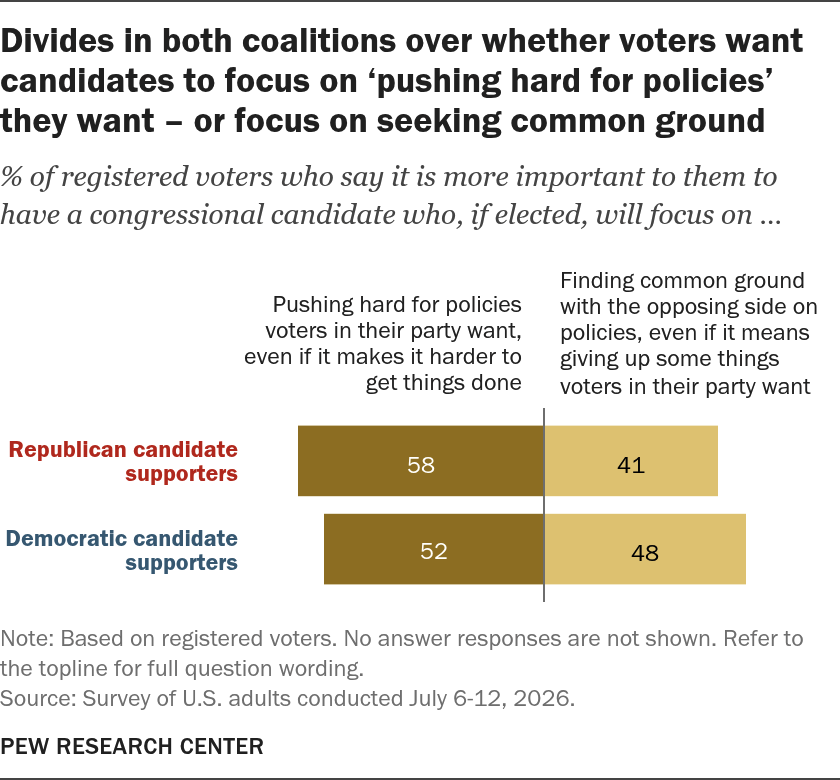
The survey, conducted between July 6 and July 12, 2026, reveals that the appetite for political combat is strong, particularly among the most engaged segments of the electorate. Among registered voters who support Republican congressional candidates, 58% stated they prefer a candidate who will push hard for their party’s policies, even if such a stance creates gridlock or makes it difficult to pass legislation. In contrast, 41% of Republican supporters expressed a preference for candidates who prioritize finding common ground with the opposition, even if it means sacrificing certain party-aligned goals.
Democratic voters display a more nuanced, though equally divided, perspective. Among those supporting Democratic candidates, 52% favor the “push hard” approach, while 48% lean toward a strategy centered on compromise. These figures underscore a broader trend in American politics: the decline of moderate consensus and the rise of a base-driven demand for ideological fidelity.
A Chronology of the 2026 Primary Season
The current political landscape is the result of months of intensifying rhetoric that began earlier this year. As congressional primaries began in the spring, the debate over "what works" in Washington took center stage.
- Early 2026: Initial candidate forums highlighted a shift in tone. Incumbents and challengers alike faced pressure to demonstrate their loyalty to party platforms, with many campaigns focusing on "taking the fight" to the other side rather than highlighting bipartisan legislative accomplishments.
- Late Spring 2026: As primaries moved into higher gear, voter sentiment began to solidify. The discourse shifted from broad policy issues to questions of character and resolve. The recurring question at town halls was not "What will you fix?" but rather "Will you stand your ground?"
- July 2026: The Pew Research findings represent a mid-summer snapshot, capturing a electorate that is now fully engaged. With the general election only months away, the data suggests that candidates who lean into their party’s most prominent priorities are finding more traction with their respective bases than those who attempt to stake out a moderate middle.
Analyzing the Data: Engagement and Intensity
One of the most striking findings in the report is the correlation between a voter’s desire for an uncompromising candidate and their overall level of interest in the election. The data suggests that "the base" is indeed the most energized demographic.
Among all registered voters who support a Republican candidate, 69% believe it "really matters" which party wins control of Congress. However, when you zoom in on the subset of those voters who specifically demand that their candidate push hard for party policies, that figure jumps to 80%. Conversely, among Republicans who prioritize common ground, only 54% express the same level of concern regarding which party wins control.
A similar trend exists within the Democratic coalition. Eight-in-ten Democrats who want a "fighter" say the outcome of the midterm election is of critical importance, while that number drops to 71% among those who favor a candidate focused on compromise.
This engagement gap extends to the amount of thought voters have given to the election. Republicans who prioritize policy-pushing are twice as likely to have spent significant time contemplating the election (30%) compared to those who prioritize compromise (15%). For Democrats, 46% of those favoring a policy-focused candidate have given significant thought to the midterms, compared to 39% of those who prefer a candidate willing to seek common ground.
Demographic Divides and Generational Shifts
The internal divide is not uniform; it varies significantly across age, race, and education levels. Perhaps most notably, younger voters in the Democratic coalition are the most eager for aggressive, agenda-driven leadership.
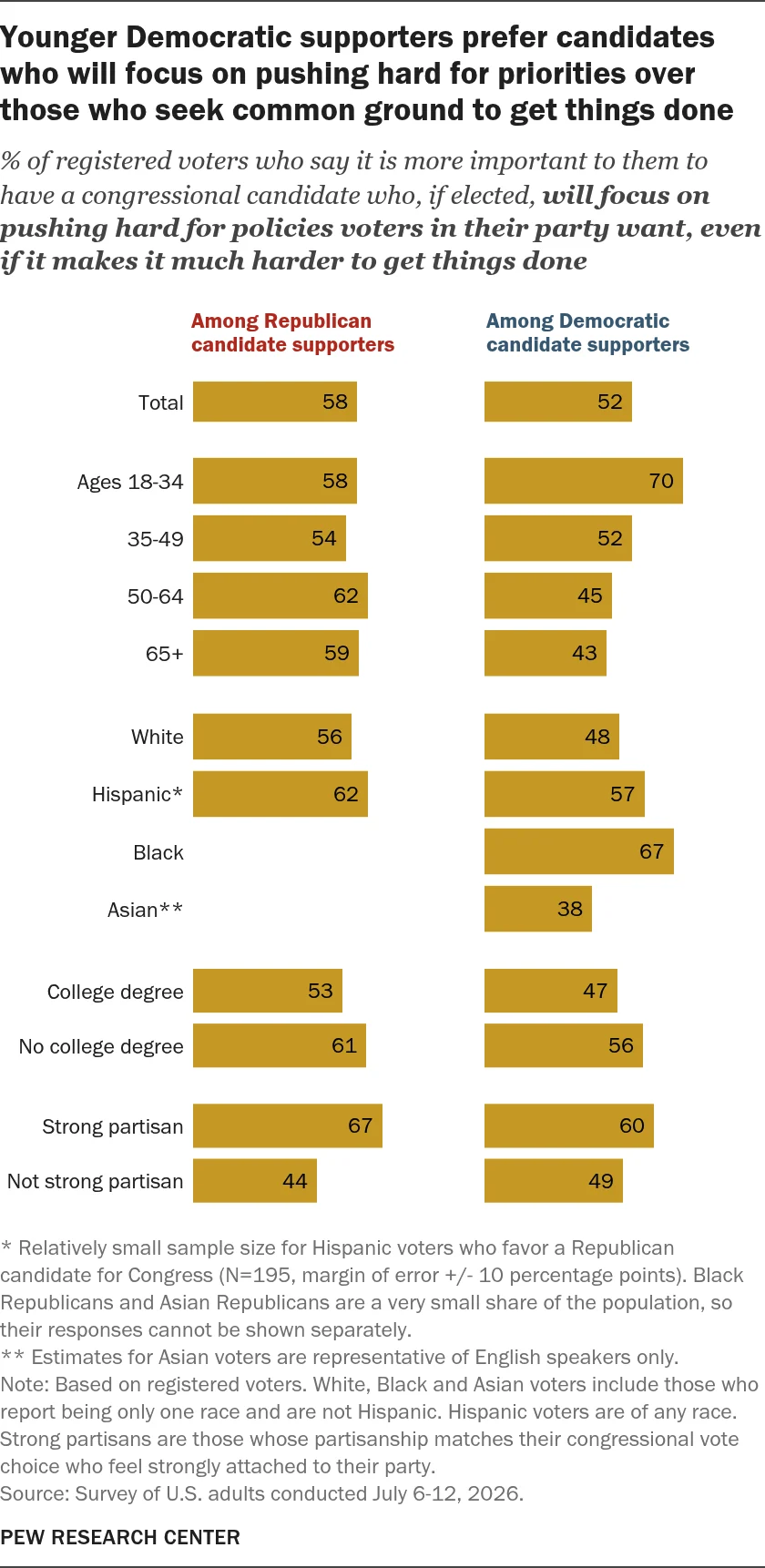
Among Democratic-leaning voters aged 18 to 34, 70% support a candidate who will fight for party priorities, a sharp contrast to older Democratic voters (those 65 and older), who are significantly more likely to prefer a candidate focused on compromise. This suggests that the Democratic Party’s youth wing is increasingly impatient with the traditional legislative process and is demanding a more assertive, ideological approach to governance.
Race and ethnicity also play a role. Among Democrats, Black voters are the most likely to favor a candidate who pushes hard for policy priorities (67%). Hispanic voters lean in that direction as well, with 57% favoring a hard-line approach. Asian voters in the Democratic coalition, however, are the outliers, with only 38% favoring an aggressive policy-pushing strategy, indicating a higher comfort level with compromise among that demographic.
For Republicans, the trend is more consistent across demographics, with a solid majority of white and Hispanic voters favoring an aggressive approach to policy. Notably, voters who describe themselves as "strong partisans"—those who feel a deep emotional and ideological connection to their party—are significantly more likely to demand an uncompromising representative, regardless of whether they are Republican (67%) or Democrat (60%).
The View from the Campaigns
While the report captures voter sentiment, the implications for candidates are clear: the "middle" is a dangerous place to be during a primary. Official responses from party strategists, though often kept private, reflect a strategic pivot.
In many districts, challengers have utilized the "common ground" label to attack incumbents, framing it as a synonym for "surrender." Conversely, some moderate candidates are attempting to rebrand compromise as "effective governance," arguing that a party that refuses to negotiate will ultimately achieve nothing. However, as the data shows, the voters who actually show up to vote in primaries—the most engaged and the most partisan—are increasingly skeptical of such narratives.

Implications for the Future of Congress
The implications of these findings are profound for the legislative branch. If voters continue to punish candidates who seek common ground, the next Congress may be defined by even deeper levels of gridlock.
If both parties are incentivized by their most committed voters to pursue a "my way or the highway" strategy, the structural barriers to passing complex legislation—ranging from budget reconciliation to national security and social policy—will become increasingly insurmountable. The data points to a growing "intensity gap," where the most vocal and engaged segments of the electorate are the most resistant to the very compromises necessary for the functioning of a democratic, representative government.
As we move toward November, the tension between these two philosophies—the desire for ideological victory versus the necessity of functional governance—will remain the defining friction point of the 2026 election. Whether candidates can find a way to honor the demands of their base while still functioning as effective legislators remains the ultimate test of the current political cycle. The results of the upcoming midterms will likely tell us whether the American public is ready to embrace a return to the center or if the era of uncompromising political warfare is only just beginning.