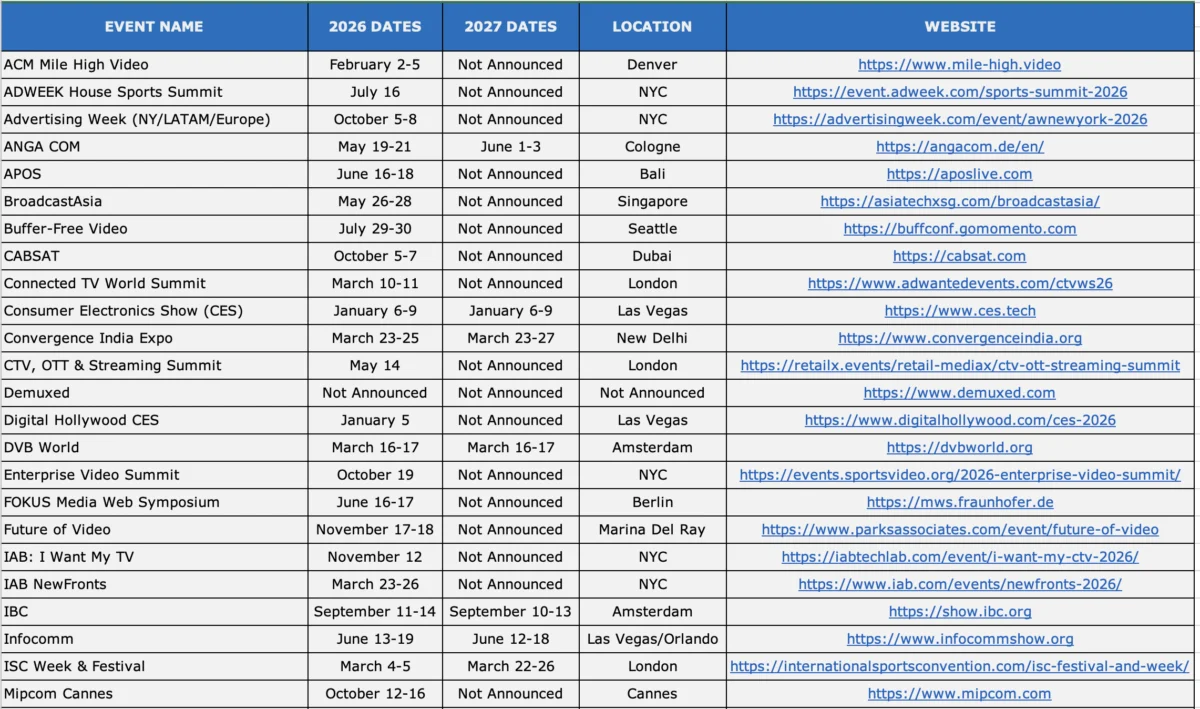
In the rapidly evolving landscape of digital media, the ability to discern which industry gatherings offer genuine value has become a competitive necessity. As streaming technology, Over-the-Top (OTT) distribution, and broadcast innovation converge, professionals are often inundated with an overwhelming volume of event invitations. To provide clarity, industry analyst Dan Rayburn has curated a definitive, open-source resource: a master list of nearly 50 essential in-person conferences tailored specifically to the streaming media sector.
The Strategic Importance of Industry Gatherings
For vendors, content creators, and technologists, the "event season" represents a significant investment of time, capital, and human resources. Choosing the wrong venue can lead to lost opportunities and diminished return on investment (ROI). Recognizing this, Rayburn has released an Excel-based directory designed to help stakeholders navigate the complex global event circuit.
"I’m often asked for a list of in-person conferences and events in the streaming media industry," Rayburn notes. By formalizing this list, he provides a roadmap for professionals seeking to align their marketing objectives with the most relevant industry forums. For those in the vendor community—particularly marketing teams new to the space—Rayburn offers direct consultation to help identify which events best serve specific business goals.
Scope and Methodology: Defining the Streaming Ecosystem
The challenge in categorizing streaming events lies in the industry’s intersectional nature. As Rayburn highlights, the distinctions between technology, business models, and industry verticals are often blurred by casual usage. To ensure the list remains highly curated and actionable, specific parameters were established:
The Parameters of Inclusion
- Sector Focus: The list is strictly confined to events tied to the broadcast/TV and sports industries, as well as the OTT business model.
- Exclusivity: The directory excludes private functions, vendor-produced roadshows, localized meetups, and member-only closed-door sessions.
- Technological Rigor: Events that focus exclusively on video production, cinematography, or the creator economy—without a substantive focus on streaming infrastructure, distribution technology, or business model innovation—have been omitted.
- Market Verticals: The list intentionally excludes niches such as video for retail, e-commerce, security, education, gaming, and government-specific applications.
By setting these boundaries, the resource functions as a high-signal tool for professionals dedicated to the core infrastructure and monetization of streaming media.
The Taxonomy of Modern Media: Tech vs. Business vs. Industry
To understand why this list is structured the way it is, one must differentiate between the terms often used interchangeably in the boardroom.
Streaming as Technology
At its foundation, streaming is a technological delivery mechanism. It involves the complex architecture of encoding, transcode-on-demand, Content Delivery Networks (CDNs), low-latency protocols (such as WebRTC or CMAF), and playback performance metrics. Events on this list that prioritize this angle are essential for engineers, CTOs, and product developers.
OTT as a Business Model
Over-the-Top is not a technology; it is a delivery vehicle for a business model. Whether it is Subscription Video on Demand (SVOD), Advertising-based VOD (AVOD), or Fast-Ad-Supported TV (FAST), the core of these events revolves around churn mitigation, subscriber acquisition, content rights management, and ad-tech integration.
Broadcast as an Industry
Broadcast represents the legacy infrastructure and institutional standards that are currently undergoing a digital transformation. Understanding the transition from SDI to IP-based workflows is a cornerstone for attendees focused on this segment.
The Chronology of Development: A Living Document
Rayburn’s initiative began as a response to the fragmented nature of industry event scheduling. Recognizing that the industry changes rapidly, the current list is designed as a living document rather than a static report.
- Initial Curation: The current list comprises nearly 50 global events, vetted for their relevance to the core streaming business.
- Community Integration: Rayburn has invited industry participation. Rather than maintaining a closed gate, he encourages feedback via his LinkedIn channel.
- Open Access Philosophy: The Excel file is unlocked and editable. This allows users to customize the data for their internal planning, add notes on past experiences, or track budget allocations for future travel.
- Regular Updates: The document includes a timestamp of the last revision. Rayburn has committed to updating the file multiple times per year, ensuring that as conferences evolve or dissolve, the list remains a reliable compass for the industry.
Supporting Data and Vendor Strategy
For vendors, the event strategy is often the largest line item in the annual marketing budget. The support offered by industry analysts in this space—such as the consultations Rayburn provides—serves as a vital "de-risking" exercise.
When evaluating a conference, vendors should look for the following metrics:
- Attendee Composition: Are the participants decision-makers (C-suite, VPs of Engineering, Heads of Product) or are they primarily entry-level practitioners?
- Quality of Content: Do the sessions feature substantive technical case studies, or are they high-level "fluff" marketing panels?
- Networking Velocity: How effective is the venue at facilitating high-value, one-on-one meetings?
By utilizing the Rayburn list as a baseline, vendors can filter out events that do not offer the required density of target prospects.
Official Commentary and Industry Implications
The implications of such a curated list are significant. For years, the streaming industry has struggled with "conference fatigue," where the sheer number of events has diluted the value of networking. By narrowing the focus to events that address the business of streaming and broadcast, Rayburn is effectively helping the industry move toward a more efficient, higher-quality event culture.
"I may not add every suggestion to the list," Rayburn clarifies, "but the list is open and unlocked, so feel free to download and edit it as you wish." This transparency acknowledges that "relevance" is subjective; a company specializing in sports rights will have a different set of priorities than a company building AI-driven encoding software.
The industry’s reliance on these gatherings suggests that despite the digital-first nature of the streaming business, the human element of deal-making remains paramount. The ability to shake hands, demo new hardware, and engage in off-the-record discussions about market shifts is something that Zoom calls and webinars have yet to replicate.
Looking Ahead: The Future of Streaming Conferences
As the streaming industry matures, we can expect a consolidation of events. The current "gold rush" phase of event proliferation is likely to yield to a more disciplined period where only the most value-dense conferences survive.
For the professional, the strategy is clear:
- Audit your goals: Are you looking for technical talent, lead generation, or brand awareness?
- Reference the data: Use the Rayburn list to identify the top three events that align with those goals.
- Consult the experts: Engage with industry analysts to get the "insider" view of which conferences have seen a decline in quality or a shift in focus.
- Execute and adapt: Use the open-source nature of the document to keep your own internal records up to date.
By treating event participation as a data-driven investment rather than a tradition, organizations can significantly improve their visibility and ROI in the global streaming theater. For those interested in the current state of the industry, the provided resource serves as an essential starting point for the remainder of the 2026 calendar and beyond.