In a seismic shift for the global media landscape, Fox Corporation has officially confirmed that it will acquire Roku in a deal valued at approximately $22 billion. The announcement, which confirms months of persistent industry speculation, marks one of the most significant consolidations in the history of streaming technology and content distribution. By bringing the world’s most prominent streaming platform under its umbrella, Fox is positioning itself as a dominant vertically integrated powerhouse, capable of controlling both the programming that viewers watch and the sophisticated advertising ecosystem that delivers it to them.
The Deal Mechanics: Financial Architecture and Ownership
The agreement, structured as a combination of cash and stock, sets the acquisition price at $160 per share for Roku. The compensation package consists of 60% cash and 40% in Fox common stock. To facilitate the massive cash requirement, Fox Corporation has secured $12 billion in fully committed bridge financing from Morgan Stanley, signaling a aggressive move to leverage its balance sheet for long-term growth.
Upon the expected closing of the deal in the first half of 2027, the ownership structure of the combined entity will shift significantly. Existing Fox shareholders are projected to retain a 73% stake in the merged company, while legacy Roku shareholders will hold approximately 27%. This transition marks a full-circle moment for Fox, which was an early, pre-IPO investor in Roku back in 2013, having recognized the potential of the platform long before the streaming boom redefined the television industry.
Fox leadership has been quick to emphasize the fiscal viability of the acquisition. The company anticipates that the deal will be accretive to free cash flow per share by the second full year post-closing. Furthermore, Fox has identified approximately $400 million in run-rate cost synergies, with executives hinting at additional revenue upside derived from cross-platform advertising optimization and combined data intelligence.
A Chronology of a Streaming Giant: From Pandemic Highs to Acquisition
To understand the valuation of this deal, one must look at the turbulent history of Roku’s market performance. During the pandemic-era streaming explosion of 2021, Roku was a market darling, with its stock price reaching an all-time high of $479.50. Investors viewed the platform as the essential gateway to the "living room" of the future.
However, the post-pandemic reality proved harsh. As the streaming market became saturated and hardware competition intensified, Roku’s valuation plummeted, falling under $100 per share by 2022. Between April 2022 and December 2025, the stock struggled to regain its former glory, only periodically peaking above the $100 mark.
For Fox, the $160-per-share offer represents a strategic entry point. While it is a significant premium over the recent trading range, it is a fraction of the valuation the company once commanded. By acquiring Roku at this juncture, Fox is effectively betting that the platform’s advertising prowess and scale will outweigh the volatility that characterized the company’s recent stock performance.
Data Deep-Dive: The Health of the Roku Ecosystem
The acquisition is underpinned by the robust underlying metrics of Roku’s business. In their most recent Q1 earnings report, Roku provided a transparent look at the shift in their revenue model. Total revenue for the quarter reached $1.248 billion—a 22% increase year-over-year—resulting in a net income of $85.7 million.
Critically, the composition of that revenue has shifted away from hardware. Device sales accounted for only $118 million, or less than 10% of total revenue, representing a 16% decline. In contrast, the company’s core growth drivers—advertising and subscriptions—showed incredible resilience. Advertising revenue surged to $613 million (up 27% YoY), while subscription revenue climbed to $519 million (up 30% YoY).
This shift confirms that Roku is no longer a hardware company that happens to have a software interface; it is a high-margin advertising and services platform. With 38.7 billion streaming hours recorded in Q1—an 8% increase—the platform’s stickiness remains its most valuable asset. Furthermore, Roku entered this acquisition from a position of relative financial strength, holding $2.38 billion in cash and cash equivalents with zero long-term debt, providing the combined entity with a clean slate to begin integration.
Strategic Implications: Aggregation and the Future of Content
One of the primary concerns among industry analysts has been whether Fox would close the Roku platform to favor its own content. Fox has explicitly stated that Roku will remain an open platform. This commitment is vital for maintaining the platform’s value; Roku’s strength lies in its ability to aggregate diverse content sources, and turning it into a "walled garden" would likely trigger a mass exodus of users and third-party partners.
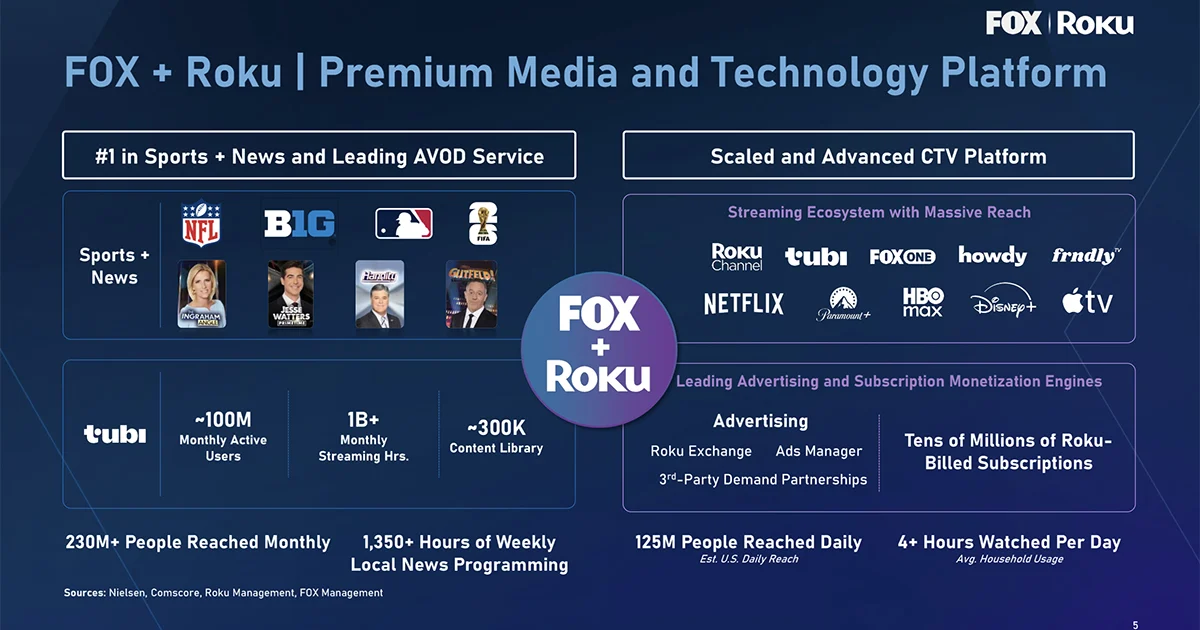
Furthermore, Fox has indicated that it plans to keep Tubi—its own free, ad-supported streaming service—separate from The Roku Channel. While there is approximately a 33% overlap in their respective audiences, management believes that maintaining two distinct, complementary brands will allow them to maximize market share in the free, ad-supported television (FAST) space.
The acquisition effectively marries Fox’s traditional strengths—live news and sports programming—with the technological infrastructure of the modern streaming era. By controlling the "pipes" (Roku) and the "water" (Fox content), the company can utilize sophisticated data targeting to insert high-value advertisements into live broadcasts, a capability that is becoming increasingly lucrative as traditional cable advertising continues to decline.
Official Responses and Governance
The governance of the newly expanded Fox Corporation will be bolstered by the addition of Anthony Wood, the founder, chairman, and CEO of Roku, to the Fox board of directors. Wood’s inclusion is intended to ensure continuity of the technological vision that made Roku a household name.
In the official investor presentation released following the announcement, Fox leadership highlighted the rationale behind the 24x FY27E EBITDA valuation. They argue that the combined company’s ability to leverage Roku’s advertising technology across Fox’s massive content library will create a virtuous cycle of revenue growth that justifies the premium price tag.
"This is not merely an acquisition of a platform," one industry analyst noted. "This is a fundamental realignment of the media food chain. Fox is ensuring that in a fragmented streaming world, they are not just a provider of content, but the gatekeeper of the interface."
Looking Ahead: The Challenges of Integration
While the financial and strategic logic is sound on paper, the path to 2027 is fraught with challenges. Cultural integration between a legacy media giant like Fox and a tech-first firm like Roku will be a significant hurdle. Furthermore, regulatory scrutiny is likely to be intense. The Federal Communications Commission and other global antitrust bodies will undoubtedly examine whether this level of vertical integration—combining a major content creator with a dominant distribution platform—could stifle competition or harm consumer choice.
However, if the deal closes as expected, the media landscape will be permanently altered. By 2027, the "Fox-Roku" entity will represent a formidable competitor to the likes of Google, Amazon, and Apple in the battle for the living room. As streaming becomes the primary vehicle for all television consumption, Fox has made its move to ensure it remains at the center of the experience, leveraging the very platform that once threatened to make traditional media obsolete.
For investors, the coming months will be a period of intense scrutiny as they monitor the integration plans, the regulatory landscape, and the continued performance of the Roku platform. For the average viewer, the promise is a more seamless, integrated experience where the best of live television and on-demand streaming are brought under one roof. Whether this promise translates into lower costs or a better viewing experience remains to be seen, but one thing is certain: the future of television has just arrived in a very big way.