
The latest quarterly financial disclosures from six of the industry’s most prominent publicly traded advertising technology companies have laid bare a stark and accelerating divergence within the digital marketing ecosystem. The third-quarter results tell a tale of two distinct cohorts: mobile-first and app-based advertising powerhouses riding a wave of massive structural growth, contrasted against open-web, display, and publisher-dependent giants battling sliding revenues, contracting margins, and volatile profitability.
As the earnings roll in, the data illustrates how unevenly the digital advertising industry’s growth opportunities are currently being distributed. While behemoths like AppLovin and Unity post staggering year-over-year expansions, historic stalwarts of the open internet are wrestling with severe market headwinds, structural shifts away from traditional web browsing, and shifting advertiser budgets.
Main Facts: The Great Divergence in Third-Quarter Results
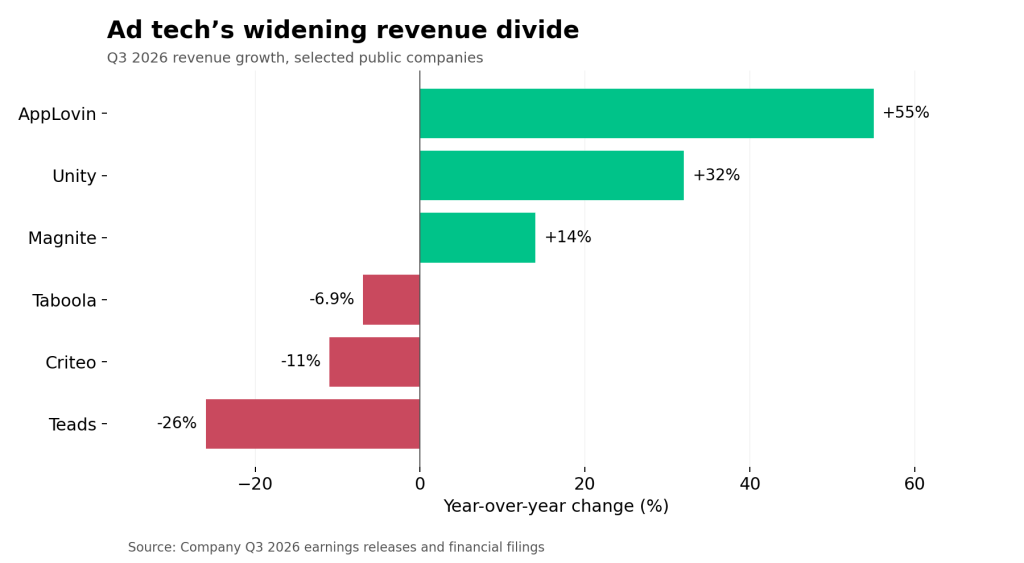
The fundamental narrative of the third-quarter earnings season is defined by hyper-growth at the top end and widespread contraction at the bottom. Across the six analyzed firms—AppLovin, Unity, Magnite, Criteo, Taboola, and Teads—outcomes varied wildly.
- The Outliers: AppLovin cemented its dominance by reporting a jaw-dropping 55% surge in quarterly revenue to $2.19 billion, paired with a 72% increase in net income to $1.44 billion. Rival mobile ad giant Unity matched the bullish momentum, posting a 32% revenue increase to $622 million and achieving a historic milestone: its first profitable quarter since its Initial Public Offering (IPO).
- The Contraction: On the opposite end of the spectrum, three of the six companies suffered sharp annual revenue declines. Teads, a historic rival to Taboola and a one-time prospective merger partner, absorbed the steepest contraction, with revenue plunging 26% to $235.1 million and culminating in a staggering net loss of $325.5 million. Criteo and Taboola also experienced downward pressure, with revenues falling 11% and 6.9%, respectively.
- The Connected TV (CTV) Bright Spot: Amid the gloom of open-web declines, Connected TV emerged as a vital, high-performing growth engine. Both Magnite and Teads pointed to double-digit gains in CTV, though for struggling firms, this nascent growth was frequently insufficient to offset broader systemic declines.
Chronology and Market Context: How the Quarter Unfolded
The reporting period, which culminated with this week’s earnings announcements, reflects a multi-year secular shift in digital consumption habits. Over the past several quarters, industry analysts have tracked a pronounced migration of eyeballs and budgets away from the traditional, open web—beleaguered by signal loss, cookie deprecation, and brand safety concerns—and toward walled gardens, mobile apps, and premium streaming environments.
The week began with mobile ad giants releasing results that immediately reset market expectations. AppLovin’s disclosures dropped early in the cycle, boasting that its single quarter revenue of $2.19 billion had eclipsed the combined revenue of its five publicly traded peers ($1.94 billion) put together.
As the week progressed, mid-tier supply-side platforms (SSPs) and demand-side platforms (DSPs) reported their metrics, revealing that even companies achieving top-line growth were fighting structural margin compression. By the time publisher-focused giants like Teads and Criteo filed their reports toward the end of the week, the underlying narrative was complete: app-based media and CTV are capturing the lion’s share of digital dollars, while open-web infrastructure providers are fighting an uphill battle to preserve baseline profitability.
Supporting Data: Deep Dive Into the Numbers
A granular examination of the financial filings reveals the mechanics behind the "haves and have-nots" paradigm shift currently reshaping ad tech.
The Mobile Titans: AppLovin and Unity
AppLovin’s dominance cannot be overstated. Alongside its $2.19 billion top-line figure and $1.44 billion net income, the company issued stellar forward-looking guidance, projecting fourth-quarter revenue to land between $2.365 billion and $2.395 billion. This exponential scaling underlines the resilience of app-based media—both mobile gaming ecosystems and in-app CTV environments.
Meanwhile, its chief mobile rival, Unity—with whom AppLovin is currently locked in an ongoing legal dispute regarding data collection practices—reported that its Grow Solutions division (housing its media offerings) generated $457 million, marking a robust 44% year-over-year increase. More impressively, Unity’s Vector ad platform accelerated by an astounding 126% year-over-year and 40% sequentially, proving that its turnaround strategy under new leadership is bearing fruit.
Supply-Side Resilience: Magnite
Magnite posted a solid 14% increase in overall revenue to $204.2 million, backed by a 20% jump in total contribution ex-TAC (traffic acquisition costs). The primary catalyst for Magnite was its booming CTV business, which saw its contribution ex-TAC surge 39% to $105.4 million. CTV now commands approximately 53% of Magnite’s total contribution ex-TAC, up from 45% a year prior, comfortably overshadowing its legacy DV+ (display and video) business, which crawled forward at a modest 5% growth rate.
Open-Web Challenges: Criteo, Taboola, and Teads
The open web painted a decidedly bleaker picture. Criteo reported Q3 revenue of $416 million (down 11%), while its contribution ex-TAC fell 17% to $240 million. Criteo’s retail media division suffered a 23% plunge, exacerbated by executive admissions that two unnamed clients had reduced their business footprint by $20 million. Consequently, Criteo’s net income plummeted 85% to just $6 million, with gross margins contracting from 55% to 50%.
Taboola managed a mixed bag: while revenues dipped 6.9% to $462.3 million due to shrinking advertising impression volumes, the company exercised strict cost discipline, lifting its gross profit by 9.6% to $152.3 million.
Teads bore the brunt of open-internet structural weakness. Its 26% revenue contraction down to $235.1 million was accompanied by a 28% drop in gross profit post-TAC (landing at $93.5 million). Most alarmingly, Teads posted a massive net loss of $325.5 million—a severe deterioration from the $19.7 million loss recorded in the corresponding period last year—prompting executive leadership to withhold forward financial guidance.
Official Responses and Executive Commentary
Corporate boardrooms and earnings call transcripts provided vital context regarding why these bifurcated results are materializing.
Executives across the struggling open-web cohort pointed repeatedly to macroeconomic pressures, shifting brand allocations, and the continuous erosion of traditional publisher inventory. Teads’ leadership explicitly cited "continued weakness in open-internet advertising" as the primary driver behind their decision to suspend financial guidance and absorb massive write-downs.
Conversely, AppLovin and Unity executives emphasized their proprietary technological advantages, machine-learning-driven optimization algorithms, and the unshakeable stickiness of app-based ecosystems. AppLovin’s leadership framed their record-shattering quarter as the natural outcome of providing high-converting, performance-driven tools that advertisers refuse to cut, even in tightening economic climates.
On the CTV front, executives from Magnite and Outbrain highlighted the medium’s unique resilience. Outbrain noted a 37% year-over-year surge in CTV-specific revenue. However, executives at Outbrain tempered enthusiasm by noting that CTV still accounted for a mere 12% of their total quarterly revenue—insufficient to entirely counteract a broader 26% company-wide revenue pullback. This dichotomy underscores a critical industry truth: while CTV is a stellar growth format, its ultimate impact on a company’s ledger depends entirely on its scale relative to legacy revenue streams.
Industry Implications: What This Means for the Future of Ad Tech
The Q3 earnings season serves as a bellwether for the structural evolution of the global digital advertising industry. Several sweeping implications emerge from these financial disclosures:
- The Marginalization of the Open Web: The steep declines registered by Teads, Criteo, and Taboola signal that the open web—traditionally defined as independent news sites, blogs, and standard browser-based environments—is facing an existential crisis. As privacy regulations tighten, third-party cookies crumble, and brands prioritize deterministic, high-engagement environments, open-web monetization models are struggling to maintain scale.
- The Triumph of Walled Gardens and App Ecosystems: AppLovin and Unity prove that closed-loop, app-centric mobile environments possess superior data integrity, targeting capabilities, and user retention. By keeping users within dedicated app ecosystems (gaming, entertainment, and social utilities), these platforms bypass many of the targeting hurdles plaguing web-based publishers.
- CTV as the Ultimate Lifeline: For supply-side platforms and media networks capable of scaling their footprint within living rooms, Connected TV remains the ultimate growth engine. However, the data proves that CTV is no longer a rising tide that lifts all boats; unless a company has achieved critical mass in CTV (as Magnite has done), it functions merely as a niche offset rather than a wholesale cure for legacy declines.
- Profitability Decoupled From Top-Line Growth: The quarter demonstrated that revenue expansion and profitability no longer move in lockstep. Companies like Unity achieved historic profitability milestones amidst solid revenue growth, while others (like Taboola) successfully expanded gross profits despite declining top-line revenues through aggressive cost-cutting. Conversely, Criteo watched both metrics deteriorate simultaneously.
Looking Ahead
As this earnings cycle reaches its midpoint, the spotlight shifts to upcoming financial filings next week from other industry heavyweights, including Zeta Global, The Trade Desk, PubMatic, and Liftoff Mobile. Market watchers will be keenly observing whether these upcoming reports reinforce the narrative of mobile and CTV dominance, or if alternative pockets of resilience will emerge within the broader digital marketing landscape. One reality remains indisputable: the days of generalized, across-the-board growth in ad tech are officially over, replaced by a ruthless Darwinian marketplace where scale, platform control, and format diversification dictate survival.