Main Facts
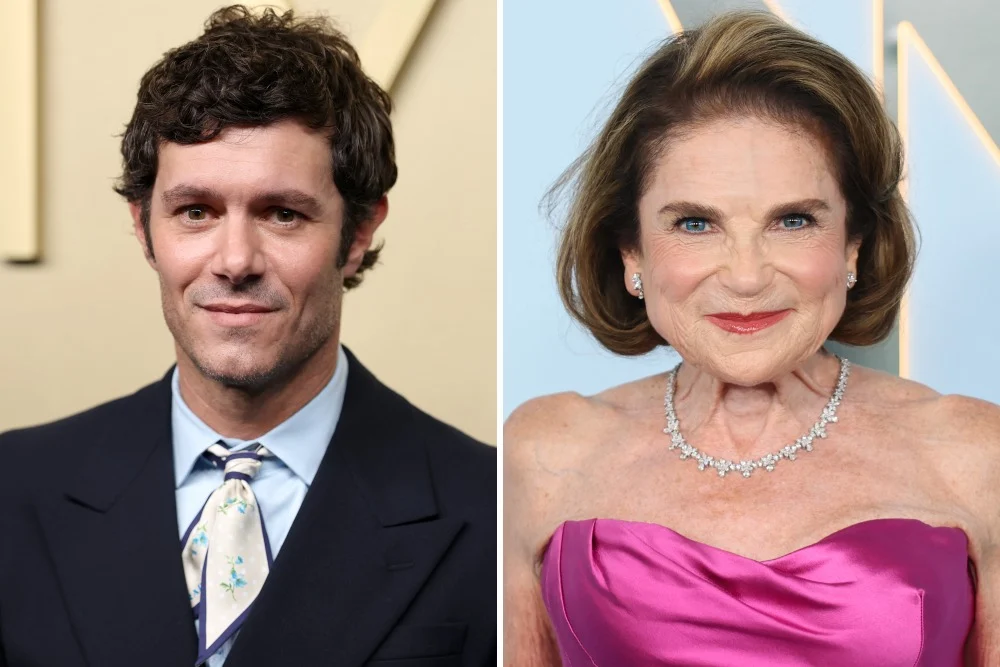
The entertainment industry is once again grappling with the intersection of personal political beliefs and high-profile television production. Veteran stage and screen actress Tovah Feldshuh has publicly and forcefully criticized her Nobody Wants This co-star, Adam Brody, following his controversial remarks regarding the Israel-Gaza conflict during a recent interview with GQ.
The dispute centers on Brody’s outspoken stance on the ongoing Middle East war. During the interview last month, Brody—who stars as the lovable, charismatic Rabbi Noah Roklov in Netflix’s hit romantic comedy series—explicitly stated his support for a "Free Palestine" and characterized the actions of Israel as a "genocide."
Feldshuh, who portrays Bina Roklov, the sharp-tongued and protective mother of Brody’s character on the show, did not mince words when addressing her colleague’s comments. In an interview with The New York Post, Feldshuh condemned Brody’s terminology, equating accusations of genocide against the Jewish people to historical antisemitic propaganda. She further emphasized the psychological and communal impact when such statements originate from individuals within the Jewish community itself.
The friction between the two prominent cast members has brought broader industry-wide questions about political expression, workplace harmony, and creative collaboration into sharp relief. Yet, despite the ideological gulf separating the actors, production on the popular Netflix series continues, mirroring the broader social reality of families and workplaces navigating deep-seated geopolitical divisions. Series creator Erin Foster has also addressed the controversy, advocating for workplace pluralism and open dialogue even in the face of fundamentally irreconcilable viewpoints.
Chronology of Events
To understand how a romantic comedy ensemble became the focal point of a fierce geopolitical debate, it is necessary to trace the timeline of events that brought these tensions to the surface:
- September 2024: Netflix premieres Nobody Wants This, created by Erin Foster and starring Adam Brody and Kristen Bell. The show quickly becomes a massive pop-cultural phenomenon, drawing praise for its chemistry, witty writing, and fresh take on interfaith relationships—specifically focusing on a secular female podcast host and an observant rabbi.
- Mid-October 2024 (The GQ Interview): Adam Brody sits down for a wide-ranging interview with GQ. While promoting his career and discussing the success of Nobody Wants This, the conversation shifts to world events. For the first time publicly, Brody addresses the Israel-Gaza conflict. He tells the magazine, "Put me down as thinking it’s a genocide. Put me down as wanting a free Palestine." He acknowledges the complexity and emotional weight of the issue while expressing a sense of urgency regarding the humanitarian crisis.
- Late October 2024 (Erin Foster’s Initial Response): As Brody’s comments circulate widely across social media and entertainment news outlets, series creator Erin Foster appears on the Not Skinny but Not Fat podcast. Addressing the controversy directly, Foster strikes a conciliatory tone, noting that while she personally disagrees with Brody’s perspective, differing views are a natural part of both the real world and their collaborative set environment.
- Late October 2024 (Tovah Feldshuh’s Sharp Rebuttal): The situation escalates when Tovah Feldshuh gives an expansive interview to The New York Post. Feldshuh rejects Brody’s characterization of the conflict, launching a heavy critique of his rhetoric and warning against the normalization of what she perceives as dangerous antisemitic tropes. Her remarks shift the narrative from a mild creative disagreement to a profound ideological clash within the core cast.
Supporting Data and Context
The public disagreement between Brody and Feldshuh occurs against the backdrop of a deeply polarized global landscape, particularly concerning the media coverage and public discourse surrounding the Israel-Hamas war.
Since the outbreak of hostilities following the October 7, 2023, attacks by Hamas and the subsequent military campaign in Gaza by the Israel Defense Forces (IDF), public figures across sports, music, and Hollywood have faced immense pressure to take stances. The entertainment industry, historically sensitive to political alignments, has seen numerous high-profile open letters, boycotts, and public statements from both pro-Israel and pro-Palestinian camps.
Adam Brody’s comments align with a growing faction of progressive voices within Hollywood—many of whom are Jewish—who have voiced severe humanitarian concerns over the high civilian death toll in Gaza and called for immediate ceasefires, humanitarian aid, and Palestinian self-determination. For these individuals, criticizing the military actions of the Israeli government is viewed as a humanitarian imperative.
Conversely, Feldshuh’s response reflects a deeply rooted perspective shared by many within the broader Jewish and Israeli diaspora. From this viewpoint, labeling Israel’s military defense against existential threats as "genocide" is viewed not only as a factual distortion but as a inversion of victimhood that historically precedes systemic violence against Jewish populations. Feldshuh’s invocation of the "horseshoe effect"—a political science theory suggesting that extreme left-wing and extreme right-wing ideologies can converge, particularly regarding antisemitism—highlights the intellectual framework through which she analyzes contemporary progressive criticisms of Israel.
Furthermore, the commercial success of Nobody Wants This provides a high-stakes platform for these debates. The show was recently renewed for a second season following robust viewership metrics on Netflix, meaning that the professional relationship between Brody, Feldshuh, and Foster will continue under intense public scrutiny.
Official Responses and Statements
The reactions from the key figures involved illustrate the delicate balancing act required when personal politics collide with professional obligations in the entertainment industry.
Tovah Feldshuh’s Stance
Feldshuh’s critique was uncompromising in its ideological framing. Speaking to The New York Post, she elaborated on the danger she believes such rhetoric poses:
"To accuse the Jewish people of genocide is wild. It’s right out of Hitler’s playbook. You take the victim, and you make the perpetrator."
She further emphasized the psychological sting of hearing such accusations from fellow members of the Jewish community:
"When these accusations come from Jewish people themselves, it makes a difference to the [Jewish] community."
Beyond the specific terminology used by Brody, Feldshuh underscored her geopolitical convictions regarding the survival and strategic necessity of the Jewish state, asserting:
"I believe that the perseverance of the existence of the state of Israel is crucial to the well-being of the democratic world and of the free world… Of course, Israel needs the United States, [but] the United States needs Israel, believe me."
Despite her sharp disagreement with Brody, Feldshuh also pivoted back to her professional ethos on set, noting:
"My job, as Bina but also as Tovah, is to love the people on set at my place of work, to be kind."
Erin Foster’s Perspective
As the creative force behind Nobody Wants This, Erin Foster has sought to de-escalate tensions and maintain a harmonious working environment. Speaking on the Not Skinny but Not Fat podcast, Foster acknowledged the ideological divide while modeling a pragmatic approach to workplace disagreement:
"I disagree with him, and that’s OK. You know, it’s complicated. I think our work environment, our set is very similar to dinner tables around the world where people are having debate and discussion and disagreeing. And, you know, while I love Adam, I also disagree with him, and that’s OK."
Adam Brody, for his part, has not issued a follow-up statement or retraction regarding his initial GQ remarks, leaving his original comments to stand as his definitive public statement on the matter.
Implications for the Entertainment Industry
The public fallout between Tovah Feldshuh and Adam Brody serves as a case study for the complex challenges facing modern Hollywood. As political polarization deepens globally, entertainment sets—traditionally viewed as neutral collaborative spaces—are increasingly becoming microcosms of societal division.
1. The Realities of Ideological Diversity on Set
Foster’s comparison of a television set to a family dinner table highlights an increasingly common reality: creative teams are frequently composed of individuals with vastly divergent political, religious, and moral frameworks. While artistic collaboration relies on mutual trust and chemistry—qualities that made the fictional mother-son dynamic between Feldshuh and Brody so convincing on screen—political flashpoints threaten to strain those interpersonal bonds.
2. The Weaponization of Celebrity Platforms
Celebrities increasingly utilize their access to media platforms to advocate for global causes. However, when those advocacy efforts touch upon deeply traumatic and historically fraught subjects like the Israeli-Palestinian conflict, the consequences can be immediate and severe. Brody’s decision to voice his stance in GQ demonstrates how personal convictions can quickly overshadow promotional campaigns. Conversely, Feldshuh’s swift pushback illustrates that counter-speech from respected industry veterans can alter the narrative dynamic, holding high-profile colleagues publicly accountable for their rhetoric.
3. Future Prospects for Nobody Wants This
Despite the off-screen friction, industry analysts do not expect the controversy to derail the future of Nobody Wants This. Netflix has invested heavily in the franchise, and both Feldshuh and Foster have emphasized professionalism, kindness, and the separation of personal politics from artistic execution. Nevertheless, when production resumes for upcoming seasons, the actors will inevitably navigate their work under the watchful eyes of fans and media outlets eager to see how this high-profile ideological divide plays out behind the scenes.