While the traditional medical establishment remains the primary source for health guidance in the United States, a significant cultural shift is underway. A growing segment of the American population is bypassing the clinic to seek health, fitness, and lifestyle advice from an increasingly influential source: social media personalities and podcast hosts.
New data from the Pew Research Center reveals that for younger generations, the line between curated online content and professional medical advice is becoming increasingly blurred. This shift is not uniform across demographics, with young women emerging as the primary consumers of "wellness influencer" content, often prioritizing personalized relatability over the clinical detachment of a traditional physician.
The Evolution of Health Information Consumption
For decades, the patient-provider relationship was the cornerstone of health literacy. Americans turned to their general practitioners for diagnosis, nutrition, and wellness protocols. However, the digital age has democratized the dissemination of health information, creating a competitive marketplace where influencers—ranging from fitness trainers and nutritionists to lifestyle bloggers and self-proclaimed wellness gurus—command the attention of millions.
The Pew Research Center’s analysis, conducted through extensive polling in June and October 2025, highlights that while medical professionals remain the most trusted authority, the frequency with which Americans engage with non-traditional sources is reaching critical mass. This phenomenon is particularly acute among adults under 30, who are increasingly integrating social media into their personal health management strategies.
Chronology: The Rise of the Wellness Influencer
The ascent of the wellness influencer did not happen overnight; it is the culmination of several overlapping societal trends:

- 2010–2015: The "Fitspo" Era: As platforms like Instagram and YouTube gained traction, early wellness influencers focused primarily on aesthetic goals, sharing gym routines and "clean eating" meal plans.
- 2016–2020: The Rise of Biohacking: The industry pivoted toward more granular health data, with influencers championing supplements, tracking apps, and wearable technology.
- 2021–2024: The Pandemic Shift: The COVID-19 pandemic forced a mass migration to virtual health spaces. With doctors’ offices often restricted, patients turned to social media for mental health support, immunity-boosting tips, and wellness community building.
- 2025–2026: Consolidation and Mainstream Integration: Current trends show that wellness influencers have become a permanent fixture in the media landscape. Large-scale surveys, such as the one conducted by Pew, now confirm that over 40% of U.S. adults regularly source health or wellness information from these digital creators.
Supporting Data: A Gendered Divide
The data reveals a stark divergence in how young men and women interact with these online figures. According to the 2025 Pew survey, 57% of women aged 18 to 29 report getting health or wellness information from influencers—a figure 10 percentage points higher than their male counterparts in the same age bracket.
The Content Spectrum
When researchers analyzed the specific topics discussed by these influencers, the gendered nature of the content became even more pronounced.
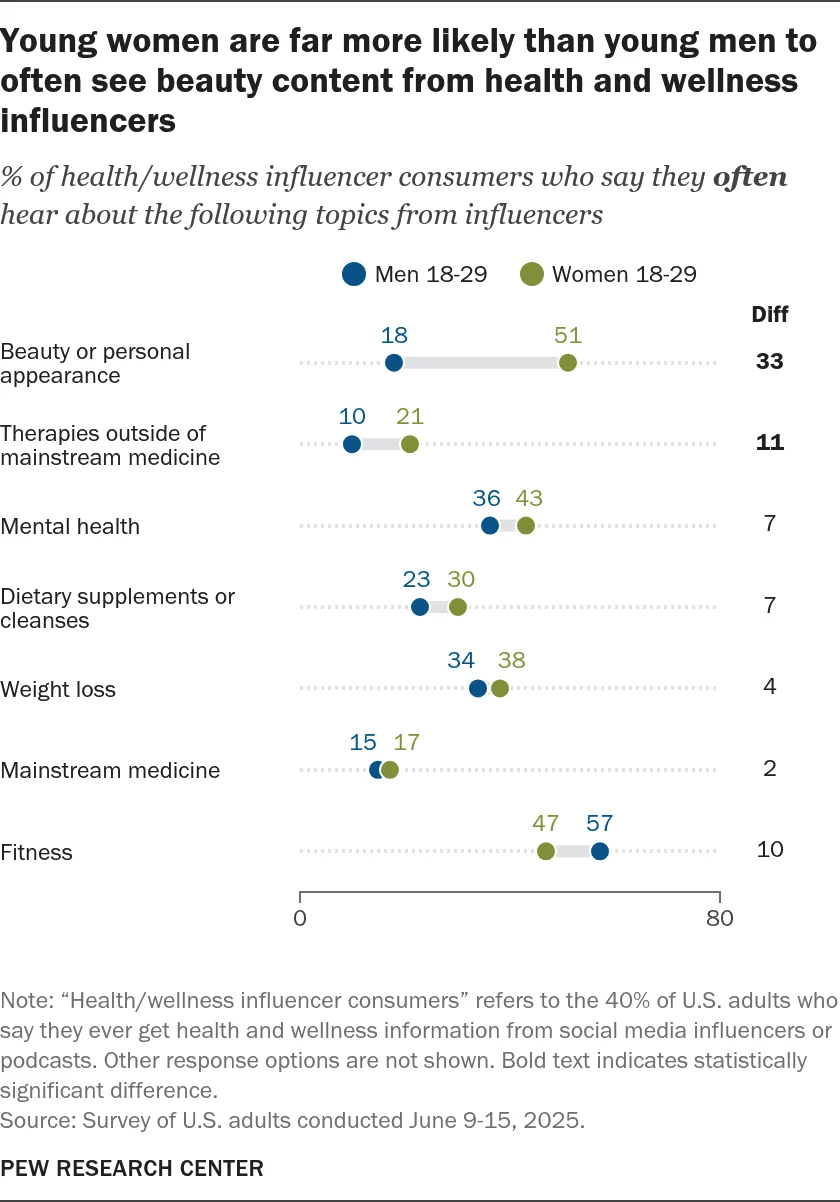
- Beauty and Personal Appearance: This remains the most significant point of divergence. Among young adults who consume influencer health content, 51% of women report frequently hearing about beauty or personal appearance, compared to just 18% of men.
- Alternative Medicine: Young women are twice as likely as young men to consume content related to "therapies outside of mainstream medicine," suggesting a higher propensity to explore holistic or non-clinical health avenues.
- Fitness and Mental Health: These areas show the most parity. Approximately half of both young men and young women report consuming fitness content, while a significant portion of both groups—over one-third—report hearing about mental health issues from these sources regularly.
This data suggests that while men and women share an interest in core health pillars like physical activity, their pathways to seeking beauty, aesthetic, and alternative health solutions are filtered through distinctly different digital algorithms.
Why Influencers? The Psychology of Digital Health
The transition from clinical care to digital influencers is driven by more than just convenience. According to the Pew study, the motivation to seek out influencers is rooted in a desire for autonomy and representation.
The Need for Change
For 51% of young women who rely on these influencers, the primary driver is a desire to make a concrete change in their lifestyle. Many feel that the medical system is reactive—focused on treating illness rather than optimizing health—whereas wellness influencers are often viewed as "lifestyle architects" who provide proactive roadmaps for daily living.

The "Relatability" Factor
A recurring theme in the research is the desire for communal validation. Young women are significantly more likely than men to state that they turn to influencers because these creators "share their background or beliefs." In a medical system that often feels impersonal or exclusionary, the parasocial relationship formed with a content creator can provide a sense of belonging that a standard doctor’s appointment cannot.
The Stigma Barrier
Perhaps most tellingly, 19% of young women report using influencers to learn about topics they are uncomfortable discussing with their own doctors. Whether due to embarrassment, fear of being judged, or a belief that a physician will dismiss their concerns, many individuals are using social media as a "pre-consultation" space to gather information before—or instead of—seeking professional care.
Implications for Public Health
The rise of the "influencer-doctor" creates a complex landscape for public health policy. On one hand, the accessibility of these platforms can help reach populations that are traditionally underserved or wary of the medical establishment. On the other, the lack of rigorous oversight for health claims made on social media poses significant risks.
The Misinformation Challenge
When wellness influencers promote supplements, cleanses, or unproven diagnostic techniques, the scale of their reach can lead to widespread misinformation. Unlike medical professionals, who are bound by ethical codes and regulatory standards, influencers are primarily incentivized by engagement, views, and affiliate revenue. The rapid spread of "wellness hacks" that lack scientific backing can, at best, be a waste of money, and at worst, lead to severe health complications.
The Role of Medical Professionals
The medical community is now facing a challenge of adaptation. If nearly 6 in 10 young women are receiving health information from online sources, physicians must find ways to bridge this gap. This may require doctors to become more "digitally literate," proactively asking patients what they are seeing on social media and providing a safe, non-judgmental environment to debunk myths or clarify health advice.

Conclusion: A New Era of Health Literacy
The Pew Research Center’s findings serve as a wake-up call for healthcare providers and public health officials. The era in which the doctor was the sole gatekeeper of health information has passed. Americans, particularly younger generations, are curating their own health ecosystems, blending traditional clinical guidance with the personalized, relatable, and constant stream of content provided by influencers.
As this trend continues, the challenge will be to ensure that the autonomy sought by these individuals does not come at the expense of their physical safety. Bridging the gap between the influence of social media and the authority of clinical medicine is no longer a luxury—it is a necessity for the future of public health.
Research for this report was directed by Aaron Smith, Director of Data Labs at the Pew Research Center. The analysis is based on two national surveys of U.S. adults conducted via the American Trends Panel in June and October 2025, involving over 10,000 respondents.