WASHINGTON — As artificial intelligence rapidly reshapes industries across the globe, healthcare has emerged as one of the most critical frontiers for technological integration. From analyzing complex radiological scans to predicting patient deterioration, machine learning models are increasingly being deployed to assist medical professionals. However, a groundbreaking nationwide survey conducted by the Pew Research Center between June 22 and June 28, 2026, reveals a nuanced landscape of public perception.
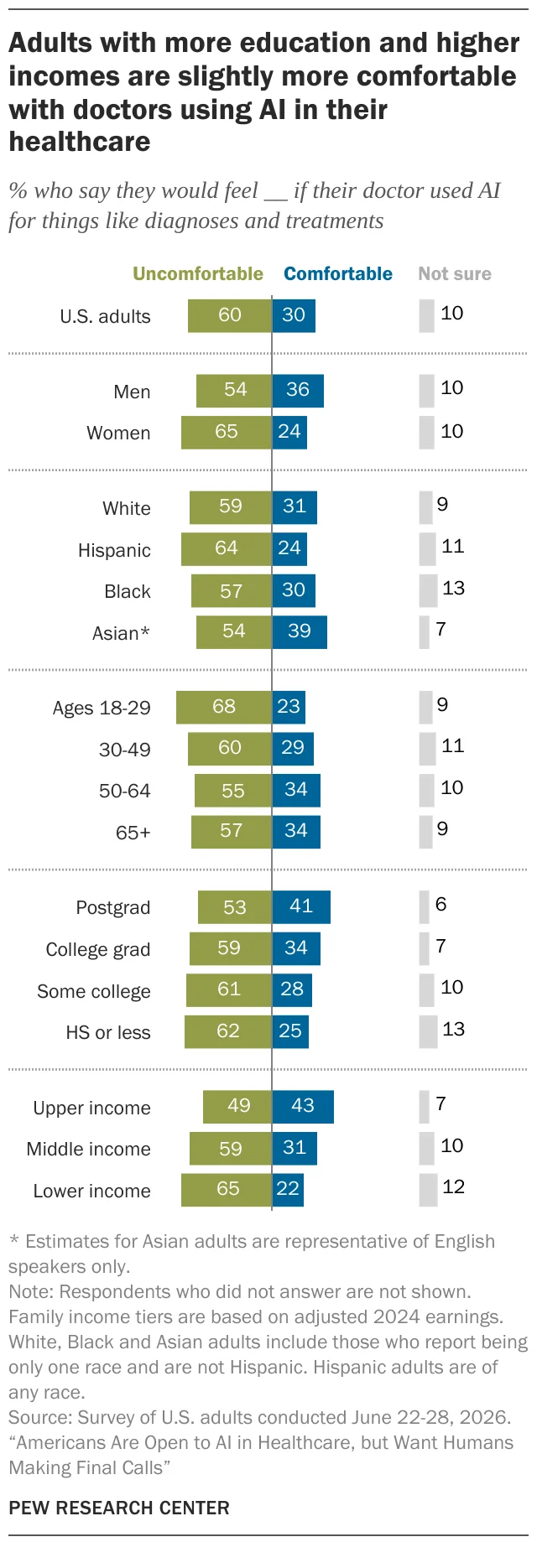
According to the data, while a substantial portion of the U.S. public remains open to the integration of artificial intelligence in medicine, comfort levels vary noticeably along socioeconomic lines. Specifically, adults with higher levels of educational attainment and greater household incomes exhibit a slightly higher degree of comfort with doctors utilizing AI for critical healthcare procedures, such as diagnostics and treatments.
Despite this measured openness, the overarching sentiment among Americans remains clear: technological innovation in medicine must remain tethered to human oversight. As captured in the Pew Research Center’s report, titled "Americans Are Open to AI in Healthcare, but Want Humans Making Final Calls," patients across all demographic strata express a strong preference for human physicians maintaining ultimate authority over medical decisions.
Main Facts
The latest survey data from the Pew Research Center sheds light on how socioeconomic status influences public trust and comfort regarding artificial intelligence in clinical settings. The core findings highlight a persistent demographic divide in technology adoption and trust:
- Socioeconomic Disparities in Comfort: Adults possessing higher educational credentials (such as postgraduate or undergraduate degrees) and those situated in upper-income brackets report a greater degree of ease when considering AI utilization in their personal medical care. Conversely, individuals with lower formal education levels and modest household incomes display higher rates of hesitation, skepticism, or discomfort.
- The Demand for Human Oversight: Across all economic and educational tiers, the public demonstrates a unified skepticism toward fully autonomous medical AI. Patients overwhelmingly expect human doctors to review, interpret, and ultimately make the final call on diagnoses and treatment plans.
- Demographic Scope: The nationally representative survey captured the perspectives of diverse U.S. adults, providing granular insights across racial and ethnic groups—including white, Black, Hispanic, and English-speaking Asian adults—while accounting for family income tiers based on adjusted 2024 earnings.
- The Diagnostic Frontier: The survey specifically targeted public attitudes toward AI applications that directly impact patient outcomes, such as identifying anomalies in medical imaging, streamlining administrative diagnoses, and formulating personalized treatment regimens.
Chronology of AI Integration in Healthcare
To understand why public comfort levels are stratified by education and income, it is essential to trace the rapid evolution of artificial intelligence in the medical sector over the past decade. The journey from theoretical computer science to bedside application has been swift, often outpacing public education and policy frameworks.
2015–2018: The Era of Algorithmic Proof-of-Concept
During the mid-2010s, artificial intelligence in healthcare was largely confined to academic medical centers and specialized research labs. Early machine learning models demonstrated remarkable proficiency in pattern recognition, successfully identifying cancerous lesions in dermatological images and mammograms with accuracy rates rivaling human specialists. However, these tools were purely experimental, and public awareness remained minimal.
2019–2021: Administrative Digitization and Pandemic Acceleration
As electronic health records (EHRs) became ubiquitous, hospitals began adopting AI-driven administrative tools to streamline billing, optimize scheduling, and manage hospital bed capacity. The COVID-19 pandemic further accelerated the reliance on digital health infrastructure. Telehealth surged, and automated triage algorithms were deployed nationwide to manage overwhelmed emergency departments. For the average consumer, AI transitioned from a futuristic sci-fi concept to a behind-the-scenes reality of modern hospital administration.
2022–2024: Generative AI and Consumer-Facing Tools
The public launch of advanced generative AI models in late 2022 fundamentally altered the public consciousness. Patients began utilizing consumer-grade language models to research symptoms, interpret lab results, and draft questions for their doctors. At the same time, health tech companies began rolling out ambient listening tools—AI scribes designed to record patient-doctor interactions and automatically generate clinical notes.
2025–June 2026: Clinical Integration and Public Hesitation
By 2025, artificial intelligence was actively embedded in clinical workflows, assisting physicians with complex diagnostics and personalized medicine. However, as the technology moved closer to direct patient care, ethical concerns surrounding algorithmic bias, data privacy, and accountability came to the forefront. This tension culminated in the late-June 2026 Pew Research Center survey, which sought to measure precisely how comfortable everyday Americans were with these clinical advancements.
Supporting Data and Demographic Analysis
The Pew Research Center survey data provides a detailed breakdown of how education and income influence patient attitudes. While the general populace displays a cautious optimism, a closer examination of the data reveals distinct gradients of comfort.
The Education Gradient
Education emerges as one of the most reliable predictors of technological trust in clinical environments. Adults with a college degree or higher education are consistently more likely to express comfort with AI-driven diagnostics compared to those with a high school education or less.
- Familiarity with Complex Systems: Highly educated individuals are frequently exposed to complex data systems, algorithmic modeling, and emerging technologies in their professional lives, which may mitigate the fear of the unknown.
- Scientific Literacy: Greater exposure to STEM education often correlates with a deeper understanding of probabilistic models, helping patients recognize that AI tools are designed to assist—rather than entirely replace—human clinical judgment.
The Income Gradient
Parallel to educational attainment, family income tiers—calculated using adjusted 2024 earnings—demonstrate that higher-income earners are slightly more amenable to AI in their healthcare.

- Access to Premium Care: Higher-income individuals are more likely to receive care at premier academic medical centers and advanced health systems that actively invest in cutting-edge technologies. Consequently, these patients may encounter AI integrations as a standard, premium component of modern medicine.
- Resource Security: Individuals with higher socioeconomic status often possess greater resources to seek second opinions or alternative care if they encounter algorithmic errors, reducing the perceived risk of technological failure.
Intersectional Demographics
The survey data also captures perspectives across racial and ethnic lines, noting that estimates for Asian adults are representative of English-speakers only, while white, Black, and Hispanic respondents reflect broader community viewpoints. Across all these groups, the common denominator remains the demand for human accountability. No demographic cohort indicated a willingness to trade human empathy and clinical intuition for fully automated medical decision-making.
Official Responses and Stakeholder Perspectives
The release of the Pew Research Center’s findings has prompted widespread discussion among medical associations, artificial intelligence developers, policymakers, and patient advocacy groups.
The Medical Community: Embracing Caution and Collaboration
Major medical societies, including the American Medical Association (AMA), have consistently emphasized that artificial intelligence must serve as an augmentative tool rather than a replacement for physician expertise.
"Artificial intelligence holds immense potential to reduce administrative burnout, enhance diagnostic precision, and personalize patient care," noted a representative from a leading national medical coalition. "However, our primary obligation is to the patient-physician relationship. The data confirms what we see in practice: patients want efficiency, but they demand empathy, accountability, and human judgment at the center of their care."
Technology Developers: Addressing the Trust Gap
Health tech developers and software engineers acknowledge the socioeconomic divide highlighted by the survey. Industry leaders stress the urgent need for transparent communication and patient-facing education campaigns to demystify how algorithms work.
"If higher-income and more educated populations are more comfortable with AI, it is partly an issue of access and transparency," stated the chief technology officer of a prominent health-AI firm. "We must ensure that AI tools are deployed equitably, that patients understand how their data is protected, and that the benefits of these technologies are communicated clearly to every community, regardless of socioeconomic background."
Policy Makers and Regulators
Federal regulators, including the U.S. Food and Drug Administration (FDA) and the Department of Health and Human Services (HHS), have been under increasing pressure to establish robust governance frameworks for medical AI. Policymakers point to the Pew survey as a critical reminder that public trust must be earned through rigorous validation, protection against algorithmic bias, and stringent safety standards.
Implications for the Future of Healthcare
The insights gathered from the June 2026 survey carry profound implications for the future trajectory of medicine, health equity, and healthcare policy.
1. Navigating the Tech-Driven Health Disparity
As AI becomes more deeply entrenched in clinical practice, healthcare systems must guard against widening existing health inequities. If lower-income and less-educated patients harbor greater skepticism toward AI-assisted diagnostics, they may actively resist recommended treatments or seek out care models that exclude advanced technologies. Health providers must bridge this gap through proactive patient education, ensuring that the benefits of AI are distributed equitably across all demographic segments.
2. Preserving the Human Element in Medicine
Perhaps the most definitive takeaway from the data is the absolute centrality of the human physician. No matter how advanced machine learning models become in detecting patterns or calculating risk scores, they lack the emotional intelligence, ethical reasoning, and bedside manner that patients require during vulnerable health crises. Healthcare institutions must design workflows that use AI to handle background data processing while freeing up physicians to spend more meaningful, high-touch time with their patients.
3. Ethical Governance and Algorithmic Transparency
To build universal trust—crossing boundaries of education and income—health tech developers and medical providers must prioritize transparency. Patients deserve to know when and how artificial intelligence is being utilized in their diagnostic workups and treatment planning. Clear disclosure policies, rigorous clinical trials proving algorithmic safety, and robust mechanisms for human override will be foundational requirements for the successful adoption of AI in medicine.
Conclusion
The Pew Research Center’s findings from June 2026 provide a vital checkpoint for the medical industry. While adults with higher education and income levels show a slight edge in comfort regarding AI-assisted healthcare, the broader American public shares a unified consensus: technology is welcome in the examination room, provided it remains firmly under the control of human hands. As medicine continues its digital transformation, the ultimate success of artificial intelligence will be measured not just by its computational accuracy, but by its ability to preserve trust, equity, and the irreplaceable human connection at the heart of healing.