
By Nadica Naceva
Published by Influencer Marketing Hub
Main Facts: The Cross-Border Payout Paradox
Scaling a marketing campaign from a single domestic market to a multi-country operation is often treated as a purely creative milestone. Brands map out localized content themes, secure translation services for captions, and celebrate global reach. Yet, behind the polished grid posts and viral video views lies a vastly different reality: administrative gridlock.
Consider a mid-sized skincare brand wrapping up a successful autumn campaign. The metrics look stellar. Twenty-two creators across six distinct countries—the United States, the United Kingdom, Brazil, the Philippines, Poland, and South Africa—have delivered content on time, hit their briefs, and generated significant engagement. The marketing lead has already moved on to strategizing the next product launch.
Then, finance asks a deceptively simple question: Who gets paid this week, in what currency, against what paperwork, and who is missing a signed form?
Suddenly, the cracks in the operational foundation appear. Three creators never returned their tax documentation. Two are owed partial payments because a video had to be reshot due to a minor product rebrand. Another creator has requested funds be wired to a completely different banking account than the one on file.
None of these hurdles are anomalous; they are standard operating friction for brands expanding internationally. Some enterprises attempt to navigate this maze using ad-hoc wire transfers and manual oversight, while others route payments through specialized contractor-payment gateways like 4dev.com. However, as influencer marketing matures into a truly borderless medium, the operational mechanics of paying talent can no longer be treated as an afterthought for the finance department.
Chronology: The Lifecycle of a Global Creator Campaign
Understanding where campaigns break down requires tracing the chronological path of a creator partnership from inception to payout.
Phase 1: The Brief and Alignment
The relationship begins not with a formal financial contract, but with creative alignment. A standard influencer brief outlines the visual expectations, posting schedules, and core messaging. However, experienced brand managers know that a brief is not legally binding. It must be paired with an ironclad agreement covering four non-negotiable pillars: deliverables, usage rights, exclusivity windows, and strict payment terms.
Phase 2: The Onboarding and Compliance Bottleneck
Once the agreement is signed, compliance enters the spotlight. Before a single dollar or local currency equivalent changes hands, geographic-specific tax documentation must be secured. For US-based brands, this means collecting IRS Form W-9 for domestic talent or Form W-8BEN for international contractors. Collecting these forms after a payment has been dispatched is a compliance nightmare, often resulting in retroactive backup withholding or frantic attempts to track down overseas creators who have already delivered their content and moved on.
Phase 3: Content Go-Live and Adjustments
Content goes live, metrics are audited, and performance is verified. This is also when edge cases emerge: reshoots, delayed postings, currency preference changes, and localized compliance adjustments.
Phase 4: Payout Day and Financial Reconciliation
The campaign concludes with the financial settlement. In a domestic campaign, this involves a batch payroll run or standard accounts payable process. In a cross-border campaign involving dozens of independent contractors across multiple time zones, payout day often morphs into a high-stress administrative puzzle involving multiple banking corridors, fluctuating exchange rates, and manual verification sheets.
Supporting Data: Decoding the True Cost of Cross-Border Payments
When money finally moves across borders, hidden costs emerge that rarely appear on initial invoices. Brands frequently assume that paying cross-border talent is as straightforward as initiating an international wire transfer through a traditional banking partner. The data tells a different story.
The Anatomy of Cross-Border Costs
According to global financial data, the average total cost of a business cross-border payment hovers around 1.6% of the total amount sent. Crucially, roughly seven-eighths of that total—approximately 1.4 percentage points—is not a transparent, itemized transaction fee. Instead, it is the exchange-rate margin baked into the currency conversion.
While visible wire fees tend to shrink as payment sizes scale upward, the exchange-rate margin remains stubborn, holding steady in the 0.7% to 1.1% range regardless of volume. Furthermore, these margins vary wildly by region:
- Europe: Cross-border payment friction and costs remain relatively low, tracking closer to 1%.
- Sub-Saharan Africa and Parts of Latin America: Costs can surge up to 3.5%, driven by regional banking complexities and currency controls.
By strict international financial standards, any spread over the interbank exchange rate constitutes a cost, regardless of whether it is itemized as a fee on an invoice. Platforms and payment routes that obscure their exchange rates fail the test of true financial transparency.
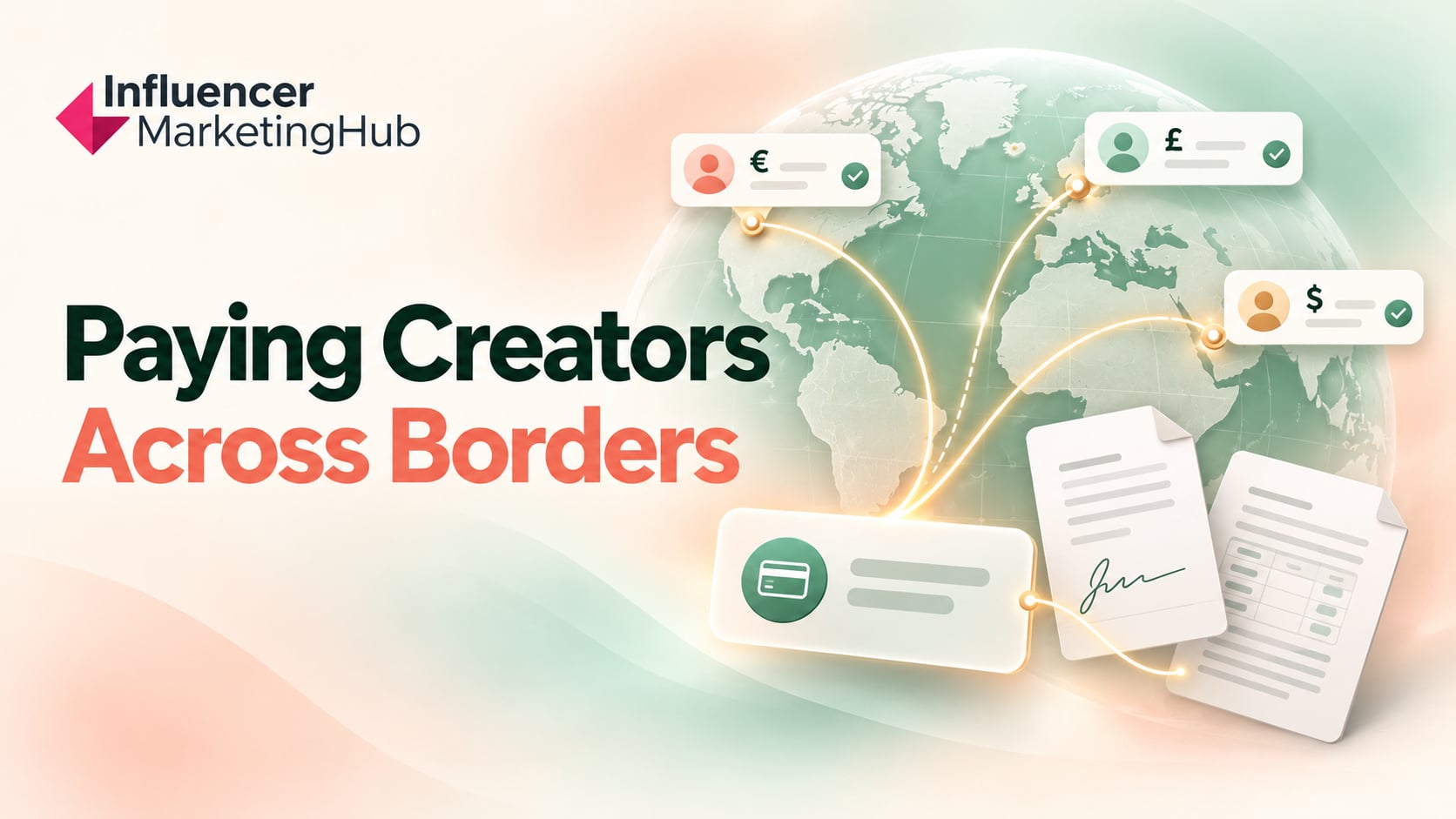
For creators, these hidden costs manifest as a "free" transfer that actually results in a diminished payout once the funds land in their local bank account, eroded by unfavorable conversion rates rather than explicit deductions.
Official Perspectives: Navigating the Independent Contractor Classification
To understand why creator payments are so legally complex, one must look at how labor authorities view the relationship between brands and influencers. In almost every legal jurisdiction, an influencer operating on a paid campaign is classified as an independent contractor, not an employee.
The Substance-Over-Form Principle
Labor and tax authorities across the globe consistently apply a "substance over form" doctrine. It matters very little what a brand’s contract is titled; enforcement agencies look at the actual operational reality of the working relationship.
Classification tests vary slightly by country (such as the IRS guidelines in the US, IR35 regulations in the UK, or similar worker-status tests in the EU and Latin America), but they universally hinge on a core set of questions:
- Control: Who dictates the working hours, methods, and creative execution?
- Tools and Equipment: Whose equipment, software, and platforms are utilized to produce the work?
- Integration: How deeply embedded is the creator within the brand’s core business operations?
- Exclusivity and Economic Dependence: Is the creator restricted from working with competitors, and do they rely on this single brand for the majority of their livelihood?
- Permanence: Is the relationship ongoing and open-ended, or project-specific?
Legal Implications for Brands
When a brand oversteps these boundaries—such as dictating strict minute-by-minute posting schedules, demanding the exclusive use of brand-provided filming equipment, or treating a creator like a full-time staff member—they inadvertently build a legal case for worker misclassification.
For the brand, maintaining proper contractor status requires three disciplined practices:
- Autonomy in Execution: Providing creative briefs that outline goals and brand safety guardrails rather than dictating step-by-step labor processes.
- Arm’s Length Financials: Treating compensation strictly as project-based B2B transactions rather than recurring payroll.
- Strict Tax Compliance: Ensuring proper collection of regional tax documentation (such as W-9 and W-8BEN forms) to substantiate the independent contractor status to auditing authorities.
Implications: Scaling Without Spreadsheets
As influencer marketing budgets expand and brands routinely activate rosters of 50 to 200+ creators across a dozen or more countries per campaign, traditional administrative methods collapse under their own weight.
Managing fifty international creators via a manual spreadsheet is no longer just a chaotic alternative; it is an active financial and legal liability.
The Spreadsheet Liability Trap
At scale, manual tracking introduces critical failure points:
- Data Security Risks: Storing sensitive banking details, tax identification numbers, and personal identification documents in unsecured spreadsheets violates data privacy regulations (such as GDPR in Europe).
- Version Control Failures: Multiple team members updating payment statuses lead to double payments, missed invoices, and strained creator relationships.
- Compliance Blind Spots: Losing track of which creators have submitted valid tax documentation exposes the brand to severe auditing penalties.
- Currency and Banking Errors: Manually inputting international routing codes and IBAN numbers increases the likelihood of rejected wires, costly recall fees, and delayed campaign reporting.
The Shift Toward Infrastructure Platforms
To solve this structural friction, leading brands and global agencies are abandoning the quarterly ritual of rebuilding payment processes from scratch. Instead, they are integrating specialized international contractor-payment platforms—such as 4dev.com—into their marketing tech stacks.
On these platforms, the operational workflow is decentralized and automated:
- Self-Service Onboarding: Each creator completes their own profile onboarding, securely submitting their engagement agreements, banking details, and required regional tax documents directly into an encrypted environment.
- Master Agreement Structures: Brands sign a single overarching agreement covering the roster, while automated digital mechanisms handle individual compliance sign-offs.
- Real-Time Readiness Tracking: Marketing and finance teams gain a unified dashboard view showing exactly which creators are compliant, whose documents are pending, and whose payouts are cleared for release.
While the brand retains absolute control over creative direction, messaging strategies, and campaign briefs, the technical infrastructure platform absorbs the heavy lifting of document flows, compliance checks, and cross-border payout mechanics.
Five Critical Mistakes Brands Make with Creator Payouts
To safeguard campaign ROI and maintain stellar relationships with top-tier talent, marketing and finance leaders must actively avoid these five perennial pitfalls:
- Treating Tax Documentation as an Aftermath: Disbursing funds before collecting a valid W-9, W-8BEN, or local equivalent tax form, forcing frantic retroactive corrections or absorbing avoidable withholding penalties.
- Ignoring the Hidden Costs of Currency Conversion: Budgeting solely for visible wire transfer fees while ignoring the significant erosion caused by non-transparent exchange-rate margins.
- Misclassifying Contractors as Employees: Exerting excessive operational control over creators during content production, thereby risking severe legal penalties for worker misclassification.
- Relying on Manual Spreadsheets at Scale: Using vulnerable, decentralized spreadsheets to track banking details, compliance forms, and international payouts for large creator rosters.
- Failing to Align Payment Terms with Creator Expectations: Imposing rigid, overly delayed corporate payment terms (such as Net-90) on independent creators who rely on predictable, rapid cash flow to sustain their businesses.
Conclusion
Global influencer marketing has evolved past the point where manual finance operations can keep pace with creative ambitions. Brands that treat operational compliance, transparent currency routing, and streamlined contractor onboarding as core components of their strategy will build lasting, trusted relationships with global talent. Those that treat payouts as an afterthought will continue to find themselves scrambling on Friday afternoons, trapped in a web of spreadsheet errors and cross-border friction.