
By Nadica Naceva
Published by Influencer Marketing Hub
Main Facts: The Hidden Complexity of Global Influencer Payouts
The lifecycle of an influencer marketing campaign usually follows a predictable, glamorous trajectory. A brand launches a product, partners with content creators across the globe, monitors the rollout of high-performing videos, and celebrates spikes in engagement.
However, once the campaign ends, a far less glamorous reality sets in: the finance department steps in with a cascade of complex questions. Who gets paid this week? In what currency? Against what paperwork? And crucially, who is missing a signed tax form?
When a brand scales from a single-market influencer program to a multi-country operation, the administrative burden multiplies exponentially. Consider a typical mid-sized campaign: a skincare brand closes out an autumn initiative working with 22 creators spread across six distinct jurisdictions—the United States, the United Kingdom, Brazil, the Philippines, Poland, and South Africa.
While the marketing team has successfully moved on to the next product launch, finance is left wrestling with international banking hurdles. Three creators have failed to submit mandatory tax documentation. Two are owed partial payments because a video had to be reshot due to a last-minute brief change. Another creator has requested funds be routed to an entirely different bank account than the one originally on file.
None of these hurdles are anomalous; they are standard operating friction for modern cross-border creator economies. Brands generally respond in one of two ways: they either route their operations through specialized international contractor-payment platforms like 4dev.com, or they attempt to reinvent a bespoke, manual spreadsheet process from scratch every single quarter—risking compliance errors, delayed payments, and strained creator relationships.
Chronology: From Brief to Balance Sheet
Understanding how a global influencer campaign goes from creative concept to cleared wire transfer requires tracing the operational timeline step by step.
Phase 1: The Campaign Brief and Contracting
Long before a single piece of content is filmed, the legal foundation must be established. A brief is not a legally binding contract. A robust influencer agreement must explicitly outline four non-negotiable elements:
- Deliverables: Exactly what content is expected (e.g., two TikTok videos, one Instagram Reel), including timelines, posting schedules, and content guidelines.
- Usage Rights: Where, how long, and for what purpose the brand can repurpose the creator’s content (e.g., whitelisting, paid social ads, website embedding).
- Exclusivity: Whether the creator is restricted from working with competing brands within a specific timeframe and geographic radius.
- Payment Terms: Net-30, milestone-based, or upon completion, alongside clear invoicing instructions.
Phase 2: Creator Classification and Compliance
Once the agreement is signed, the legal status of the creator must be acknowledged. In almost every jurisdiction, an influencer operating on a paid campaign is classified as an independent contractor, not an employee.
Classification tests vary worldwide, but tax and labor authorities generally evaluate the same core criteria:
- Who controls the working hours and methods?
- Whose equipment and digital platforms are utilized?
- How integrated is the individual into the brand’s day-to-day operations?
- Is the arrangement exclusive, and what is the degree of economic dependency?
Authorities consistently weigh the substantive reality of the working relationship over semantic definitions in a contract. If a brand dictates rigorous posting hours, mandates specific equipment ownership, or treats a creator like an internal marketing employee, labor boards may reclassify them—exposing the company to retroactive tax liabilities and penalties.
Phase 3: Tax Documentation Collection
Before any funds are disbursed, compliance requires securing the correct tax paperwork. For US-based brands, this means collecting either a W-9 (for domestic US-based creators) or a W-8BEN (for international creators).
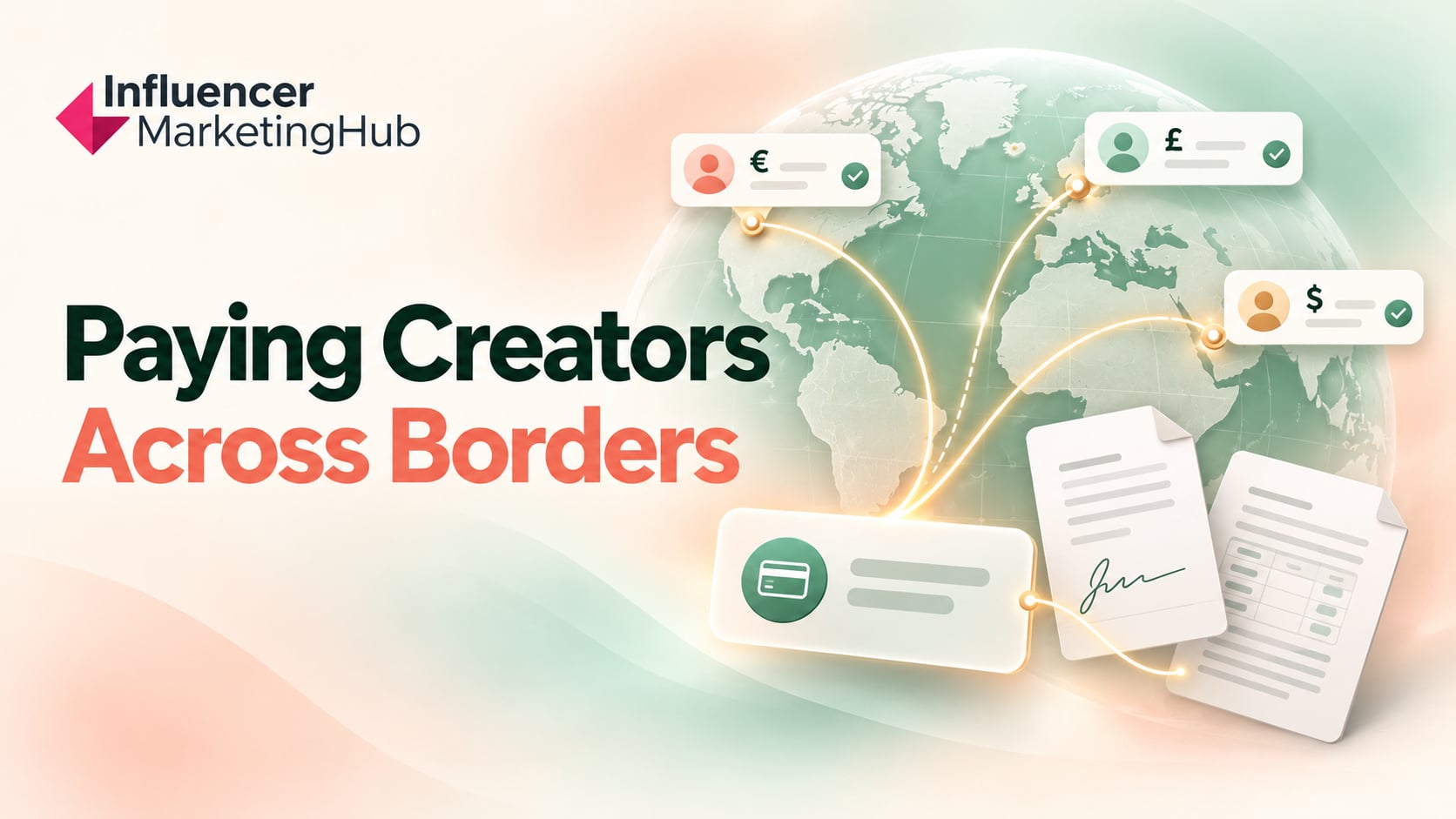
This is not administrative cleanup to be handled post-payment. Brands that disburse funds prior to collecting these documents risk facing mandatory backup withholding retroactively or fruitlessly chasing signatures across international borders once the capital has already left their accounts.
Phase 4: Payout Execution and Cross-Border Transfers
With contracts signed and tax forms verified, the funds must cross international boundaries. Brands typically deploy three primary routing methods:
- Traditional Wire Transfers (SWIFT): Reliable for large sums, but notoriously slow and plagued by high intermediary bank fees.
- Global Mass-Payout Platforms: Services designed specifically to handle multi-currency, multi-recipient disbursements efficiently.
- Local E-Wallets and Regional Payout Tools: Often favored by creators in emerging markets due to speed and local currency accessibility.
Supporting Data: The True Cost of Cross-Border Payments
Many brands mistakenly assume that the visible transaction fee charged by a financial provider represents the entire cost of a cross-border payout. Financial data paints a starkly different picture.
According to global payment benchmarks, the average total cost of a business cross-border payment hovers around 1.6% of the total amount sent. Crucially, roughly seven-eighths of that total cost—approximately 1.4 percentage points—comes from the exchange-rate margin baked into the currency conversion, rather than a transparent line-item fee.
- Fee Compression vs. Margin Persistence: While visible transaction fees tend to shrink as payment sizes scale up, the exchange-rate margin remains remarkably rigid, holding steady in the 0.7% to 1.1% range regardless of transfer volume.
- Regional Disparities: Currency conversion costs fluctuate wildly by geography. Cross-border transaction costs run closer to 1% within Europe, but can skyrocket to 3.5% or higher in parts of sub-Saharan Africa due to local currency controls and banking infrastructure limitations.
- Transparency Standards: Under international banking conventions, any spread over the interbank rate constitutes an explicit cost—whether it appears on an invoice as a fee or is quietly absorbed into a bloated exchange rate. Payment rails that refuse to disclose their exact exchange-rate margins fail basic transparency tests.
From the creator’s perspective, speed and predictability trump brand-side administrative savings. A transfer marketed by a brand as "zero-fee" often carries hidden costs for the recipient through an unfavorable conversion rate, eroding trust and discouraging long-term partnerships.
Official Responses and Industry Perspectives
As influencer marketing matures into a multi-billion-dollar global industry, regulatory bodies and operational experts are urging brands to modernize their financial infrastructure.
Labor attorneys and tax specialists emphasize that multinational brands can no longer treat creator payouts as an afterthought handled by local marketing coordinators. With tax authorities in the US, EU, and Latin America increasing audits on digital economy participants, cross-border compliance has transformed from a back-office chore into a board-level risk management priority.
Financial technology leaders note that manual processing is the single greatest point of failure for expanding creator programs. According to platform integration specialists, scaling past 50 creators across multiple continents using spreadsheets and ad-hoc bank wires introduces unsustainable operational debt.
Industry analysts point out that modern platforms like 4dev.com have fundamentally altered this dynamic. By decentralizing the onboarding process—allowing creators to independently input their bank details, upload tax documentation, and verify agreement terms through a secure portal—brands can eliminate administrative bottlenecks. Rather than managing dozens of fragmented email chains, financial leads gain a centralized, real-time dashboard tracking the compliance readiness of every single roster member.
Implications: How to Avoid the Top Five Creator Payout Mistakes
For brands looking to scale their global creator networks sustainably, avoiding systemic operational traps is critical. Industry data highlights five major mistakes brands repeatedly make when handling creator payouts:
- Treating Tax Forms as Post-Payment Homework: Paying creators before collecting W-9 or W-8BEN documentation creates massive tax exposure, forcing companies into retroactive withholding nightmares.
- Relying on Spreadsheets at Scale: Manually tracking 50+ creators across multiple currencies in Excel inevitably leads to version control errors, missed deadlines, and duplicate or failed payments.
- Ignoring Hidden Foreign Exchange (FX) Margins: Focusing solely on wire transfer fees while ignoring inflated exchange-rate markups results in unexpected budget overruns and lower net payouts for creators.
- Misclassifying Contractors as Employees: Exerting excessive control over a creator’s daily schedule, equipment, or exclusivity without proper legal frameworks risks severe regulatory reclassification penalties.
- Failing to Standardize Global Agreements: Utilizing fragmented, ad-hoc contracts across different countries leaves brands vulnerable to local compliance failures, unclear usage rights, and protracted legal disputes.
Conclusion
As global influencer marketing continues its rapid expansion, the brands that succeed will be those that treat creator operations with the same professional rigor as traditional supply chain logistics. By abandoning manual spreadsheets, prioritizing transparent cross-border payment rails, and utilizing dedicated platforms like 4dev.com, marketing and finance teams can transform payout day from a chaotic weekly scramble into a seamless, automated competitive advantage.