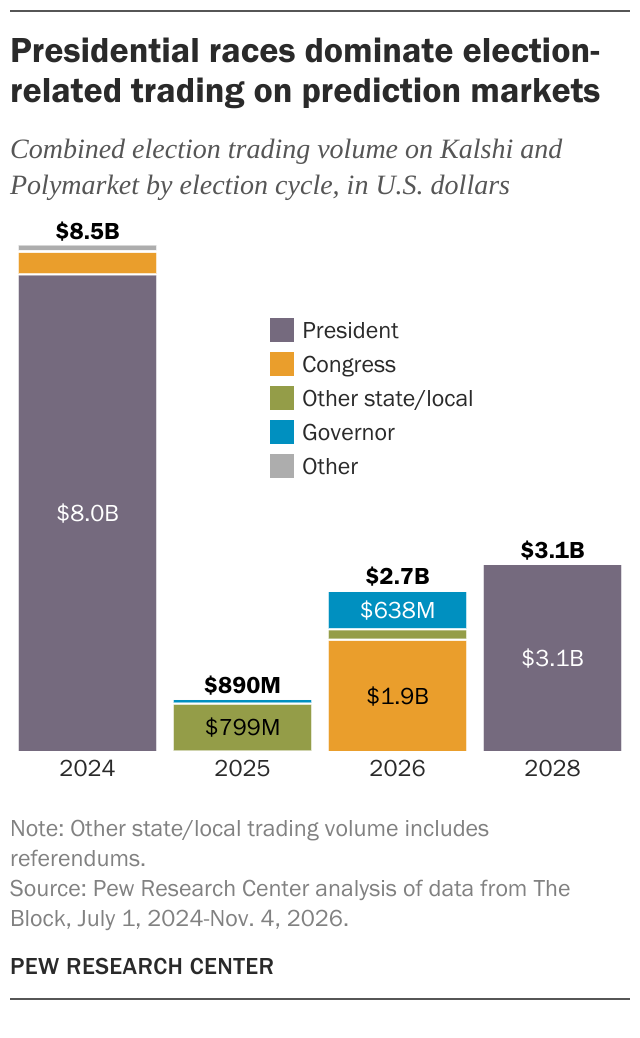
As the dust settles on the 2026 United States midterm elections, a new, controversial barometer of public sentiment has emerged: the prediction market. According to a comprehensive analysis from the Pew Research Center, leveraging data from digital assets intelligence firm The Block, the 2026 midterms generated a staggering $2.7 billion in trading volume across the industry’s two dominant platforms, Kalshi and Polymarket.
While this figure represents a significant cooling off compared to the white-hot $8.5 billion traded during the 2024 presidential cycle, it underscores a permanent shift in how political forecasting is conducted. Prediction markets—once the niche domain of economists and political scientists—have evolved into high-stakes financial arenas where participants wager real capital on the outcomes of democratic processes.
The State of the Market: A $2.7 Billion Midterm
The 2026 midterm cycle was marked by a shift in focus from the singular, high-octane spectacle of a presidential contest to a granular, state-by-state assessment of legislative control.
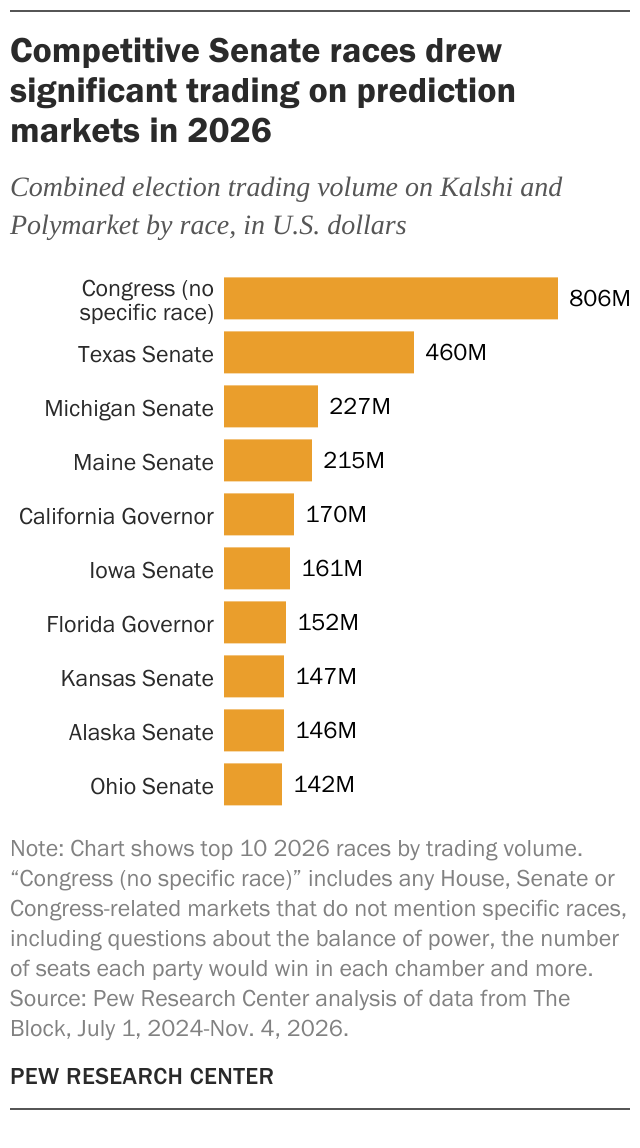
In 2024, the presidential race acted as a black hole for capital, pulling in the vast majority of available liquidity. In contrast, 2026 saw a diversification of interest. Roughly 70% of the $2.7 billion in trading volume was concentrated on congressional control—specifically the battle for seats in the House and Senate—while nearly a quarter of all funds were directed toward gubernatorial races.
This shift suggests that prediction markets are becoming more sophisticated, moving beyond "horse-race" journalism to become tools for analyzing the balance of power within the legislative branch. However, the sheer volume of contracts available ballooned significantly. Users traded on approximately 34,000 distinct election-related markets in 2026, compared to just 2,300 in 2024. This hyper-fragmentation reflects a growing appetite among bettors to capitalize on hyper-local outcomes, from specific Senate seats in Texas and Michigan to individual local referendums.
Chronology: From Presidential Spectacle to Midterm Granularity
To understand the current landscape, one must look at the trajectory of these platforms since mid-2024.
- 2024: The Presidential Peak: The market was defined by a single, massive narrative. The total volume reached $8.5 billion, almost entirely dominated by the binary outcome of the presidential election.
- 2025: The Off-Cycle Anomaly: Trading volume dipped significantly to $889 million. However, the period proved that these markets could sustain interest even during "quiet" election years. The New York City mayoral election was the clear standout, accounting for three-quarters of all political trading volume that year.
- 2026: The Congressional Surge: The midterms brought a resurgence of activity, with $2.7 billion flowing into thousands of specific congressional and state-level markets.
- 2028: The Pre-emptive Future: Even as the 2026 midterms concluded, the 2028 presidential race had already begun to exert a gravitational pull. Markets regarding the 2028 nomination and general election have already seen $3 billion in volume, signaling that prediction markets are increasingly "future-looking" assets.
Supporting Data: Where the Money Flows
The data reveals a stark divide between the two primary platforms, Kalshi and Polymarket. While both have touted their "event contracts" as superior forecasting tools, their user bases and focus areas differ.
Polymarket, which has gained significant traction as a global hub for speculative activity, has seen a massive $31 billion in total political trading volume since 2024, with only about 35% of that specifically tied to U.S. elections. In contrast, Kalshi has positioned itself as a more domestic-focused entity; of its $5.7 billion in total political trading, a significant 72% was dedicated to U.S. election outcomes.
Furthermore, the data highlights a "thin market" phenomenon. While there were 34,000 markets available in 2026, liquidity was not distributed evenly. Nearly half of all markets saw less than $1,000 in volume, making them susceptible to manipulation by "whales" or small groups of traders who can move the needle on the odds with relatively little capital. Conversely, a elite tier of 1,087 markets—roughly 3% of the total—captured 90% of all trading volume.
The Legal and Ethical Labyrinth
The proliferation of these markets has not occurred without pushback. Critics, ranging from election officials to policy watchdogs, have raised alarms regarding the potential for these platforms to undermine democratic integrity.
The most prominent concerns involve "insider trading" and market manipulation. In an era where news moves at the speed of an algorithm, the risk that participants might use non-public information—or attempt to create a self-fulfilling prophecy by moving the odds in favor of a specific candidate—is a significant regulatory hurdle.
Perhaps most striking is the geographical tension: 42% of the $2.7 billion traded in 2026 occurred in states where election betting is restricted or illegal. Despite these bans, residents in these jurisdictions have found ways to engage with the platforms. Some state authorities have explicitly warned their constituents that participating in these contracts could be a violation of local gambling statutes, yet the platforms continue to operate under a gray area of financial regulation, as they are often not classified as traditional gambling operators.
Implications: The "Prediction Economy" and Its Future
What does the rise of a multi-billion-dollar prediction market mean for the future of democracy?
1. The Erosion of Polling Authority
For decades, professional pollsters and media outlets were the primary arbiters of election expectations. Prediction markets have challenged this monopoly. Because these platforms use real money as a "skin in the game" mechanism, proponents argue they are more accurate than surveys, which suffer from non-response bias and sampling errors. News organizations have increasingly begun to cite market odds alongside traditional polling, effectively legitimizing betting as a form of expert analysis.
2. Market Manipulation vs. Market Wisdom
The "wisdom of the crowd" theory is the bedrock of these platforms. However, the 2026 data shows that this "crowd" is often thin. When 90% of volume is concentrated in just 3% of markets, the "wisdom" being priced in may actually be the result of a few high-net-worth individuals or institutional actors rather than a broad, diverse public consensus. This raises the risk that prediction markets could become vectors for disinformation rather than truth.
3. Regulatory Inevitability
The current "wild west" nature of these markets is unlikely to persist. With billions of dollars at stake, the Commodity Futures Trading Commission (CFTC) and other federal bodies are under increasing pressure to establish a cohesive regulatory framework. The question is whether these markets should be treated as legitimate financial hedges or as prohibited gambling operations.
4. The Gamification of Civic Duty
Perhaps the most profound implication is cultural. By turning the outcome of a congressional race into a liquid asset, these platforms contribute to the gamification of the political process. For the average user, the distinction between supporting a candidate’s platform and betting on their victory becomes blurred. While platforms like Kalshi argue that this increases voter engagement and provides better information, critics argue it commodifies the most sacred aspect of a republic—the vote.
Conclusion
The 2026 midterm election cycle has solidified prediction markets as a permanent fixture of the American political landscape. They are no longer mere experiments; they are massive, liquid, and highly influential repositories of capital that mirror, and sometimes shape, the trajectory of our elections.
As we look toward the 2028 presidential cycle, the trajectory is clear: volume will likely continue to climb, and the integration of these markets into mainstream political discourse will deepen. Whether this evolution serves to clarify our democratic choices or complicates them through the lenses of speculation and manipulation remains the defining question of this new, digital-first political era.
The data provided by the Pew Research Center serves as a vital reminder that while the technology of betting on democracy has advanced, the fundamental risks to its integrity remain as present as ever. As these markets continue to grow, the need for transparency, oversight, and a clear-eyed understanding of their impact on the electorate has never been more urgent.