By Sara Guaglione | Updated November 20, 2026
OpenAI has quietly revised the terms of service for its newly launched ChatGPT Business Hub following sharp criticism from legal experts. The original agreement contained broad liability waivers that industry lawyers warned could strip businesses—particularly digital publishers—of their fundamental right to pursue historical copyright infringement claims and other legal actions against the artificial intelligence giant.
The controversy highlights a rapidly escalating flashpoint in the digital media ecosystem: the uneasy, high-stakes relationship between multi-billion-dollar AI developers and the publishers whose intellectual property underpins much of their technological capability.
Main Facts
The core of the controversy centers on OpenAI’s rollout of the ChatGPT Business Hub, a platform designed to give verified organizations direct, first-party analytics regarding how their websites and brands appear within ChatGPT. For media outlets, brands, and enterprises, the dashboard offers unprecedented visibility into metrics that were previously opaque, tracking profile views, referral clicks, specific mentions, and discovery topics.
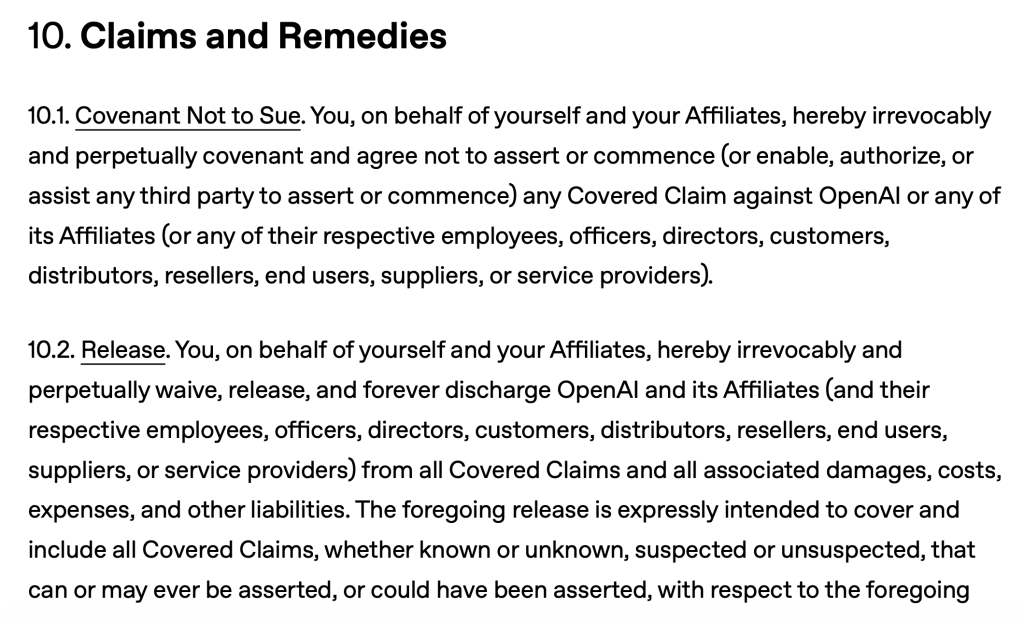
However, the legal framework accompanying the feature sparked immediate alarm. Prior to its swift revision on November 18, Section 10 of the Business Hub’s terms of service appeared to mandate a broad release of claims. Legal professionals analyzing the document discovered that businesses accepting the terms might inadvertently be signing away their rights to sue OpenAI over past grievances—including intellectual property theft, unauthorized data scraping, and copyright infringement that occurred prior to platform adoption.
Furthermore, the original terms included mandatory arbitration clauses and sweeping class-action waivers. These provisions would have forced aggrieved companies to resolve disputes individually through private arbitration rather than public court proceedings, fundamentally altering how organizations could hold AI platforms accountable.
Chronology of Events
The timeline of the ChatGPT Business Hub rollout reveals a reactive scramble by OpenAI following investigative media inquiries and legal evaluations:
- November 10, 2026: OpenAI officially publishes its initial terms of service for businesses utilizing the ChatGPT Business Hub and associated AI Business Agents.
- Mid-November 2026: Corporate legal teams and privacy experts review the fine print. Industry insiders begin sounding internal alarms regarding the sweeping nature of the "covered claims" provision, advising publisher legal counsels to exercise extreme caution.
- November 18, 2026 (Morning): Trade publication Digiday contacts OpenAI for comment regarding the potential legal implications and restrictions embedded in the original terms of service.
- November 18, 2026 (Hours Later): OpenAI quietly modifies its legal documentation, replacing the separate "covered claims" provision with more narrowly tailored language embedded in Section 5.2.
- November 20, 2026: Legal analysts evaluate the revised terms, noting that while the scope has narrowed, significant restrictions regarding customer data and specific agent usage remain in place.
Supporting Data and Context
The friction between publishers and OpenAI does not occur in a vacuum; it mirrors broader industry anxieties regarding data scraping, compensation, and intellectual property rights in the generative AI era.
Legal and privacy experts point out that the initial language drafted by OpenAI was calculated, aggressive, and potentially detrimental to the media industry’s ongoing survival strategies.
The Anatomy of the Original Clauses
Alan Chapell, a prominent privacy expert and the founder of Chapell and Associates, explained that the pre-revision terms forced organizations to weigh the value of analytics against severe legal concessions. By failing to opt out of the mandatory arbitration window—which spanned just 30 days—businesses risked losing vital legal leverage.
"The provision was broadly worded to cover certain claims that arose before the agreement was accepted," Chapell noted. "Businesses could have faced limits on their ability to obtain evidence, pursue appeals, and establish legal precedent through public court proceedings."
For publishers currently navigating existential financial pressures, this legal architecture could have proved fatal. Media organizations are heavily invested in discovering how to protect and monetize their digital assets against automated scraping. Signing away historical claims would have heavily compromised their positions in ongoing and future legal battles.
Expert Legal Assessment
Legal professionals consulted regarding the document rejected the notion that the original phrasing was merely an administrative oversight or drafting error.
"This is certainly not an oversight because they put these terms out there," said Gary Kibel, a partner at the law firm Davis+ Gilbert, which regularly advises major media and advertising clients. "It was incredibly intentional, and they were seeking to use this opportunity to get a release and waiver for any of these claims. It seems to be quite aggressive to do that."
Kibel noted that even under the updated framework, businesses are still required to waive certain legal claims tied directly to their active use of the ChatGPT Business Hub and its customized AI Business Agents—essentially brand-specific chatbots designed to interact with consumers. However, the crucial victory for the legal community is that the waiver no longer bleeds into unrelated, historical legal disputes or preexisting copyright grievances.
Official Responses
When pressed on the matter, OpenAI defended the updates while maintaining that the original iteration of the terms was misinterpreted or misapplied to scenarios for which it was never designed.
An OpenAI spokesperson stated that the previous version of the terms "were not intended to cover this scenario," confirming that the documentation was successfully updated on November 18.
"We continually evaluate the language in our Terms to make sure they are as clear as possible," the spokesperson added. "The updated terms replace the separate ‘covered claims’ provision with language in Section 5.2 that ties the release to claims arising from a business’s Business Agent, including the use of customer data with that agent."
Despite this clarification, independent intellectual property and technology lawyers remain skeptical. One anonymous tech lawyer observed that while the revised terms still feature restrictive elements—such as waiving a customer’s right to seek specific court injunctions preventing OpenAI from utilizing certain customer data—they at least leave a pathway for monetary damages open.
"There are still some restrictions here, but they don’t leave a customer completely without recourse," the lawyer stated. "A customer could still, even if not entirely practical, sue for monetary damages."
Broader Industry Implications
The OpenAI controversy erupts at a uniquely volatile moment for Big Tech and the publishing sector, underscoring a pattern of aggressive legal positioning by AI and social media platforms.
Parallels with Meta’s Scraping Controversy
Just weeks prior to the ChatGPT Business Hub dispute, Meta faced an overwhelming global backlash from publishers, trade organizations, and regulatory bodies over its own revised commercial terms of service. Meta’s policy updates would have explicitly permitted the tech giant to scrape the websites of users operating Meta Business accounts to train its proprietary AI models.
The fierce, coordinated resistance from the media industry forced Meta to temporarily pause its rollout to engage in stakeholder consultations. OpenAI’s attempt to introduce broad liability waivers via analytics dashboards appears to follow a similar playbook: embedding sweeping legal protections inside functional, highly desired business tools.
The Shadow of Ongoing Litigation
The timing of OpenAI’s terms revision also coincides with mounting legal scrutiny over how AI companies acquire training data. Two months prior to the incident, court documents unsealed in The New York Times v. OpenAI and Microsoft lawsuit revealed explosive internal communications. The filings demonstrated that major tech firms routinely treated published journalistic content as "free fuel" for AI products, despite clear warnings that these systems could cannibalize the traditional publishing business model.
A Damaged Trust Ecosystem
Ultimately, while OpenAI’s rapid revision of the Business Hub terms averted an immediate crisis and salvaged relations with pragmatic enterprise users, it has done little to soothe deep-seated industry anxieties.
For publishers, the incident serves as a cautionary tale: tools marketed as collaborative analytics dashboards can simultaneously function as legal traps. As generative AI continues to reshape the contours of information distribution, the trust gap between creators and AI developers remains wide, ensuring that every line of corporate boilerplate will be scrutinized with intense legal hostility.