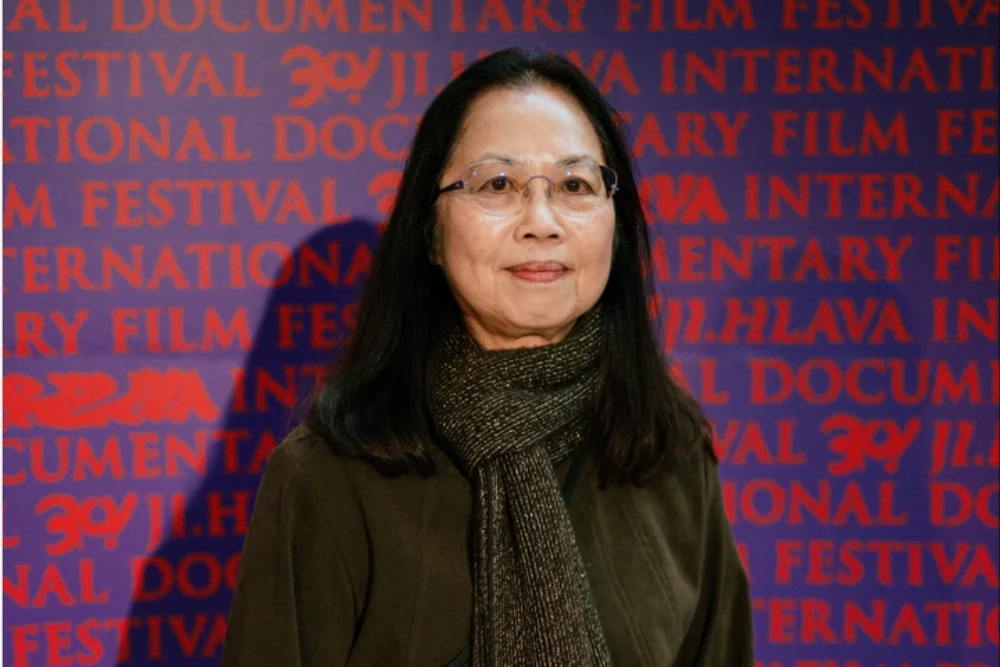
JI.HLAVA, Czech Republic — For decades, the celebrated Vietnamese-American filmmaker, writer, feminist, and post-colonial theorist Trinh T. Minh-ha has trained her camera on the complexities of culture, post-colonial identity, and geography across Africa, Asia, and beyond. Now, she has turned her contemplative lens toward a landscape much closer to home: the vast, unforgiving expanse of the American West.
Speaking at the prestigious Ji.hlava Documentary Film Festival, where she is currently being honored with a comprehensive career retrospective, Trinh announced that she has officially finished editing her long-awaited upcoming feature, The Undying Desert. The project represents a monumental undertaking, having been filmed across nearly two decades within the shifting sands of the Great Basin Desert.
Despite a legendary career defined by boundary-pushing cinematic essays such as Reassemblage, Surname Viet Given Name Nam, Forgetting Vietnam, and What About China?, Trinh’s latest project marks her first sustained cinematic engagement with the United States.
"I’ve made films in Africa, China, Vietnam, and Japan, and people would ask: ‘When are you going to make a film about the U.S.?’" Trinh told Variety during her festival appearance. "They were right, because I live there."
Main Facts: Inside The Undying Desert
The Undying Desert is a multi-layered cinematic exploration of human relationships with one of Earth’s most extreme ecosystems. Eschewing traditional narrative structures and individual character arcs, Trinh approaches the Great Basin Desert through a poetic, philosophical, and ecological framework.
Key elements of the film and its production include:
- The Production Timeline: Filming and conceptualization took place over a span of nearly 20 years in the Great Basin Desert, located primarily in Nevada and parts of Utah, Oregon, California, and Idaho.
- Core Themes: The documentary examines indigenous philosophies—particularly those of Native Americans—confronting colonialist prejudices that mischaracterize deserts as "dead" or "arid" spaces. It also explores the psychological impact of desert landscapes on the modern human psyche.
- Immediate Successor: Trinh has already completed principal work on a companion project, co-directed with her longtime collaborator Jean-Paul Bourdieu. Set in the same desert, this subsequent film investigates isolationist groups establishing research centers to simulate Mars colonization.
- Artistic Philosophy: True to her decades-long methodology, Trinh rejects conventional documentary tropes, treating cinema as a total sensory experience that merges the visual and auditory realms.
Chronology: A Two-Decade Journey into the American West
The genesis of The Undying Desert stretches back nearly twenty years, reflecting Trinh’s patient, observational approach to filmmaking—an ethos that refuses to rush artistic inquiry for the sake of industry turnaround times.
Phase 1: The Initial Inquiry (Mid-2000s)
Following decades of international projects analyzing decolonization, gender, and language in West Africa and East Asia, Trinh began questioning her omission of the American landscape. Responding to prompts from peers and critics regarding her lack of a U.S.-based project, she turned her attention to the Great Basin. Unlike the coastal metropolises most frequently associated with American cinema, the Great Basin—a vast arid region characterized by internal drainage and high mountain ranges—offered a stark canvas to explore foundational myths of American expansionism and frontier culture.
Phase 2: Sustained Observation and Fieldwork (2000s–2010s)
Over the course of many years, Trinh made recurring trips to the desert, documenting not just the physical environment, but the shifting human presence within it. During this extended period, she observed a stark dichotomy in how people interact with the terrain: from casual tourists and extreme sports enthusiasts utilizing the dunes as a playground, to indigenous communities who view the land as an interconnected web of ancestral life.
Phase 3: Post-Production and Completion (2023–2024)
As filming wound down, Trinh entered an intensive editing phase, synthesizing thousands of hours of material into a cohesive cinematic poem. The editing process concluded just in time for her career retrospective at the Ji.hlava Documentary Film Festival, where industry professionals and cinephiles received the first official confirmation of the film’s completion.
Phase 4: Expansion and Future Work (Present)
Demonstrating an unflagging creative momentum, Trinh immediately transitioned into her next project, continuing her creative partnership with Jean-Paul Bourdieu. This new venture explores the bizarre intersection of desert isolationism and space-age colonization efforts, drawing a direct line between historical earthly imperialism and contemporary Mars research initiatives situated in the Great Basin.
Supporting Data and Conceptual Framework
Trinh’s work cannot be understood through standard metrics of box office performance or traditional journalistic data points; rather, its "data" lies in its theoretical rigor, formal achievements, and thematic consistency across a half-century career.
Challenging Colonialist Lexicon
Central to The Undying Desert is an interrogation of language. Trinh notes that the very word "arid"—applied routinely to deserts by colonizing powers—carries a preconceived judgment of sterility and uselessness.
"A desert is huge, majestic, and beautiful. At the same time, it’s considered ‘arid’ by colonizing forces. All these prejudices about what a desert is still exist in our language. But it’s actually very lively."
Indigenous Epistemologies vs. Extractive Tourism
The film contrasts two fundamentally opposed worldviews occupying the same geographic coordinates:
- The Extractive/Recreational Approach: Many modern visitors treat the desert as a blank slate for adrenaline sports or temporary escapism. As Trinh observes, "Some just use it as a terrain for sports. They’re there, but they are not with the desert."
- The Indigenous Framework: Native American traditions view the desert as layered with continuous life, where past and present coexist. "They always remember that their ancestors are with them too. Life and death go together," Trinh explains.
The Collective "I"
In films like Surname Viet Given Name Nam (1989) and What About China? (2021), Trinh consistently subverts biographical documentary standards. In The Undying Desert, this rejection of individualist storytelling continues.
"It’s like poetry, where the ‘I’ is collective. You’re inviting people to come in."
Official Responses and Filmmaker Insights
During her extensive interviews and retrospective panels at Ji.hlava, Trinh offered profound reflections on the nature of political filmmaking, sensory perception in cinema, and the shifting responsibilities of documentary makers in the 21st century.
On the True Meaning of Political Cinema
Drawing a parallel to the French New Wave pioneer Jean-Luc Godard, Trinh emphasized that true political art stems from everyday awareness rather than superficial message-mongering:
"I’ve always been engaged in politics, but as Jean-Luc Godard also noticed, there’s a difference between the political and politics. Everything we do can be political. This is particularly relevant for women because we’re very attuned to everyday activities. If you remain blind to that, you might make a political film about a progressive subject. But the way you treat it can be very regressive. When you turn the camera toward someone else, you also have to turn it toward yourself."
Synesthesia and Total Sensory Experience
Reflecting on her landmark 1982 debut feature, Reassemblage, Trinh recalled an audience member who told her, "I’m hearing this film with my eyes and seeing it with my ears."
Rather than correcting the observation, Trinh embraced it:
"Perfect. In East Asia, the senses are not that separate. They overlap. A painter is also a musician and a poet. I think it’s the same with film. It’s better to come with an open mind and see how it speaks to you, rather than focusing on what constitutes a ‘good documentary,’ or what its story or message is."
Navigating Modern Documentary Freedoms
Addressing emerging filmmakers who often grapple with industry standards, funding constraints, and generic categorization, Trinh urged self-reliance:
"You set up the rules for yourself. I’m very glad that I was able to stick with the path I chose and not be intimidated by all these oppressive regulations."
While acknowledging that contemporary documentary makers enjoy greater formal freedom than in decades past, she cautioned that freedom brings a heightened ethical burden:
"On the contrary, you have to be much more responsible because you are the one setting the rules. When people ask if your film is fiction or documentary, you have to find a way to talk to them. And say: ‘Why do you need to know?’ Of course, you don’t always succeed. Even after so many years of making films, producers or programmers are not immediately interested in my work. But I’m still building my audience."
Implications: Redefining American Landscapes and Cinema
The completion of The Undying Desert and its impending festival circuit run carry significant implications for both documentary theory and environmental discourse.
1. Decentering the American Mythos
By bringing her post-colonial theoretical framework to bear on the American West, Trinh disrupts romanticized, colonial narratives of the "frontier." Historically, American desert spaces have been depicted in cinema either as empty backdrops for Western shootouts or as nuclear testing sites sacrificed to geopolitical ambition. Trinh’s two-decade immersion reclaims the desert as a site of ecological resilience and indigenous memory, forcing viewers to confront the continuities between historical earthly colonization and contemporary corporate space exploration (as highlighted in her companion Mars-simulation project).
2. Challenging Industry Categorization
Trinh’s career-long resistance to traditional documentary forms serves as a persistent critique of modern streaming and broadcast algorithms that demand easily digestible narratives, clear protagonists, and neat moral resolutions. By continuing to build an audience for poetic, non-linear cinema, she expands the boundaries of what non-fiction film can achieve aesthetically and philosophically.
3. A Blueprint for Independent Longevity
At a time when independent filmmakers face intense pressure to produce rapidly and conform to commercial formulas, Trinh’s twenty-year gestation period for The Undying Desert stands as an act of radical patience. It demonstrates that artistic integrity, sustained observation, and uncompromising personal rules remain viable—and vital—pathways in contemporary cinema.
As The Undying Desert prepares for its international premiere trajectory following its celebration at Ji.hlava, it stands not merely as a new entry in Trinh T. Minh-ha’s distinguished filmography, but as a profound meditation on how humans inhabit, misunderstand, and attempt to conquer the earth.