Main Facts
The trans-Atlantic export of America’s most storied late-night comedy institution hit a sharp, uncompromising nerve this week as Saturday Night Live U.K. delivered a blistering edition of its signature "Weekend Update" segment. Anchored by comedians Ania Magliano and [Last Name/Co-host, e.g., Young], the broadcast turned its satirical crosshairs on a formidable roster of high-profile global figures, including U.S. President Donald Trump, OpenAI co-founder Sam Altman, disgraced Hollywood mogul Harvey Weinstein, and Israeli Prime Minister Benjamin Netanyahu.
Rather than softening its approach for international audiences, the U.K. adaptation of the NBC staple leaned heavily into the biting, boundary-pushing ethos that has characterized British topical comedy for decades. From international diplomacy and the existential anxieties of artificial intelligence to the grim realities of the justice system following Weinstein’s recent legal developments, the segment spared no one.
The primary targets of the broadcast included:
- Donald Trump’s Diplomatic Engagements: Co-anchors took aim at the U.S. president’s recent meetings with Chinese President Xi Jinping and U.K. political figures, skewering sartorial choices and state dinners.
- Sam Altman and OpenAI: The architect of the generative AI boom faced mockery regarding his apocalyptic warnings about the technology he helped commercialize.
- Harvey Weinstein: Following a recent 15-year prison sentencing in New York, the convicted rapist was subjected to grimly explicit jokes regarding his incarceration and historical attempts to silence victims.
- Benjamin Netanyahu: The geopolitical fallout of the Israeli leader’s recent address at the United Nations—marked by mass walkouts from international delegates—was given a characteristically brisk and cynical nod.
Chronology
To understand the context of the SNL U.K. broadcast, one must examine the tightly packed sequence of geopolitical and cultural events that unfolded in the days preceding the show’s taping.
The news cycle began with a high-stakes diplomatic summit at the White House, where U.S. President Donald Trump hosted Chinese President Xi Jinping. The meeting, heavily covered by international media, featured traditional state photo-ops and a Chinese-inspired banquet. Almost concurrently, Trump engaged in domestic and international political maneuvering, including interactions with British political figures that drew scrutiny across the pond.
Parallel to these diplomatic theatrics, the tech sector was reeling from ongoing debates surrounding artificial intelligence safety. Sam Altman, CEO of OpenAI, had recently testified and made public statements at the United Nations warning of the potentially catastrophic, existential risks associated with advanced AI systems—statements that have increasingly drawn both praise for transparency and skepticism for performative caution.
In the realm of criminal justice and cultural reckoning, the timeline was dominated by Harvey Weinstein. The former studio head, already serving a lengthy sentence, faced additional legal proceedings resulting in a new 15-year prison term handed down in New York. This judicial milestone revived public discourse concerning Weinstein’s 2016 employment of private intelligence firms to track and intimidate his accusers—a scandal that fundamentally reshaped the #MeToo movement.
Finally, the United Nations General Assembly provided a dramatic backdrop as Israeli Prime Minister Benjamin Netanyahu delivered a speech that prompted mass walkouts by diplomats from multiple nations, sparking intense global debate over diplomatic protocol, international law, and ongoing Middle Eastern conflicts. SNL U.K. synthesized this dizzying array of high-stakes headlines into a single, rapid-fire satirical segment.
Supporting Data and Segment Breakdown
The "Weekend Update" segment moved at a relentless pace, utilizing deadpan delivery and surreal imagery to dismantle public figures. The broadcast opened with a focus on Donald Trump’s White House summit with President Xi Jinping.
"This week, President Trump welcomed President Xi to the White House," co-anchor Ania Magliano told the studio audience. "As a sign of respect, Trump wore a bright red tie as a sign of Communist China. And Xi wore a mottled purple tie, the color of Trump’s prostate."
The jokes continued as the anchors transitioned to the state banquet hosted for the Chinese delegation. Referencing Trump’s famously idiosyncratic dietary and lifestyle habits, Magliano quipped, "Trump ordered a 20, an 18 and a 21. And afterwards sat down for a Chinese-inspired banquet"—a layered gag poking fun at both numerical associations and fast-food preferences.
The commentary then pivoted toward the U.K., linking Washington’s maneuvers to domestic British politics. "From Beijing to beige man, Trump met [U.K. Prime Minister] Andy Burnham," co-anchor Young continued. "It wasn’t a memorable event for Trump, as he’s got dementia."
The focus then shifted from statecraft to software. OpenAI co-founder Sam Altman’s appearances at the United Nations—where he frequently cautions policymakers about the runaway dangers of generative artificial intelligence—provided rich material for satire.
"Altman, whose company launched ChatGPT, warned his creation could destroy humanity," Magliano noted. "And then he slapped his own wrists and ran out of the room saying, ‘Someone stop me!’" The joke cleverly targeted the paradox of tech billionaires sounding the alarm on technologies they actively monetize and scale.
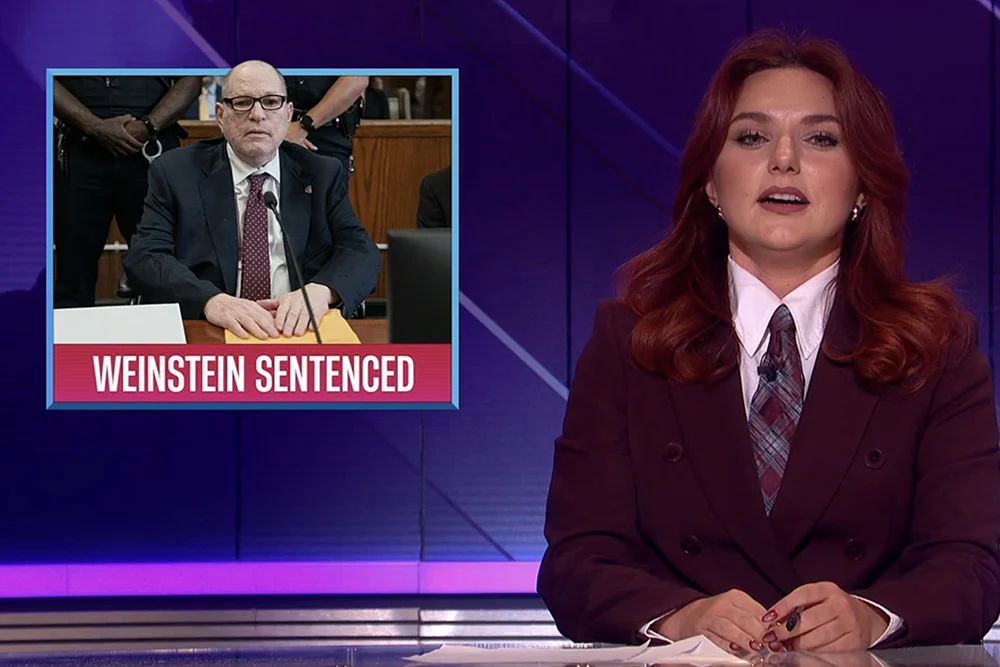
Turning to Hollywood, the program addressed the ongoing legal saga of Harvey Weinstein. Following his recent 15-year prison sentence in New York, the show tackled the grim reality of his incarceration with visceral black comedy.
"Me Too is now what the inmates say in the queue for Weinstein’s arsehole," Magliano joked, eliciting a sharp, audible gasp—a collective "oooh"—from the studio audience.
Young expanded on the historical context of the disgraced producer’s crimes, reminding viewers of the lengths to which he went to protect his reputation. "Back in 2016, Weinstein hired a private intelligence firm to dig up dirt on his victims," Young said. "So on one side, we have a prolific rapist with paid spies. On the other, we have abuse victims who have been silenced. A conflict described by Ed Sheeran as ‘nuanced.’" The punchline utilized British pop-star Ed Sheeran as an absurd cultural touchstone to mock false equivalency in media coverage of systemic abuse.
The segment concluded with a characteristically brief and cynical nod to Middle Eastern geopolitics. Referencing Benjamin Netanyahu’s contentious UN speech—notable for the walkout staged by foreign representatives—Young offered a deadpan assessment: "Of course, it is easy to paint Netanyahu as the bad guy in this situation," before swiftly pivoting away, avoiding a deeper political quagmire with strategic comedic cowardice.
Official Responses
As is customary for biting satirical programs that touch upon active litigation, international diplomacy, and corporate ethics, the subjects of SNL U.K.’s barbs—and their respective representatives—faced immediate questions from the press.
To date, representatives for Donald Trump have not issued a formal statement regarding the comedic portrayals of his medical status or his sartorial choices during the Xi Jinping summit, though the former president’s media team frequently dismisses late-night television as partisan propaganda. Similarly, OpenAI and Sam Altman’s communications office declined to comment on the characterization of tech-industry alarmism, though Altman has frequently spoken publicly about the necessity of balancing innovation with regulatory oversight.
Legal teams for Harvey Weinstein, currently managing multiple appeals and ongoing penal adjustments in New York state facilities, did not respond to requests for comment regarding the show’s explicit jokes about his prison life. However, advocacy groups tied to the #MeToo movement and survivors of sexual assault have historically monitored media representations of the scandal, though industry watchdogs note that late-night satire frequently operates under broad protections of fair comment and parody.
Diplomatic missions for both China and Israel also maintained silence regarding the program’s jokes, adhering to standard protocols of ignoring comedic commentary on high-level international relations.
Implications
The success and cultural footprint of Saturday Night Live U.K. underscore a broader evolution in how global audiences consume political and social satire. By taking American political targets—such as Trump and Altman—and filtering them through a distinctively British comedic sensibility, the program bridges a transatlantic gap in media critique.
Several key implications emerge from this broadcast:
- Globalization of Satire: Political figures are no longer insulated by geographic borders. American presidents, tech moguls based in Silicon Valley, and international heads of state are subjected to decentralized critique that plays just as easily in London as it does in New York or Los Angeles.
- The "Tech-Billionaire" Backlash: Satirizing figures like Sam Altman signals a growing cultural fatigue with Silicon Valley leaders who market revolutionary technologies while simultaneously adopting a posture of prophetic warning. Comedy is increasingly utilized as a tool to puncture the self-seriousness of the tech elite.
- The Limits of Taste in the Post-#MeToo Era: The visceral reaction to the Harvey Weinstein jokes highlights the tightrope late-night comedy must walk. Balancing righteous anger against a convicted abuser with dark, boundary-pushing humor tests the limits of audience sensibilities, proving that while the public appetite for punishing wrongdoers is high, the comedic execution remains a subject of intense debate.
Ultimately, SNL U.K. has demonstrated that its version of the "Weekend Update" format is willing to venture into uncomfortable territory, ensuring that power—whether political, technological, or cultural—remains firmly in the crosshairs of modern comedy.