Main Facts
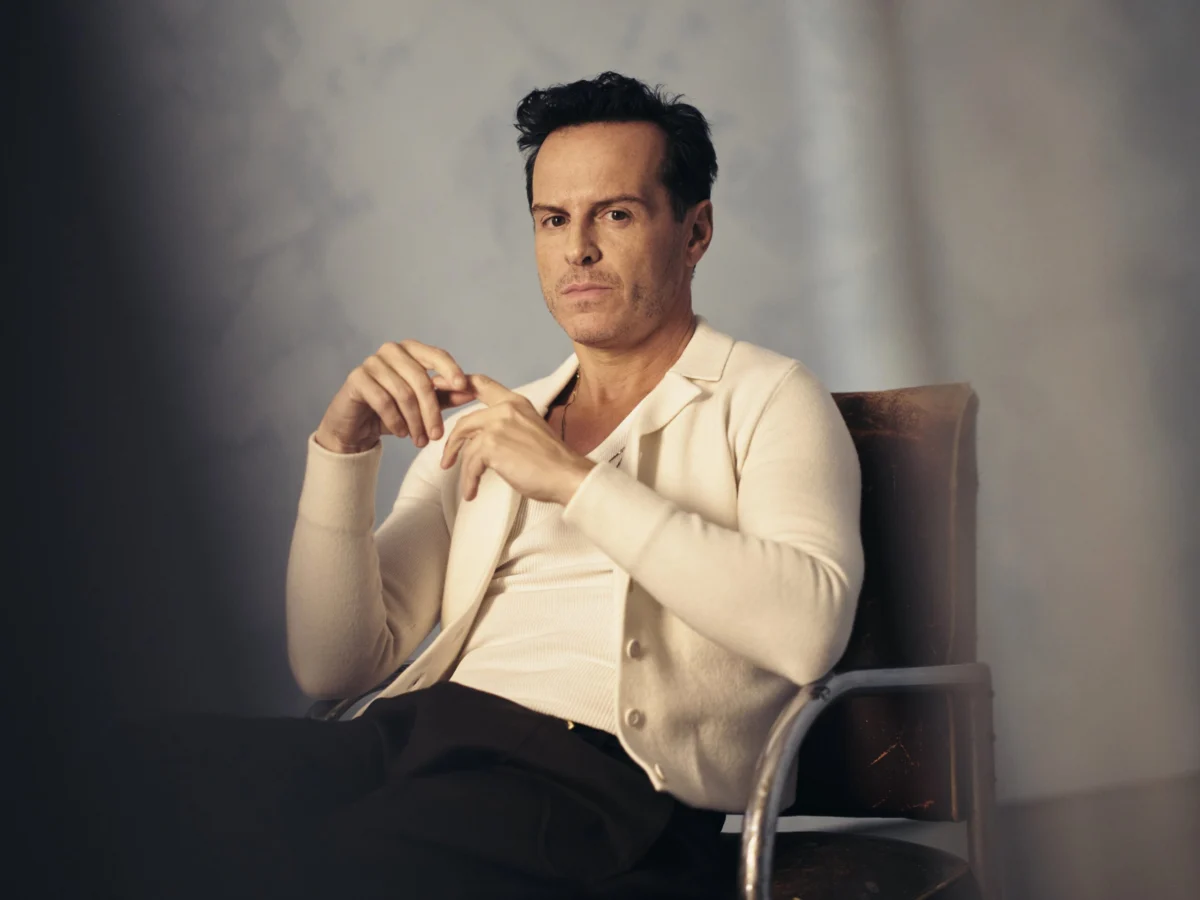
Irish actor Andrew Scott stands on the precipice of cinematic history. Following stellar critical receptions at both the Telluride Film Festival and the Toronto International Film Festival (TIFF), Scott’s towering, deeply emotional performance in Simon Stone’s period drama Elsinore has positioned him as an early frontrunner for the Academy Award for Best Actor.
In Elsinore, Scott portrays Ian Charleson, a real-life Scottish stage and screen star whose career lost momentum following his breakout role in the 1981 classic Chariots of Fire. Set in 1989, the film follows Charleson as he seizes an unexpected career-defining opportunity: when Daniel Day-Lewis abruptly walks offstage during a production of Hamlet at London’s National Theatre, Charleson steps into the iconic role. He does so not only to prove his enduring theatrical mettle, but also as a final, defiant act against a body ravaged by AIDS, and despite the stark warnings of his doctor (played by Academy Award winner Olivia Colman) that the intense physical and mental strain will hasten his decline.
Beyond its artistic merit, the film carries immense historical weight regarding representation. No openly gay man has ever won the Academy Award for Best Actor. Should Scott secure a nomination and subsequent win for Elsinore, he would shatter a long-standing glass ceiling in Hollywood history.
Chronology: From Speech Impediment to the Global Stage
Scott’s journey to the center of the global awards conversation has been decades in the making, marked by formative milestones on both stage and screen.
- Early Childhood: Growing up with a pronounced lisp and speech impediment, a seven-year-old Scott was enrolled in elocution lessons. The inclusion of a drama module—where he was encouraged to improvise, recite poetry, and deliver monologues in front of peers—ignited a dormant passion for performance.
- 1995: At the age of 17, Scott made his professional acting debut in the Irish feature film Korea, which premiered at TIFF. He received an invaluable masterclass in professional on-set conduct by observing veteran co-star Donal Donnelly, whose authority was matched only by his profound kindness and respect for the crew.
- 2017: Scott famously took on the mantle of Hamlet in a celebrated, radical staging at London’s Almeida Theatre, a theatrical triumph that resonates deeply with his current role in Elsinore.
- 2019: Global superstardom arrived via the second season of Phoebe Waller-Bridge’s critically acclaimed dark comedy Fleabag. Scott’s portrayal of a Catholic priest involved in a complex romantic dynamic with the protagonist captured the cultural zeitgeist, turning "The Hot Priest" into an internet sensation and reshaping industry perceptions of his romantic leading-man viability.
- Recent Years: After suffering notable awards season snubs for his work as Richard Rodgers in Blue Moon and as the haunted protagonist Adam in All of Us Strangers, Scott expanded his creative footprint by serving as a producer for the first time on Elsinore.
- September 12, 2026: Taking the stage at the Royal Alexandra Theatre for TIFF’s signature "In Conversation" series, moderated by TIFF Vice President of Public Programming Keith Bennie, Scott discussed his expansive career, the internet’s obsession with his persona, and the deeply personal stakes of Elsinore.
Supporting Data & Context
The cultural and industry significance of Elsinore is underscored by the convergence of several historical and biographical factors:
- The Real-Life Subject: Ian Charleson was a celebrated Scottish actor renowned for his stage work and his unforgettable portrayal of Eric Liddell in Chariots of Fire. He tragically died from AIDS-related complications in January 1990 at the age of 40, just months after his triumphant, physically punishing run as Hamlet.
- The Creative Alignment: Clayton Davis, awards editor for Variety, noted the meta-textual brilliance of the casting: "The casting is too perfect to be accidental. Scott is himself a celebrated London Hamlet, here playing a man whose Hamlet was his last act of defiance."
- Historical Oscar Precedent: While the Academy has historically recognized LGBTQ+ actors in supporting categories or lead actress categories (such as Jodie Foster, Sir John Gielgud, and Ian McKellen, the latter two receiving nominations), an openly gay man has never claimed the prize for Best Actor. Scott’s performance is viewed by pundits as the most viable vehicle yet to bridge this historical gap.
- Production Footprint: Elsinore represents a major career pivot for Scott, marking his debut as a feature film producer. He has noted that bringing the project to life required immense collaborative vision, given its delicate subject matter concerning the erasure of gay artists in the late 20th century.
Official Responses and Public Commentary
During his extensive, highly publicized appearance at TIFF, Scott addressed everything from internet fandom to the lingering prejudices of the entertainment industry.
When Bennie queried the 49-year-old actor about his immense digital footprint and the internet’s fixation on him, Scott maintained a self-deprecating distance from online culture:
"I don’t have the internet. I never see it," he joked to the packed Royal Alexandra Theatre, before adding, "It’s actually wild: You never know what feral things people [will say]."
Reflecting on the cultural phenomenon of "The Hot Priest" from Fleabag, Scott admitted to initial anxieties regarding whether mainstream audiences would accept an openly gay actor in a traditionally romantic role:
"I guess there was a fear that I wouldn’t be able to get cast in those roles. That’s what everybody said. But I knew, because when I did plays, that the people that were waiting at the stage door, they knew my sexuality and they did not care."
Scott forcefully rejected the antiquated notion that audiences cannot suspend disbelief regarding an actor’s personal life:
"I feel very proud that that was quite a big moment because people were like, ‘The actor is gay. Whoa!’ And it is like this idea that the audience is stupid. We go to see ‘Batman,’ and it’s like, ‘Oh my god! He is not a bat?’"
Addressing those who harbour lingering typecasting biases, Scott was unequivocal:
"That’s just prejudice. And we won’t cater to those people, or I’m certainly not going to."
Speaking on the emotional toll of embodying Ian Charleson in Elsinore—during which he visibly choked up on stage—Scott emphasized the universal resonance of the narrative:
"It’s about how we use our time, and he was enormously fun, attractive, beautiful, amazingly gifted actor… The reason I was so attracted to it, I think, is because it doesn’t end well for any of us, and quality of time is what he chose… I know what an Olympian, absolutely exhausting task that is [to play Hamlet]. I did it 150 times… The idea that he did it when he was so unwell, it always just gets me."
He further lamented the institutional silencing of queer artists during the height of the HIV/AIDS epidemic:
"There weren’t any gay actors — for no reason. That was taken away from them."
Implications
As Elsinore prepares for its wider theatrical rollout and subsequent awards season campaign, the film’s cultural footprint extends far beyond traditional Hollywood metrics.
First, a potential Academy Award nomination or win for Scott would serve as a watershed moment for LGBTQ+ representation in major motion pictures, validating decades of queer artists who navigated an industry reluctant to cast them in authentic, uncompromised lead roles.
Second, the film acts as a vital historical reckoning. By spotlighting Ian Charleson’s courageous final performance against the backdrop of the 1980s AIDS crisis, Elsinore rescues a crucial piece of theatrical history from potential obscurity. It highlights how art has historically served as a vehicle for resilience and political defiance in the face of systemic bigotry and physical devastation.
Finally, for Andrew Scott personally, Elsinore solidifies his transition from celebrated character actor and television icon to a formidable cinematic auteur—simultaneously producing and starring in a project that mirrors his own artistic ethos, his theatrical roots, and his unwavering refusal to pander to industry prejudices.