By Global Affairs & Religion Desk
Published: November 2026
Main Facts
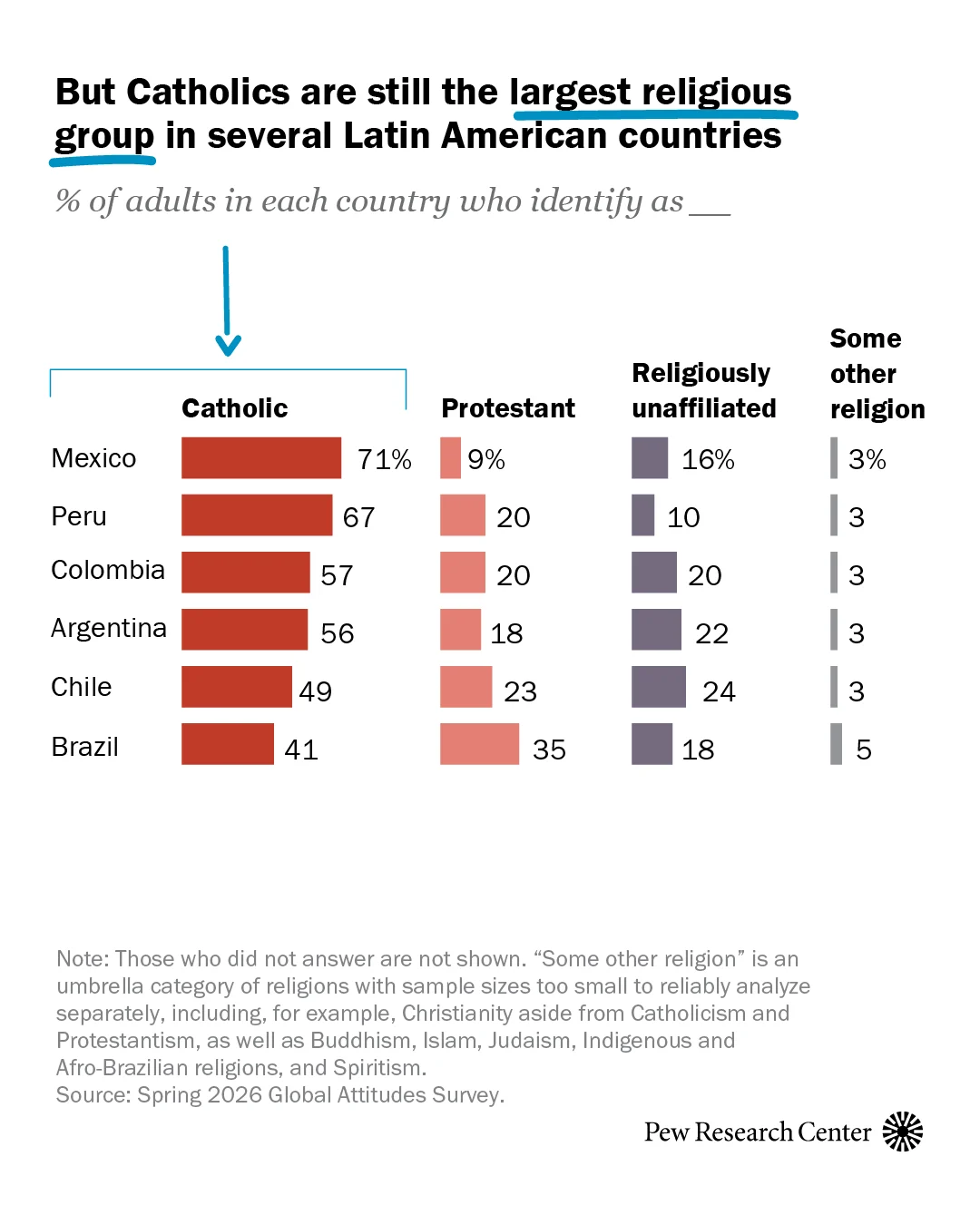
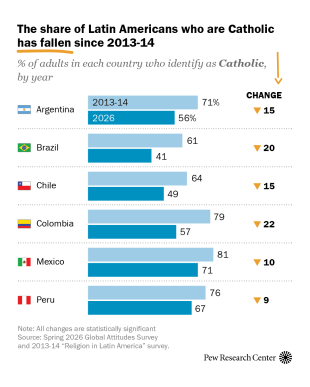
A comprehensive new data study released by the Pew Research Center highlights a profound and ongoing transformation in the religious landscape of Latin America. Based on extensive polling conducted in the spring of 2026, the research underscores a historic, decade-long decline in the share of the population identifying as Catholic across several of the region’s most populous nations.
Despite this steady erosion in institutional affiliation, Catholicism remains a foundational cultural and spiritual force in countries such as Brazil, Mexico, Colombia, Argentina, Peru, and Chile. Millions of Latin Americans continue to report robust personal devotion, frequent daily prayer, and deep-seated religious convictions.
Simultaneously, the study shines a spotlight on regional perceptions of leadership within the Catholic Church, capturing public opinion regarding Pope Leo XIV. Notably, the data reveals exceptionally warm favorability in Peru, a nation where the pontiff spent roughly two decades of his ecclesiastical career and was appointed bishop in 2014.
Conducted as part of the broader Pew-Templeton Global Religious Futures project—and supported by organizations including The Pew Charitable Trusts, the John Templeton Foundation, and the Templeton Religion Trust—this extensive survey captures the shifting intersection of demographics, personal faith, and institutional loyalty across Latin America and the Caribbean.
Chronology of Religious Shifts in Latin America
To fully understand the current state of faith in Latin America, researchers and historians look back at a multi-decade trajectory that has systematically reshaped the region’s spiritual demographics.
- The Mid-to-Late 20th Century: For generations, Latin America was overwhelmingly viewed as the demographic heartland of global Catholicism. The vast majority of citizens were born into Catholic families, and the Church enjoyed a near-monopoly on public morality, cultural traditions, and national identity.
- The Turn of the Millennium: Signs of pluralism began to accelerate. The rise of Protestantism—particularly vibrant Pentecostal and evangelical movements—began chipping away at the Catholic majority. Millions of individuals transitioned away from traditional parishes in search of more expressive, community-oriented congregations.
- 2013–2014 (The Baseline Era): Pew Research Center conducted landmark baseline surveys across the region that documented a significant exodus from Catholicism toward Protestant denominations, as well as a growing segment of the population identifying with no religion ("nones"). During this same window, specific regional milestones occurred, such as the 2014 appointment of the future Pope Leo XIV as a bishop in Peru.
- The Decade Interlude (2014–2026): Across the intervening years, urbanization, shifting socioeconomic factors, secularization, and the aggressive expansion of evangelical networks steadily altered neighborhood dynamics from Tijuana to Tierra del Fuego.
- Spring 2026: Pew Research Center deployed a major new international survey, interviewing more than 6,100 adults across six key Latin American nations (Brazil, Mexico, Colombia, Argentina, Peru, and Chile). The resulting data, finalized in late 2026, provides a clear empirical window into how far the Catholic demographic share has fallen since the 2013–2014 baseline, while simultaneously measuring contemporary attitudes toward Pope Leo XIV.
Supporting Data and Demographic Insights
The empirical backbone of the 2026 study relies on meticulous polling across Latin America’s primary demographic engines. The five most populous countries in the region—Brazil, Mexico, Colombia, Argentina, and Peru—alongside Chile (the seventh-largest), collectively represent the vast majority of the region’s inhabitants.
1. The Continuing Decline of the Catholic Share
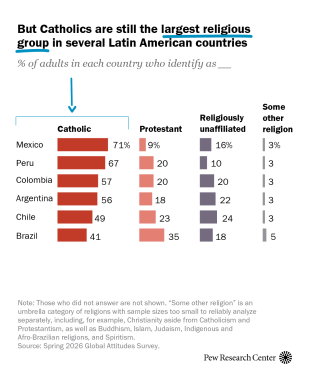
Comparative data stretching from the 2013–2014 benchmarks to the 2026 survey demonstrates that the proportion of Latin Americans identifying as Catholic has experienced a measurable, sustained decline. While Catholics still constitute the largest single religious demographic in several of these nations, their absolute majority status is increasingly contested by the growth of evangelical Protestantism and the religiously unaffiliated.
2. High Levels of Personal Devotion
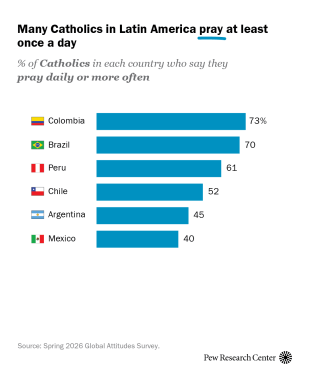
Despite declining formal affiliation numbers, the individuals who do identify as Catholic in Latin America maintain remarkably high levels of personal religious observance.
- Prayer Habits: Large pluralities and majorities of Catholics across the surveyed nations report praying at least once a day, signaling that Catholicism in the region functions as an active, daily spiritual practice rather than merely a nominal cultural label.
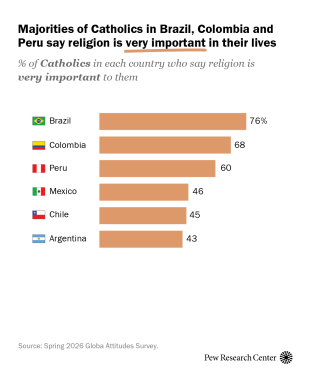
- Subjective Importance of Religion: When asked about the role of faith in their daily lives, majorities of Catholics in countries like Brazil, Colombia, and Peru explicitly state that religion is "very important" to them personally. This demonstrates that nominal secularization has not entirely overtaken the actively practicing core of the church.
3. The "Peru Effect" and Papal Favorability
Public opinion regarding Pope Leo XIV varies across the region, heavily influenced by historical and personal proximity. The data highlights that some of the most enthusiastic, positive views of Pope Leo XIV are found in Peru. Analysts attribute this high favorability directly to his extensive biographical ties to the country—having lived there for roughly twenty years and serving as a bishop starting in 2014, which forged deep, lasting connections with local clergy and the general populace before his elevation to the papacy.
Official Responses and Perspectives
The release of the Pew Research Center’s findings has prompted reactions from religious leaders, sociologists, and institutional analysts across both hemispheres.
- Ecclesiastical Leadership: Representatives of the Catholic Church in Latin America have acknowledged the complex realities highlighted by the data. While church officials openly express concern over the steady leakage of the faithful to evangelical groups and secularism, they simultaneously find pastoral encouragement in the data showing deep piety among remaining parishioners. Many bishops have emphasized the need for active evangelization, community engagement, and localized outreach to revitalize parishes.
- Sociological Experts: Sociologists specializing in Latin American religion note that the data reflects a broader global trend of religious shifting, often described as a "religious marketplace." As individuals experience upward mobility, migration, and urbanization, they frequently reevaluate their institutional allegiances. Scholars point out that the growth of non-Catholic Christian movements offers alternative structures of social support, leadership opportunities, and emotional resonance that traditional, bureaucratic Catholic parishes have sometimes struggled to match.
- The Research Consortium: Spokespersons for the Pew-Templeton Global Religious Futures project underscored the importance of tracking these trends objectively. By utilizing rigorous methodology—surveying thousands of adults across diverse linguistic, geographic, and economic strata—the project provides governments, NGOs, and faith leaders with an empirical baseline to understand how religious transformations directly influence civil society, public policy, and social cohesion.
Broader Implications for Latin America
The shifts documented in the 2026 Pew Research Center study carry profound implications for the political, social, and cultural future of Latin America.
1. Political Alignment and Public Policy
Religion has never existed in a vacuum in Latin America; it frequently intersects with political discourse, particularly regarding social issues such as education, family law, reproductive rights, and public morality. As the Catholic Church loses its near-monopoly on demographic affiliation, political actors can no longer rely on a uniform "Catholic vote." The growing political influence of evangelical Protestant blocs—particularly in nations like Brazil—creates a fragmented political ecosystem where faith-based constituencies compete for legislative leverage.
2. Evolving Community Structures
In many urban neighborhoods and rural communities throughout Latin America, the local parish or church has historically served as the primary hub of social organization, charity, and mutual aid. As religious pluralism expands—with citizens dividing their loyalties among various Catholic parishes, Pentecostal megachurches, and secular identities—traditional community safety nets are being reconfigured. This pluralism fosters diverse civic networks, though it can occasionally introduce social fragmentation or theological competition within tight-knit communities.
3. The Future of the Papacy and Global Catholicism
With the center of gravity of the global Catholic Church having shifted decisively toward the Global South, the trends in Latin America serve as a bellwether for the entire institution. The data concerning Pope Leo XIV suggests that personal affinity and localized ministry matter deeply to regional populations. For the Vatican, maintaining relevance in Latin America requires acknowledging both the demographic erosion documented since 2013 and the vibrant, highly devotional
faith of the millions who remain committed to the Church.
Ultimately, the 2026 report paints a picture of a region in spiritual transition—one where traditional institutions are being rigorously tested by modern pluralism, yet where faith, prayer, and religious identity continue to profoundly shape the daily lives of millions of Latin Americans.