In an era dominated by the curated perfection of social media filters and the heavy-handed touch of digital post-production, Florence Pugh has emerged as a refreshing anomaly. A powerhouse talent whose resume spans from the gritty, grounded television of The Little Drummer Girl to the high-octane spectacle of the Marvel Cinematic Universe, Pugh has consistently used her platform to challenge the rigid beauty standards of Tinseltown.
Her commitment to authenticity—not just in her acting, but in her physical presentation—has made her a beacon for those tired of the industry’s "polished" façade. As she steps into her latest high-profile role as the enigmatic Cathy Ames in Netflix’s upcoming adaptation of East of Eden, we revisit a foundational sentiment that has defined her career: the radical act of simply being oneself.
The Core Philosophy: "Honesty with the Way We View Ourselves"
The central tenet of Pugh’s ethos regarding fame and appearance was captured in a poignant 2019 interview with Teen Vogue. At the time, she was a rapidly ascending star, riding the momentum of critically acclaimed performances in Fighting With My Family, Little Women, and the folk-horror phenomenon Midsommar. When asked about the pressures of Hollywood, Pugh offered a perspective that has only grown more relevant:
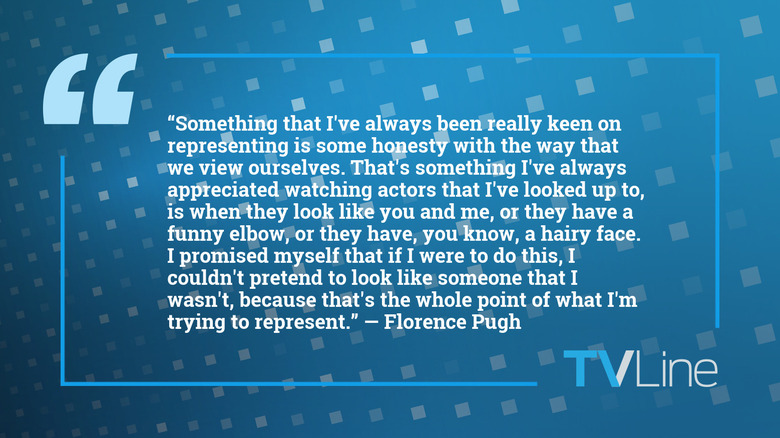
"Something that I’ve always been really keen on representing is some honesty with the way that we view ourselves. That’s something I’ve always appreciated watching actors that I’ve looked up to, is when they look like you and me, or they have a funny elbow, or they have, you know, a hairy face. I promised myself that if I were to do this, I couldn’t pretend to look like someone that I wasn’t, because that’s the whole point of what I’m trying to represent."
This statement serves as more than just a soundbite; it is a mission statement. Pugh’s rejection of the "impossible aesthetic" is an invitation for the audience to reconcile with their own perceived imperfections.
A Chronology of Career-Defining Authenticity
To understand the weight of Pugh’s words, one must look at the trajectory of her career. Her ascent has been marked by a deliberate choice to inhabit roles that require raw, unfiltered human emotion rather than superficial glamour.
2014–2018: The Emergence of a Naturalist
Pugh’s debut in The Falling (2014) signaled the arrival of a performer who favored intensity over artifice. Her subsequent move into television, notably in the 2016 thriller Marcella and the 2018 BBC adaptation of John le Carré’s The Little Drummer Girl, showcased her ability to anchor complex narratives without needing to conform to the archetypal "Hollywood starlet" mold. In The Little Drummer Girl, her portrayal of an actor recruited into international espionage required a grounded, tactile performance that resonated precisely because of its humanity.
2019–2023: The Global Stage
As she entered the mainstream consciousness through films like Little Women (earning an Academy Award nomination) and the MCU, Pugh faced the inevitable pressure to conform to the industry’s "blockbuster" aesthetic. Instead, she doubled down on her personal style, championing her natural features and maintaining a candid presence on social media. Her role as Yelena Belova in Black Widow and Hawkeye proved that one could exist within the world of high-budget superhero spectacle without losing one’s sense of self.
2024–Present: The Matriarchal Shift
Now, as she tackles the complex, often dark role of Cathy Ames in East of Eden, Pugh represents a new guard of actors who view their physical presence as a tool for storytelling, not a commodity to be molded. Her return to the small screen is a homecoming of sorts, signaling that even as a global superstar, her priority remains the depth of the character over the vanity of the image.
Supporting Data: The Illusion of Perfection
The cultural conversation Pugh addresses is backed by the reality of the industry’s infrastructure. Being a "Hollywood leading lady" is an occupation that, for many, includes a support system that is largely invisible to the public.
When we analyze the "look" of the modern movie star, we are often looking at the output of a multi-billion-dollar machine. This includes:
The Personal Trainer/Chef Industrial Complex: Studios frequently contract professionals to ensure stars adhere to strict regimens, a level of maintenance that is functionally impossible for the average working person.
The Post-Production "Polish": From color grading to digital smoothing, the image on screen is rarely the raw reality of the actor in the moment.
The Time-Equity Gap: A standard 12-to-16-hour shooting day leaves little time for the average human to prioritize the aesthetic maintenance expected of a public figure.
Pugh’s insistence on "honesty" serves to strip away the mystique of this process. By acknowledging the "funny elbows" and the "hairy faces" of the world, she highlights the absurdity of the standard we hold for ourselves by comparing our daily lives to the heavily curated lives of performers.
Official Responses and Industry Reception
Critics and peers have largely praised Pugh for her transparency. Within the industry, there has been a slow but perceptible shift in how actors discuss their bodies. Conversations surrounding "body positivity" have evolved into "body neutrality"—the concept that one’s body is a vessel for existence, not an object to be judged.
Pugh has become a central figure in this movement. By maintaining her identity, she has forced the industry to adapt. Casting directors and producers are increasingly seeking "authentic" performances, recognizing that audiences are fatigued by the artificiality of the past. Her influence has helped pave the way for a more diverse range of beauty standards to be accepted on screen, proving that vulnerability is a far more powerful tool for audience connection than perfection.
The Broader Implications: A Call for Self-Compassion
The deeper meaning of Florence Pugh’s philosophy extends far beyond the red carpet. In an era where digital comparison has led to a documented rise in body dysmorphia and anxiety, her message is a necessary counter-narrative.
Redefining Success
If we take Pugh’s lead, we must redefine what it means to be "camera-ready." Living a normal, productive life—navigating the turbulence of the current decade, maintaining relationships, and managing a career—is a feat in itself. The societal pressure to look like a retouched image is a distraction from the actual work of living.
The Power of Being "Imperfect"
Pugh’s career serves as a roadmap for self-acceptance. She demonstrates that one does not need to conform to become successful; in fact, it is often one’s unique, "imperfect" traits that lead to the most memorable and impactful work. Her success is a victory for the "real."
Looking Ahead
As we look toward her performance in East of Eden, it is clear that Pugh will continue to use her voice to advocate for this honesty. Whether she is playing a superhero or a literary villain, the core of her performance remains the same: a refusal to lie to the audience about what a human being actually looks like.
In a world that demands we be smaller, smoother, and more silent, Florence Pugh’s insistence on being herself—funny elbows and all—is perhaps the most heroic role she has ever played. It is a reminder that we are all, in our own ways, works in progress, and that there is profound beauty in that process. As we move forward, we should take this lesson to heart: be kinder to yourself, reject the impossible standard, and recognize that the most authentic version of you is, and always will be, enough.