Introduction
As the dust settles on a historic election season, the American political landscape finds itself in a state of profound transition. From seismic shifts in state-level representation to ongoing legal battles involving the nation’s highest offices, the institutions that define our democracy are under intense scrutiny. In this week’s briefing, we explore the landmark election in Mississippi, the evolving public sentiment toward media and social platforms, and the complex legal challenges shaping the future of press freedom.
The Historic Mississippi Senate Shift: A 44-Year Milestone
In a development that has sent ripples through the national political establishment, Mississippi has elected Scott Colom to the U.S. Senate. This victory marks the first time in 44 years that the state has sent a Democrat to the upper chamber, concluding a contest defined by its high stakes and a rigorous, multi-day vote-counting process.
The race served as a microcosm for the broader national anxiety regarding election integrity. As observers waited for final tallies, the Mississippi Free Press took on the critical role of guiding the electorate through the state’s complex voting infrastructure. By demystifying the procedures surrounding provisional ballots—often the most misunderstood component of the American voting process—the publication underscored the vital role that local journalism plays in upholding the perceived legitimacy of democratic outcomes.
Chronology of the Count
The days following Election Day were marked by intense public scrutiny. Unlike states with centralized, high-speed automated counting, Mississippi’s reliance on provisional ballots meant that thousands of votes were subject to manual verification. This process, while essential for ensuring that only qualified voters participate, created a window of uncertainty that tested the patience of both the electorate and the media. Colom’s eventual victory was confirmed only after election officials completed the painstaking task of reconciling these ballots, a process that highlighted the physical labor inherent in our modern democratic systems.
Public Confidence and the Mechanics of Voting
While the political divide remains sharp, recent data from the Pew Research Center suggests that the foundational belief in the integrity of the voting process remains surprisingly robust. A national survey conducted roughly one month before Election Day found that 80% of registered voters expressed at least "somewhat" high confidence that all legally qualified citizens would be able to cast a ballot.
Partisan Divergence on Election Security
However, beneath this umbrella of general confidence lie deep-seated partisan fissures. When researchers segmented the data, a distinct gap emerged between voters backing Republican and Democratic candidates. While 90% of Republican-leaning voters expressed confidence in the system’s ability to facilitate legal voting, that figure dropped to 72% among Democratic-leaning voters.
The divergence becomes even more pronounced when discussing the mechanisms of fraud prevention. When asked about their confidence in the system’s ability to stop noncitizens from casting ballots, the partisan divide widened significantly. Ninety percent of Democratic supporters expressed confidence that such safeguards would function correctly, while only 45% of Republican supporters held the same view. This disparity reflects the growing "trust gap" in American politics, where the perception of a system’s fairness is often tethered to the political identity of the individual observer.
The Power Brokers: Media and Social Platforms in the Crosshairs
Perhaps the most significant finding in recent research is the pervasive sentiment that the traditional "gatekeepers" of information—news organizations and social media giants—have become too powerful. According to a new analysis from the Pew-Knight Initiative, 69% of U.S. adults believe that social media companies exert excessive influence over contemporary politics.
News organizations are not immune to this skepticism, with 55% of respondents asserting that they, too, wield too much political power. These figures are striking, particularly when juxtaposed against the low percentage of Americans who believe these institutions should have more influence. The public, it seems, is in a period of institutional retrenchment, favoring a reduction in the power of centralized information hubs.
The Partisan View of the Press
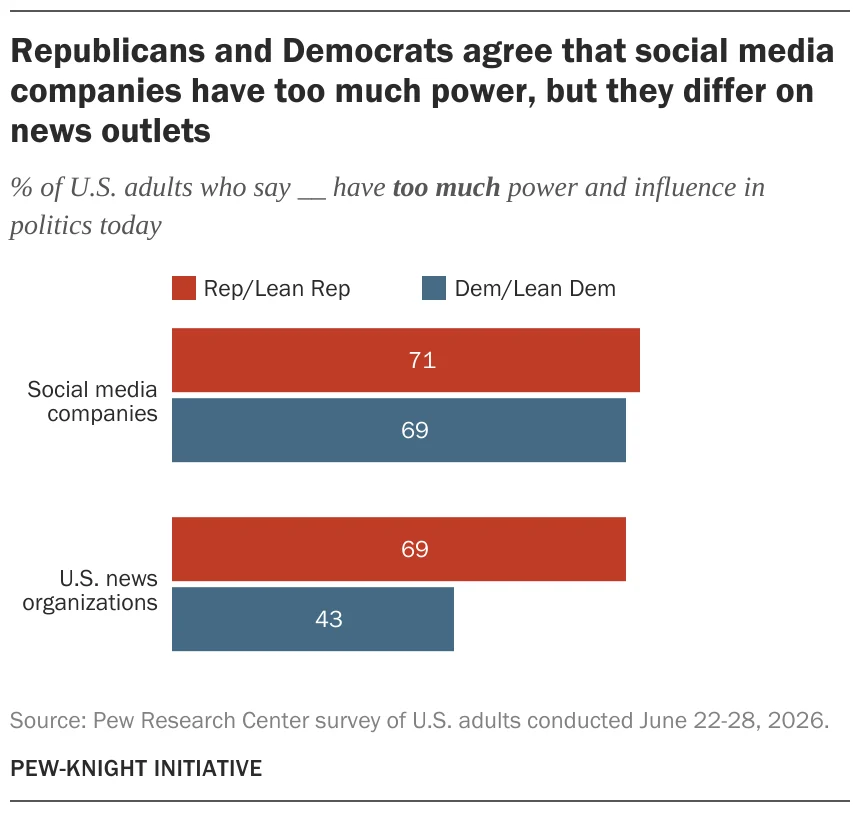
The "Chart of the Week" reveals a nuanced reality behind these numbers. While both Republicans and Democrats share a remarkably similar skepticism toward social media (71% and 69% respectively), the consensus fractures when the discussion shifts to news organizations.
There is a clear, 26-point disparity between the parties regarding the media’s role: 69% of Republicans believe news outlets have too much political influence, compared to just 43% of Democrats. This reflects a multi-year trend in which media outlets are increasingly viewed through a partisan lens, with one side of the aisle viewing mainstream reporting as an essential check on power, while the other increasingly views it as an activist participant in the political process.
Legal Battles and the Future of Press Freedom
The intersection of law, politics, and the press has reached a boiling point in recent weeks. Two high-profile defamation lawsuits—one involving President Donald Trump and the BBC, and another involving FBI Director Kash Patel and The Atlantic—are currently winding their way through the federal court system.
The Trump vs. BBC Litigation
A federal judge recently ruled that President Trump’s $10 billion defamation lawsuit against the BBC may proceed, though the court dismissed specific claims regarding unfair business practices. This case is being closely watched by legal scholars, as it tests the boundaries of what constitutes defamatory content versus protected political commentary in the international news sphere.
The Patel vs. The Atlantic Setback
Simultaneously, the legal battle initiated by FBI Director Kash Patel against The Atlantic hit a significant roadblock. A federal judge recently froze much of the discovery process in the $250 million suit. For journalists, discovery—the process of obtaining internal emails, meeting notes, and editorial communications—is often the most precarious phase of litigation. By limiting this phase, the court has provided a temporary, albeit significant, reprieve for the publication.
Implications: The Public’s Balancing Act
These cases arrive at a time when public opinion on press freedom is increasingly complicated. Data from June 2026 indicates that while Americans still value the abstract concept of a free press, the practical application is another matter. A majority (53%) of U.S. adults now argue that it is more important to prevent inaccurate reporting than to protect the absolute freedom of the press.
This shift suggests that the public is becoming increasingly comfortable with the idea of legal or institutional intervention in the news cycle. Yet, this is tempered by a lingering desire for accountability. Last year, 72% of Americans indicated that news providers should play a watchdog role, keeping an eye on "powerful people." Notably, Democrats were significantly more likely to demand this watchdog function (52%) than Republicans (31%), further illustrating how the very definition of a "free press" has become a partisan battleground.
Conclusion: The Road Ahead
The events of the past few weeks—from the historic Senate race in Mississippi to the ongoing legal challenges involving the FBI and the former President—paint a picture of a nation grappling with its own infrastructure. We are witnessing a clear pivot in how the American public perceives the institutions that facilitate their democracy.
As we move forward, the challenge for both news organizations and political leaders will be to navigate a landscape where confidence is fragmented, and the appetite for regulatory intervention in the media is at an all-time high. The balance between freedom, accountability, and the mechanics of the vote will continue to be the defining story of the coming year.
The Briefing remains committed to providing you with the data and insights necessary to understand these complexities. We invite you to join the conversation and help us shape the future of this newsletter by sharing your thoughts via our reader survey.
Editor’s Note: This report was compiled by the editorial team at the Pew Research Center, including Naomi Forman-Katz, Christopher St. Aubin, Emily Tomasik, Joanne Haner, and Sawyer Reed, with editing by Michael Lipka and Anna Jackson. For further inquiries, please contact us at [email protected].