July 23, 2026
The American media landscape faces a pivotal moment of regulatory and cultural transformation. As news organizations navigate a volatile shift toward digital video consumption, a proposed mega-merger between two industry titans—Paramount and Warner Bros. Discovery—has been brought to a screeching halt by federal intervention. This collision of corporate ambition and antitrust scrutiny highlights not only the precarious future of the U.S. media business but also the widening gap in how different generations of Americans engage with the world around them.
The Main Facts: A Merger Halted
On July 23, 2026, the consolidation of two of the world’s largest entertainment and news conglomerates was thrown into disarray. A federal judge issued a temporary restraining order (TRO) against the proposed acquisition of Warner Bros. Discovery by Paramount, citing an urgent need to evaluate the antitrust implications of the deal.
The lawsuit, spearheaded by a coalition of 12 states, argues that the merger would create a monopolistic entity with unprecedented control over the information ecosystem. Should the acquisition proceed, the resulting company would hold the keys to dozens of major cable networks, the theatrical distribution pipelines for two of Hollywood’s most storied studios, and, perhaps most significantly, two of the most influential news brands in the United States: CNN and CBS News.
According to a 2025 Pew Research Center survey, the potential consolidation of these two news powerhouses is a matter of public concern. Data shows that one-third of U.S. adults regularly consume news from CNN, while three-in-ten look to CBS News for their reporting. The union of these platforms would centralize the news-gathering operations of two of the nation’s primary sources of information, raising profound questions about media diversity and editorial independence.
A Chronology of the Deal and the Legal Pushback
The path to this week’s legal blockade was paved with months of intense corporate negotiation.
- Early 2026: Rumors of a "mega-merger" between Paramount and Warner Bros. Discovery begin to circulate as both entities struggle with the transition from traditional cable revenue to the high-cost, high-risk streaming era.
- Spring 2026: Formal talks begin. Financial analysts suggest that the merger is a defensive play to gain scale against tech giants like Amazon, Apple, and Google, which have become increasingly dominant in the content creation space.
- July 2026: The merger agreement is publicly announced, sparking immediate outrage from consumer advocacy groups and state attorneys general.
- July 20, 2026: A bipartisan coalition of 12 states files a formal antitrust lawsuit in federal court, alleging that the combination would "substantially lessen competition" in both the television production and news distribution markets.
- July 23, 2026: A federal judge grants the temporary restraining order, effectively freezing all integration activities between the two companies until a full evidentiary hearing can take place.
Supporting Data: The Digital Shift and Demographic Engagement
While the legal battle unfolds, the industry is simultaneously grappling with a fundamental shift in user behavior. A recent report from the Pew-Knight Initiative illustrates that the "pivot to video" is no longer just a strategy—it is a response to a hard, data-driven reality.
Recent industry trends show that legacy print organizations, including The New York Times and The Wall Street Journal, are aggressively reallocating resources to video production. This move is a direct response to the fact that, as of August 2025, 44% of Americans state that their preferred method of receiving news is by watching it. Only 37% prefer reading, and 19% prefer listening.
This preference is heavily reflected in the rapid growth of video-based social platforms. In 2020, only 23% of U.S. adults reported getting news from YouTube; by 2025, that number had surged to 35%. This trend is reshaping the business model of news, forcing organizations to compete not just with other newspapers, but with influencers, content creators, and algorithmic feeds on TikTok and Instagram.
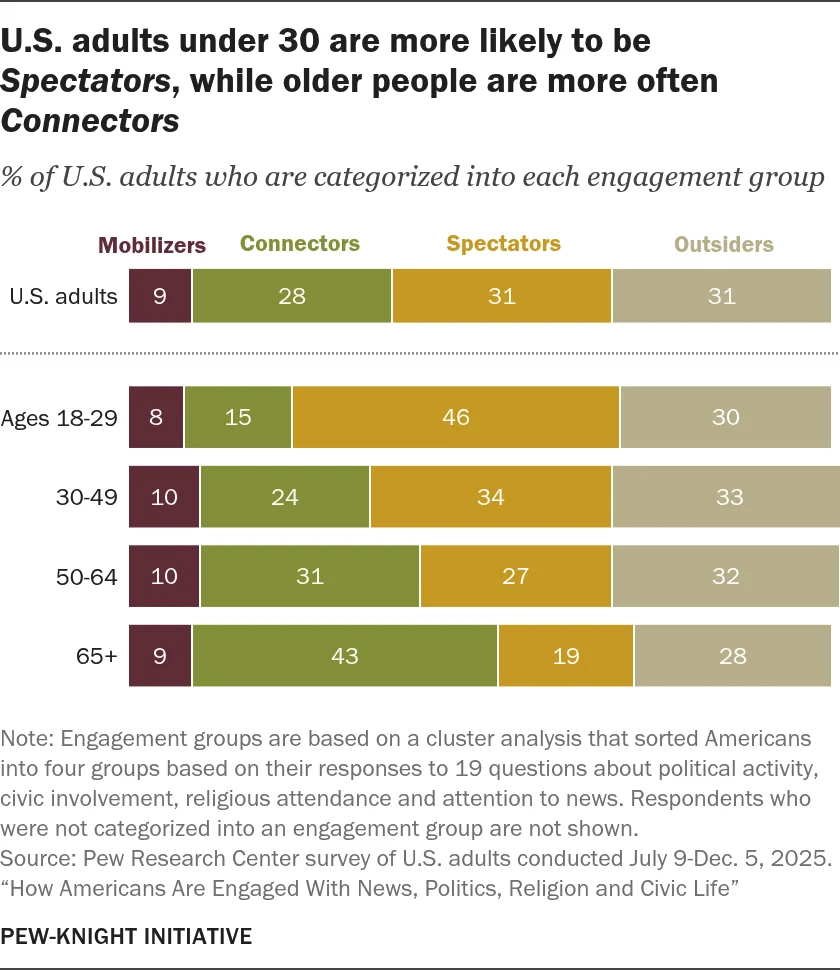
Furthermore, a deep dive into public engagement shows a stark divide based on age. The Pew-Knight Initiative categorized the American public into four distinct groups:

- Mobilizers: Highly active in political, civic, and community life.
- Connectors: Engaged in community organizations, religious services, and civic life.
- Spectators: Primarily interact with the world through consuming news online but are less active in face-to-face civic groups.
- Outsiders: Low levels of engagement across all metrics.
The data reveals that older Americans are significantly more likely to fall into the "Connector" category, while younger adults (under 30) are overwhelmingly "Spectators," with 46% of that demographic falling into the group that follows the news passively rather than participating in the community.
Official Responses and Industry Sentiment
The legal community and corporate analysts are currently divided on the merits of the antitrust case.
Representatives for Paramount and Warner Bros. Discovery have maintained that the merger is essential for the long-term survival of the companies. In a brief statement following the TRO, a spokesperson for the companies argued that the merger would "provide the necessary scale to invest in high-quality journalism and entertainment in an increasingly global and hyper-competitive digital marketplace." They contend that the market is already highly fragmented due to the presence of global tech conglomerates, and that a larger domestic media company would actually increase consumer choice by sustaining jobs and content production.
Conversely, the states involved in the litigation argue that the merger represents a dangerous level of "horizontal integration." In a press release following the filing, lead council for the coalition stated, "When two of the most trusted names in American news fall under the same corporate umbrella, the diversity of the marketplace suffers. We are not just talking about movie studios; we are talking about the gatekeepers of our democratic information."
Implications: The Future of the Newsroom
The implications of this legal battle extend far beyond the courtroom. If the merger is ultimately blocked, it may force both companies to pursue "Plan B" scenarios, which could include selling off key assets—potentially splitting their news divisions from their entertainment arms. This would be a significant victory for media watchdogs who have long feared the homogenization of national news.
However, if the merger is allowed to proceed under strict conditions, it could set a precedent for how future media consolidations are handled. It suggests that regulators are moving toward a framework where news division independence is a core requirement for approving any major media merger.
The shift toward video content also presents a long-term challenge for the industry. As newsrooms pivot, they face the "pivot to video" dilemma of a decade ago: the difficulty of monetizing video content as effectively as traditional advertising while maintaining the depth and nuance that only text-based journalism can provide. As Americans—particularly the "Spectator" demographic—become more reliant on platforms like YouTube and TikTok for their information, the responsibility for maintaining high editorial standards becomes even more critical.
As the legal proceedings continue through the remainder of the summer, the industry will be watching closely. For the average American citizen, the outcome of this case will define not only which corporate logo appears on their evening news broadcast, but also the very landscape of the information ecosystem for the next decade.
For now, the status quo remains, but the pressure on media companies to innovate while navigating a increasingly hostile regulatory environment has never been greater. The era of the mega-conglomerate is being tested, and the outcome will be felt in every American household that turns to the news to understand a rapidly changing world.