In the realm of public opinion research, the integrity of the data is only as strong as the methodology used to collect it. As political discourse becomes increasingly fragmented and the American electorate shifts, the challenge of capturing a truly representative snapshot of the nation has never been greater. Recently, the Pew Research Center released the findings from Wave 196 of its American Trends Panel (ATP), a landmark survey conducted between July 6 and July 12, 2026. This report provides an in-depth exploration of the rigorous scientific framework underpinning this study, detailing how the Center navigates the complexities of modern polling to ensure accuracy, inclusivity, and statistical significance.
Main Facts: The Anatomy of Wave 196
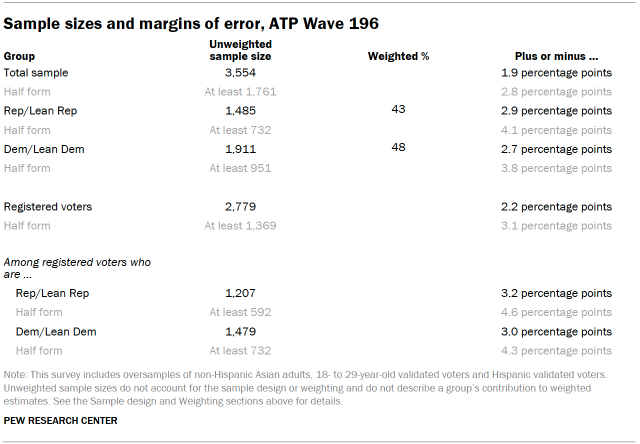
Wave 196 represents a significant effort to gauge the pulse of the American adult population. Drawing from the ATP—a nationally representative, randomly selected panel of U.S. adults—the survey achieved a robust sample size of 3,554 respondents out of 4,173 sampled. This yielded a survey-level response rate of 85%, a testament to the Center’s sustained engagement strategies.
The margin of sampling error for this full sample stands at plus or minus 1.9 percentage points, providing a high degree of confidence in the findings. To ensure the inclusion of traditionally underrepresented voices, the study utilized strategic oversampling of non-Hispanic Asian adults, as well as validated voters within the 18-to-29 age bracket and the Hispanic community. These oversampled cohorts are subsequently weighted to align with their actual demographic proportions in the U.S. census, ensuring that the final dataset remains an accurate reflection of the national landscape. The fieldwork, managed by SSRS, utilized a hybrid approach, incorporating both online (n=3,428) and live telephone (n=126) interviews conducted in both English and Spanish.
Chronology of Recruitment and Execution
The methodology behind the ATP has evolved significantly since its inception in 2014. While early recruitment relied on traditional random-digit-dial (RDD) methods, the Center transitioned to an address-based sampling (ABS) model in 2018. This shift allows for more precise targeting of households through the U.S. Postal Service’s Computerized Delivery Sequence File, which covers an estimated 90% to 98% of the total population.
Recruitment Cycles
The panel is replenished through annual recruitment drives. These drives are not merely administrative; they are carefully orchestrated campaigns to ensure the panel remains "fresh" and representative. Over the years, the Center has integrated targeted oversampling efforts to capture the views of specific demographics—notably Hispanic adults in 2019, Black adults in 2022, and Asian adults in 2023. This longitudinal commitment ensures that the ATP does not stagnate, but rather matures alongside the changing demographic fabric of the United States.
The Fieldwork Timeline (July 2026)
The execution of Wave 196 followed a strictly controlled protocol:
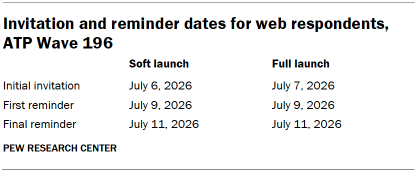
- July 2: Prenotification postcards were dispatched to telephone participants.
- July 6: Official commencement of the field period. Online postcard notifications were mailed, and the "soft launch" began. A small, controlled group of 60 panelists was invited to participate to test the stability of the digital infrastructure.
- July 7: The full launch commenced, with invitations extended to the remaining English- and Spanish-speaking online panelists.
- July 6–12: The primary window for data collection occurred, involving persistent but measured follow-up, including email reminders, SMS invitations for opted-in users, and up to six telephone call attempts by trained SSRS interviewers.
Supporting Data and Technical Rigor
The credibility of survey data relies on the mitigation of bias and the elimination of "satisficing"—a phenomenon where respondents provide perfunctory or rushed answers.
Data Quality and Cleaning
Before the data was analyzed, researchers performed a rigorous "scrubbing" process. Respondents who exhibited patterns of suspicious behavior—such as leaving a high volume of questions blank or defaulting to "straight-lining" (selecting the same answer for every item in a battery)—were flagged. In Wave 196, this stringent quality control led to the removal of two respondents from the dataset, ensuring that the final analysis was built upon a foundation of genuine, thoughtful engagement.
Weighting: The Science of Representation
The raw data from a survey is rarely a perfect mirror of the population. To correct for the inevitable imbalances created by nonresponse and the differing probabilities of selection, the Center employs a multi-stage weighting process.
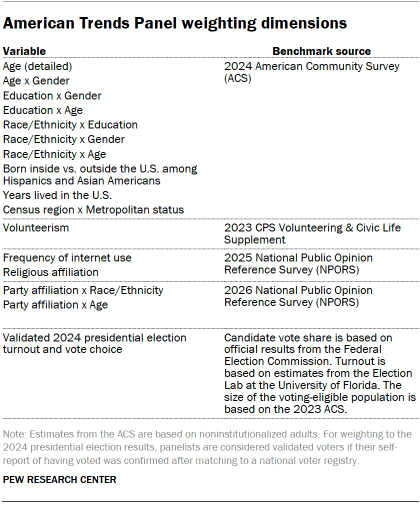
- Base Weighting: Each participant is assigned a weight based on their probability of recruitment.
- Calibration: These weights are then adjusted to align with known population benchmarks (such as age, gender, education, race, and region).
- Trimming: To prevent individual respondents from exerting undue influence on the results due to extreme weighting, the values are trimmed at the 1st and 99th percentiles. This delicate balance preserves the precision of the data while ensuring that no single demographic group is either over-represented or erased.
Official Responses and Strategic Development
The collaboration between the Pew Research Center and SSRS is built on a foundation of iterative testing. For Wave 196, the questionnaire underwent extensive pilot testing across multiple platforms. Recognizing that a significant portion of the audience interacts with surveys via mobile devices, the web program was optimized for both PC and smartphone interfaces.
Furthermore, the implementation of a post-paid incentive structure—ranging from $5 to $15 depending on the difficulty of reaching the specific demographic—serves as an acknowledgement of the participant’s time and a tool to ensure high response rates among harder-to-reach populations. By offering flexible rewards (checks or digital gift cards for major retailers), the Center removes barriers to participation, reinforcing the democratic nature of the survey process.
Implications for Future Research
The methodology employed in Wave 196 offers a blueprint for the future of public opinion research. As the digital divide persists and telephone reliability fluctuates, the hybrid approach of the ATP—combining address-based mail recruitment with digital and telephonic engagement—provides a robust solution.
The implications for researchers are clear: high-quality polling is not a static endeavor. It requires:
- Proactive Recruitment: Continuous investment in bringing new voices into the panel.
- Technological Adaptability: Ensuring that the survey experience is seamless regardless of the device used.
- Transparency: By openly publishing the details of the weighting dimensions, the margin of error, and the disposition of the respondents, the Pew Research Center sets a gold standard for transparency.
As the political landscape moves toward the midterm elections and beyond, the data derived from these rigorous methods will be essential for policymakers, journalists, and the public. By prioritizing scientific rigor over speed, the Pew Research Center ensures that its findings are not just numbers on a page, but a reliable reflection of the complex, evolving, and diverse opinions of the American people. The success of Wave 196 serves as a powerful reminder that while the tools of polling may change, the necessity of scientific integrity remains the bedrock of a well-informed society.