

In an era where public opinion is increasingly fragmented, the ability to capture a truly representative snapshot of the American electorate is a cornerstone of democratic accountability. Pew Research Center’s American Trends Panel (ATP) remains a gold standard for this endeavor. The release of data from Wave 181—conducted from October 6 to October 16, 2025—offers not only a wealth of insight into the contemporary American experience but also serves as a masterclass in rigorous survey methodology.
By combining advanced statistical weighting, targeted oversampling, and multi-modal data collection, the ATP provides a granular view of the U.S. population. This report outlines the technical framework that ensures the findings of Wave 181 maintain the highest levels of scientific validity.
The Foundation: Main Facts and Survey Architecture
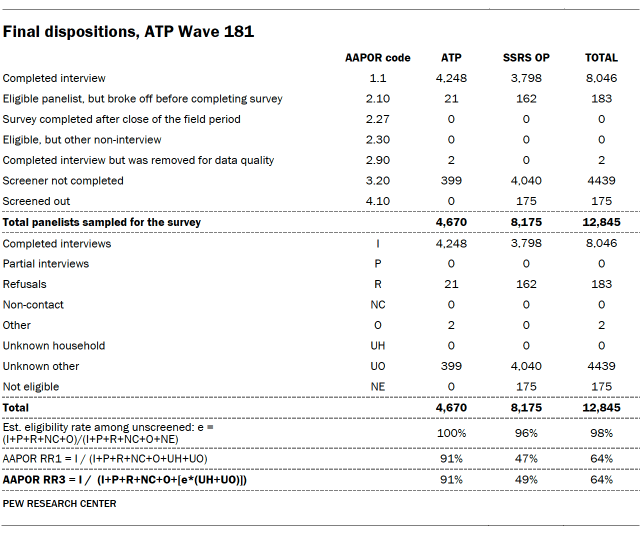
Wave 181 of the ATP stands as a significant achievement in large-scale social science research. The survey successfully engaged 8,046 respondents out of a total sample of 12,845, yielding a robust survey-level response rate of 64% (based on the AAPOR RR3 standard). This collective effort was comprised of 4,248 participants from the established American Trends Panel and an additional 3,798 respondents sourced from the SSRS Opinion Panel.

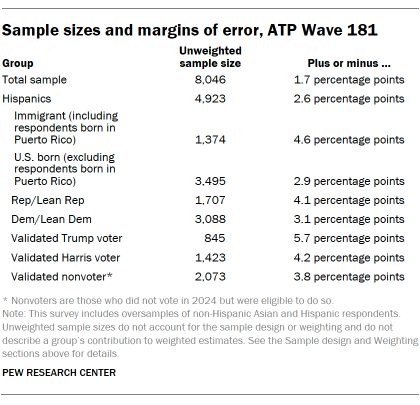
The scope of this research is intentionally broad, targeting non-institutionalized U.S. adults aged 18 and older. To ensure that the findings were not merely a reflection of the "majority" experience, researchers employed specific oversampling techniques. By intentionally recruiting higher numbers of non-Hispanic Asian and Hispanic adults, the Center ensured that these critical demographic subgroups could be analyzed with a level of statistical precision that is often lost in smaller, less targeted polls. These groups were subsequently weighted to reflect their true proportion within the national population, maintaining the integrity of the total dataset.
The precision of these findings is anchored by a margin of sampling error of plus or minus 1.7 percentage points for the full sample. This tight margin is essential for navigating the complex nuances of American policy preferences and social attitudes.
The Chronology of Data Collection
The success of Wave 181 relied on a meticulously timed execution strategy, divided between digital outreach and traditional live-interviewer engagement.
Pre-Survey Preparation
Before a single question was asked, the questionnaire underwent a rigorous testing phase. Developed by Pew Research Center in collaboration with SSRS, the digital interface was stress-tested across a variety of devices—ranging from high-end desktop PCs to standard mobile smartphones. By populating test data and analyzing it through SPSS software, the research team verified that the survey logic, skip patterns, and randomization protocols were functioning perfectly before the soft launch.
Execution: The Two-Stage Launch
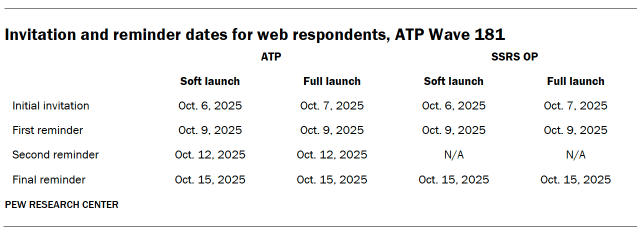
The data collection phase officially began on October 6, 2025.
- The Soft Launch (Oct 6): A smaller cohort of 801 panelists (60 from the ATP, 741 from the SSRS Opinion Panel) were invited to participate. This initial phase allowed researchers to monitor the flow of data in real-time, ensuring that no technical hurdles impeded the respondent experience.
- The Full Launch (Oct 7): Upon the successful conclusion of the soft launch, the remaining English- and Spanish-speaking panelists were invited to participate.
For online participants, the process was iterative. After the initial email invitation, respondents were sent up to three reminders. For those who had consented to SMS communication, mobile-optimized invitations and reminders were sent, significantly boosting accessibility. Simultaneously, phone-based interviews—conducted by trained SSRS professionals—ensured that those less comfortable with web interfaces were still represented. This dual-track system, involving up to six contact attempts for phone participants, minimized the risk of non-response bias.
Supporting Data and Technical Rigor
Data quality is not merely a goal at the Pew Research Center; it is a structural mandate. During the processing of Wave 181, researchers employed aggressive "satisficing" checks. This process identifies respondents who exhibit patterns of inattentiveness, such as "straight-lining" (selecting the same answer for every question) or leaving an excessive number of questions blank. Following this rigorous vetting, two respondents were removed from the dataset to protect the accuracy of the final analysis.
The Science of Weighting
Weighting is the process by which raw survey data is transformed into a representative model of the United States. The methodology for Wave 181 involved a multi-stage approach:
- Base Weights: Every respondent begins with a base weight reflecting their probability of being recruited into the panel.
- Integration: The base weights for both ATP and SSRS Opinion Panelists were scaled to harmonize the two distinct pools of data.
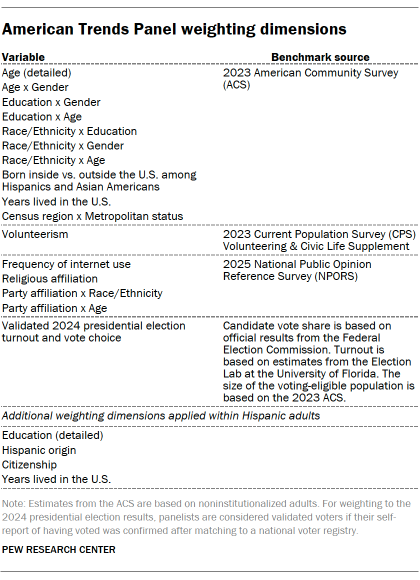
- Calibration: The final weights were calibrated against established national benchmarks—including age, gender, education, and geographic distribution—to ensure the sample mirrors the actual demographics of the United States.
- Trimming: To prevent extreme weights from skewing the results, the final values were trimmed at the 1st and 99.5th percentiles.
This mathematical rigor ensures that the final data is not just a collection of responses, but a scientifically balanced projection of the American public.
Official Responses and Participant Incentives
Recognizing the "participation fatigue" inherent in modern polling, the research team utilized a strategic incentive structure. All participants were offered post-paid rewards, ranging from $5 to $20, depending on the respondent’s demographic profile. These incentives were specifically calibrated to encourage participation among harder-to-reach groups, who historically have lower response propensities. By offering choices like Amazon, Target, or Walmart gift codes, or a traditional check, the Center removed barriers to entry, ensuring that a diverse array of economic backgrounds were captured in the final count.
Implications: Understanding Economic Disparity
One of the most innovative aspects of the Wave 181 methodology is its approach to household income. Raw income data is notoriously difficult to compare across the U.S. because of the vast differences in the cost of living.
To address this, Pew Research Center adjusts family income data based on household size and regional geographic cost-of-living differences. For instance, the research acknowledges that an income of $40,200 in a low-cost area like Pine Bluff, Arkansas, provides a standard of living equivalent to $59,100 in the high-cost San Francisco-Oakland-Berkeley area.
By applying these adjustments, the Center creates "income tiers" that provide a far more accurate picture of financial health than nominal income ever could. This level of detail allows for a deeper understanding of how economic status influences policy opinions, health outcomes, and social priorities.
Conclusion: Why Methodology Matters
The technical specifications of Wave 181 are not merely academic; they are the bedrock upon which trust in public polling is built. By utilizing address-based sampling (ABS) to recruit panelists—a practice adopted by the ATP in 2018 to capture the 90% to 98% of the population reachable via the U.S. Postal Service—the Center ensures that its reach extends beyond those who are simply "online-first."
As we look toward future waves of the American Trends Panel, the methodologies established here—the commitment to oversampling marginalized groups, the focus on geographic economic parity, and the rigorous cleaning of data—serve as a reminder that the quality of our national discourse is only as good as the data that informs it. In an age of misinformation, the transparency of the Pew Research Center’s Wave 181 methodology provides a necessary, objective lighthouse for policymakers, researchers, and the American public alike.