WASHINGTON — A sprawling new international study reveals a stark global divide in how artificial intelligence is perceived, consumed, and feared. According to comprehensive data released by the Pew Research Center, anxieties regarding artificial intelligence—particularly its capacity to disrupt labor markets and widen economic inequality—are significantly more pronounced in high-income nations than in middle-income economies.
The findings illuminate a psychological and awareness-based trench separating the industrialized world from developing markets. While citizens in wealthier countries are increasingly sounding alarms over job displacement and a widening chasm between the rich and poor, populations in middle-income countries often report lower baseline awareness of the technology, coupled with higher rates of uncertainty regarding its long-term societal fallout.
The exhaustive research project surveyed 42,151 adults across 36 countries between February 8 and May 13, 2026, offering one of the most comprehensive cross-cultural snapshots of public sentiment toward the generative AI boom to date.
Main Facts
The Pew Research Center study categorizes surveyed nations utilizing World Bank income classifications, dividing them evenly into 18 high-income and 18 middle-income countries (excluding the West Bank and East Jerusalem due to GDP data constraints). The core metrics underscore a profound disparity in outlook:
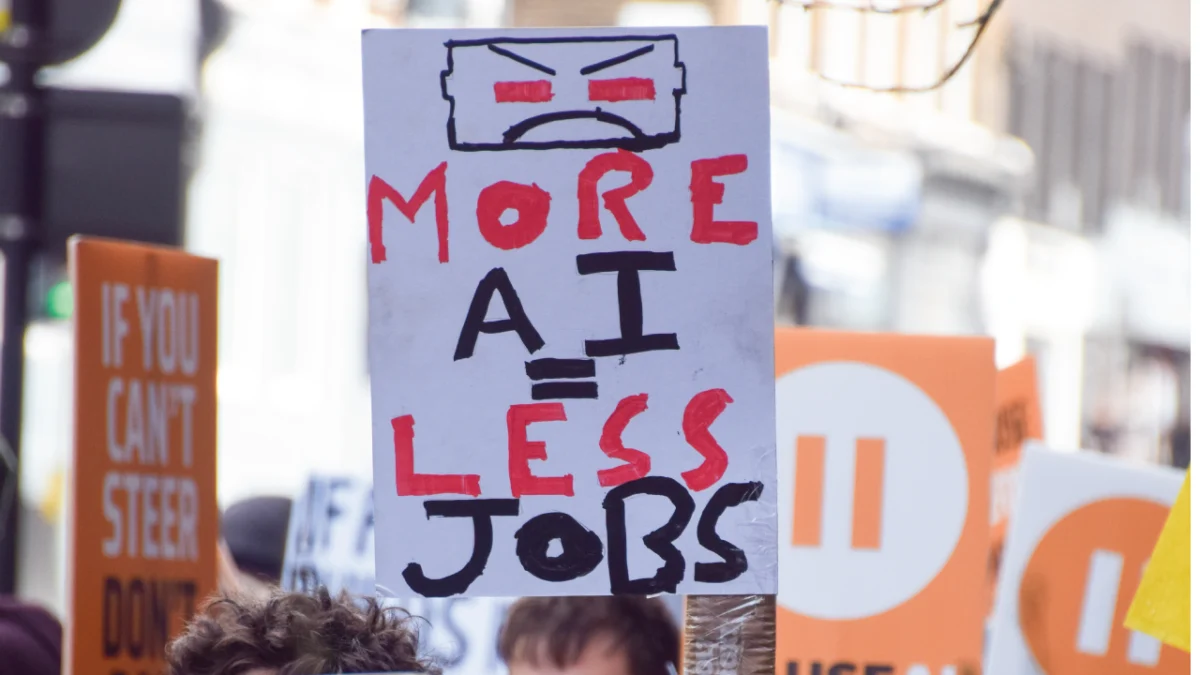
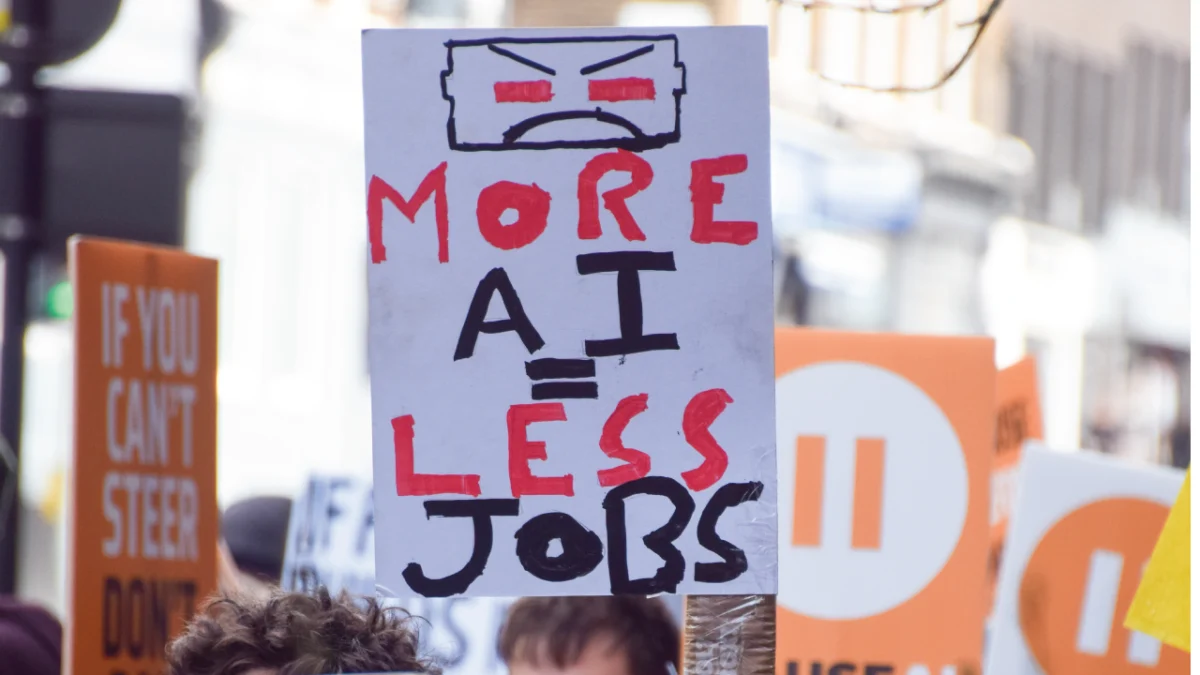
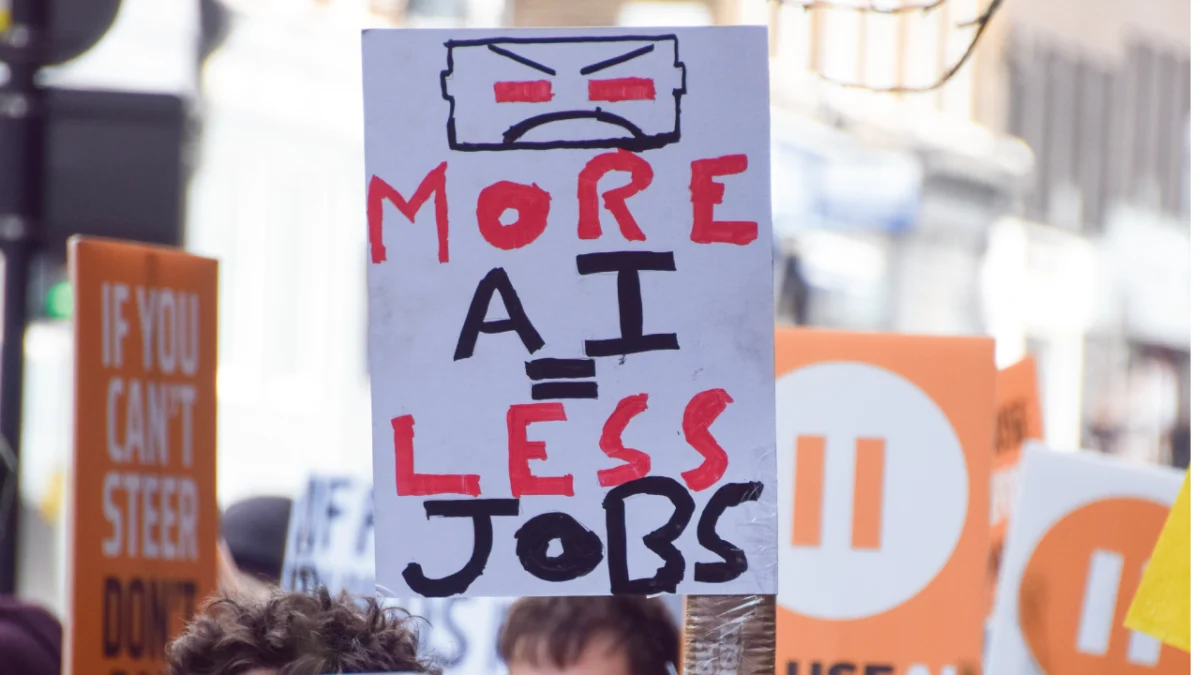
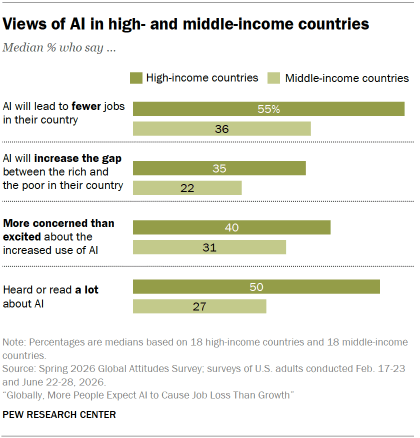
- Job Insecurity: A median of 55% of adults across the 18 high-income countries believe AI will lead to fewer jobs over the next two decades. In contrast, only 36% of respondents in the 18 middle-income countries share this pessimistic outlook, with a much larger share (34% versus 22%) expressing uncertainty.
- Economic Inequality: Wealthier nations harbor deeper fears that AI will exacerbate wealth gaps. A median of 35% of respondents in high-income countries predict the technology will increase the disparity between the rich and the poor, compared to just 22% in middle-income nations.
- Awareness Gap: Half of all respondents (a 50% median) in high-income countries report having read or heard "a lot" about AI. Conversely, only 27% of people in middle-income countries report the same level of exposure. Meanwhile, 28% of individuals in middle-income countries state they have heard "nothing at all" about AI, compared to just 9% in high-income nations.
- Net Caution Over Celebration: Globally, unbridled excitement for AI remains remarkably low. A median of 40% of people in high-income countries are more concerned than excited about AI, compared to 31% in middle-income countries. However, pure enthusiasm is scarce everywhere, hovering at a mere 14% in high-income nations and 13% in middle-income countries, with most citizens adopting a nuanced, "wait-and-see" approach that blends both anxiety and cautious optimism.
Chronology of the Research
The insights published in late 2026 are the culmination of a multi-year tracking effort by the Pew Research Center to map the rapid acceleration of AI technologies into global consumer and professional spaces.
- Prior Baselines (2025): The research builds directly upon prior baseline studies conducted across 25 countries, which initially signaled that public awareness of generative AI was growing unevenly across different geographic and economic zones.
- Early 2026 Survey Window (February 8 – May 13, 2026): Field researchers executed the primary global survey, capturing responses from 41,113 adults across 35 countries. This massive undertaking involved standardized questionnaires translated into dozens of local languages to ensure accurate cross-national comparisons.
- U.S. Panel Integration (February and June 2026): To capture a granular view of American sentiment—traditionally an early adopter and cultural epicenter for commercial AI rollouts—Pew supplemented its global data with two distinct waves from its American Trends Panel. The first wave surveyed 5,119 U.S. adults from February 17 to February 23, 2026, while a subsequent wave of 3,488 adults was polled from June 22 to June 28, 2026.
- Publication and Classification Release (September 2026): Researchers formally compiled and published the comparative dataset, utilizing World Bank lending group metrics to juxtapose high-income economies (such as the U.S., Germany, Japan, and Singapore) against middle-income powerhouses (such as India, Brazil, Nigeria, and Indonesia).
Supporting Data: The GDP Correlation
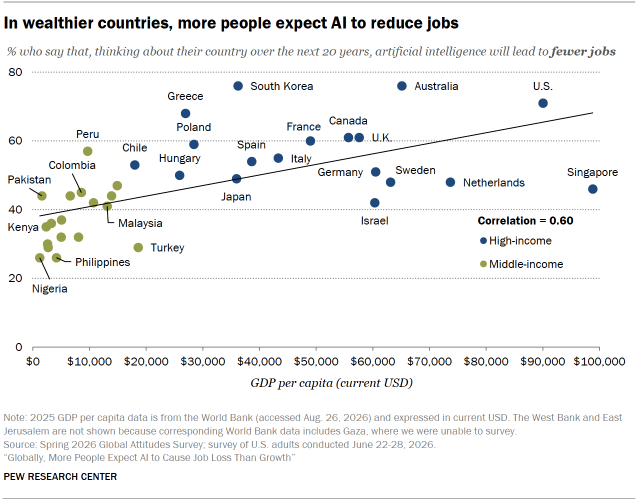
A critical discovery of the 2026 study is that skepticism surrounding AI is not random; rather, it correlates strongly with a nation’s Gross Domestic Product (GDP) per capita.
When analyzing expectations regarding job losses and inequality, statisticians noted a linear relationship: as a country’s GDP per capita rises, so too does the public’s anxiety regarding technological disruption.
[High GDP per Capita] ---> High AI Awareness ---> High Fear of Job Loss / Inequality
[Lower GDP per Capita] --> Low AI Awareness ---> Higher Uncertainty / Optimism
For instance, in nations with lower GDP per capita within the middle-income bracket—such as Kenya, Nigeria, and the Philippines—expectations that AI will destroy jobs are markedly lower. Conversely, citizens in wealthy economies boasting high GDP per capita figures, such as Australia and the United States, are significantly more likely to foresee mass unemployment driven by automation.
An interesting outlier in the dataset is Singapore, a high-income nation with immense GDP per capita where public anxiety over job loss does not spike as aggressively as in peer nations like the U.S., pointing to unique local trust in government reskilling initiatives or distinct economic structures.
When examining specific national divides, the contrast becomes stark. In the United States, 46% of surveyed adults believe AI will expand the chasm between the rich and the poor. In sharp contrast, only 13% of respondents in middle-income Colombia share that specific apprehension, highlighting how economic maturity shapes a population’s vulnerability calculus.
Official Responses and Expert Perspectives
As the findings reverberate through policy circles, international labor organizations, and tech think tanks, experts are grappling with what the "AI sentiment divide" means for global development goals.
Sociologists and economists point out that the data reflects a profound difference in immediate daily struggles. In lower- and middle-income countries, populations may be more preoccupied with systemic challenges—such as inflation, infrastructural deficits, or basic employment security—pushing speculative anxieties about machine learning and large language models down the priority list.
Furthermore, civil society leaders in the Global South have increasingly cautioned against Western-centric regulatory frameworks that assume all societies interact with technology in the same way. While policymakers in Brussels and Washington rush to pass stringent guardrails against algorithmic bias, deepfakes, and white-collar job displacement, policymakers in developing nations are often more focused on leveraging basic digital infrastructure and mobile internet access for economic inclusion.
Tech industry representatives, meanwhile, view the lower levels of concern and higher uncertainty in middle-income countries as an opportunity for educational outreach. Rather than viewing hesitation as outright rejection, industry stakeholders argue that emerging markets present fertile ground for constructive technological integration—provided that local workforces are equipped with the digital literacy tools necessary to thrive in an automated future.
Implications for the Future
The Pew Research Center’s 2026 findings carry profound implications for global economic policy, labor unions, and international governance.
1. The Threat of a Dual-Speed Workforce
If high-income countries anticipate severe labor market disruptions while middle-income nations remain uncertain or unprepared, the global distribution of labor could undergo dramatic shifts. Wealthier nations may aggressively automate service and knowledge-work sectors, potentially decoupling productivity from human headcount. Meanwhile, middle-income nations that view AI with relative nonchalance risk being blindsided by rapid technological shifts if they fail to future-proof their educational and vocational pipelines.
2. Widening the Global Digital Divide
Awareness is the precursor to agency. Because half of all citizens in high-income nations report heavy exposure to AI discourse compared to just 27% in middle-income regions, a secondary digital divide is taking shape. It is no longer just about who has access to broadband internet or computing hardware; it is about who understands the socio-economic mechanisms of algorithmic systems. Without targeted international interventions, populations in the developing world risk becoming passive consumers—or victims—of technological systems designed and governed entirely by the Global North.
3. Policy and Regulatory Divergence
The disparity in public sentiment will inevitably complicate international efforts to establish unified global standards for AI safety and ethics. Governments accountable to populations deeply anxious about inequality and job loss will face intense political pressure to enact restrictive, precautionary regulations. Conversely, nations where the public is either unware of or indifferent to AI may adopt more permissive regulatory postures to attract foreign tech investment, setting the stage for regulatory arbitrage on a global scale.
As artificial intelligence continues its relentless integration into the fabric of daily life, the 2026 Pew Research data serves as a vital warning flare: the future of AI will not be experienced uniformly. How governments, corporations, and international bodies bridge the gap between anxiety in the wealthy world and uncertainty in the developing world will define the trajectory of the global economy for decades to come.