The Content Delivery Network (CDN) industry, once a high-growth darling of the internet infrastructure world, has entered a period of profound stagnation. Following the last comprehensive market sizing in 2023, the landscape has undergone a violent consolidation. Major players have either exited the stage or collapsed entirely, leaving behind a market defined by flat revenue growth, aggressive traffic repatriation by hyperscalers, and a definitive end to the "race to the bottom" in pricing.
As of 2026, the global CDN market is no longer driven by the explosive bit-growth trajectories of the past. Instead, it is characterized by intense efficiency, shifting delivery strategies among the world’s largest content owners, and a sobering reality check regarding the impact of AI on network traffic.
Chronology of Consolidation: The Fall of the Legacy Titans
The period between 2023 and 2026 will be remembered as the era of "The Great Thinning." The industry saw the bankruptcy of Edgio, the total closure of StackPath, and a strategic retreat by Lumen, which exited the CDN business entirely.
In a move that signaled the end of an era, Akamai Technologies—the industry’s long-standing incumbent—acquired select contracts from these departing entities. Crucially, these deals were for customer relationships rather than assets. This consolidation reduced the pool of competitive vendors significantly, yet, contrary to economic theory, the reduction in supply did not trigger a surge in pricing power or revenue growth. Instead, total revenue for delivery services remained flat or experienced a slight contraction of approximately 2%. Traffic shifted, but the fundamental catalysts required to accelerate bit-delivery growth never arrived.
The Myth of Exponential Traffic Growth
For years, analysts and investors pointed to 4K streaming, Virtual Reality (VR), and Augmented Reality (AR) as the inevitable engines that would force massive infrastructure scaling. By 2026, it is clear these catalysts failed to materialize at the scale projected.
Encoding Efficiency and the Death of the "Bit-Growth" Narrative
The post-COVID era forced streaming giants to optimize their bitrate ladders aggressively. Engineering teams discovered they could deliver parity or superior video quality with significantly fewer bits. Consequently, the industry settled on 1080p HDR as the default standard for the vast majority of live events. 4K, once heralded as the future of streaming, remained a niche, failing to drive the anticipated traffic spikes.
The Agentic AI Fallacy
Wall Street’s recent obsession with the "agentic" use of the internet—traffic generated by autonomous AI agents—has proven to be a fundamental misunderstanding of delivery technology. While AI agents are undoubtedly active, they are not engaged in the activities that drive CDN volume: streaming high-bitrate video or downloading massive software binaries. AI-driven traffic is lightweight, transactional, and does not serve as a replacement for the high-volume media delivery that sustains the CDN business model.
Supporting Data: Where the Revenue Resides
A critical vulnerability of the CDN sector is its reliance on a tiny cohort of "super-customers." Industry data suggests that fewer than 50 customers account for roughly 75% of all third-party CDN revenue. This concentration creates a volatile environment where the strategic pivots of just a few major players—such as Amazon, Disney, or TikTok—can ripple through the entire ecosystem.
Customer Concentration Metrics
- Limelight Networks (pre-consolidation context): In Q1 2023, fewer than 20 customers accounted for 75% of total revenue, with Amazon and Sony alone contributing 42%.
- Fastly: As of Q1 2026, the company’s top 10 customers accounted for 34% of total revenue.
- Akamai: Historically, the company disclosed that its top six media customers accounted for nearly 18% of its media revenue at its peak.
The Shift Toward "DIY" and Hyperscale Internalization
The most significant headwind for third-party vendors is the aggressive move toward "Do-It-Yourself" (DIY) delivery. Amazon, historically a massive user of third-party CDNs for Prime Video, has systematically moved traffic in-house to its own CloudFront infrastructure. Similarly, TikTok has optimized its traffic distribution, relying more on its own internal delivery architecture and using that leverage to force down pricing among third-party vendors. Even the largest live events have increasingly migrated toward proprietary platforms like Netflix and YouTube, which bypass the third-party CDN ecosystem entirely.
Pricing Trends: The End of the "Race to the Bottom"
For those awaiting the annual, predictable "20% drop" in CDN pricing, the reality of 2026 is a hard pivot. The era of aggressive price erosion has concluded.
Why Pricing Is Ticking Up
The cost of infrastructure—hardware, electricity, and network egress—has risen substantially since the second half of 2025. This, combined with low margins in delivery services and high capital expenditure (capex) requirements, has forced vendors to move away from "build it and they will come" strategies.
In a landmark move, Akamai implemented a 3% monthly surcharge for all clients starting in Q2 2026 to offset rising power and infrastructure costs. Furthermore, in high-cost regions like Korea (where pricing is 10x that of North America) and South America (2.8x), vendors are no longer absorbing costs. Many are simply refusing to build capacity where the ROI is not guaranteed, leading to situations where traffic for entire regions is still backhauled through hubs like Miami.
The RFP Reality
Contrary to social media narratives suggesting CDNs are "giving away" delivery to land high-margin cloud security deals, the data from actual RFPs tells a different story. In recent high-value contracts (tens of millions of dollars annually), the quotes from major providers like Akamai, Fastly, CloudFront, and CDN77 were within $0.0001 per GB of each other. The market is not "racing to the bottom"; it is operating within a tight, margin-conscious band where price-cutting is no longer a viable competitive strategy.
Implications for the Industry
The CDN industry is in the midst of a painful transition from a growth market to a utility market.
1. The Death of the "Multi-CDN" Strategy
Many mid-tier OTT platforms, which previously maintained stacks of 4–6 vendors, have retracted to 2–3. The perceived benefits of a complex multi-CDN strategy simply did not manifest, and the management overhead proved unsustainable for the majority of these companies.
2. ISP and Carrier Platforms
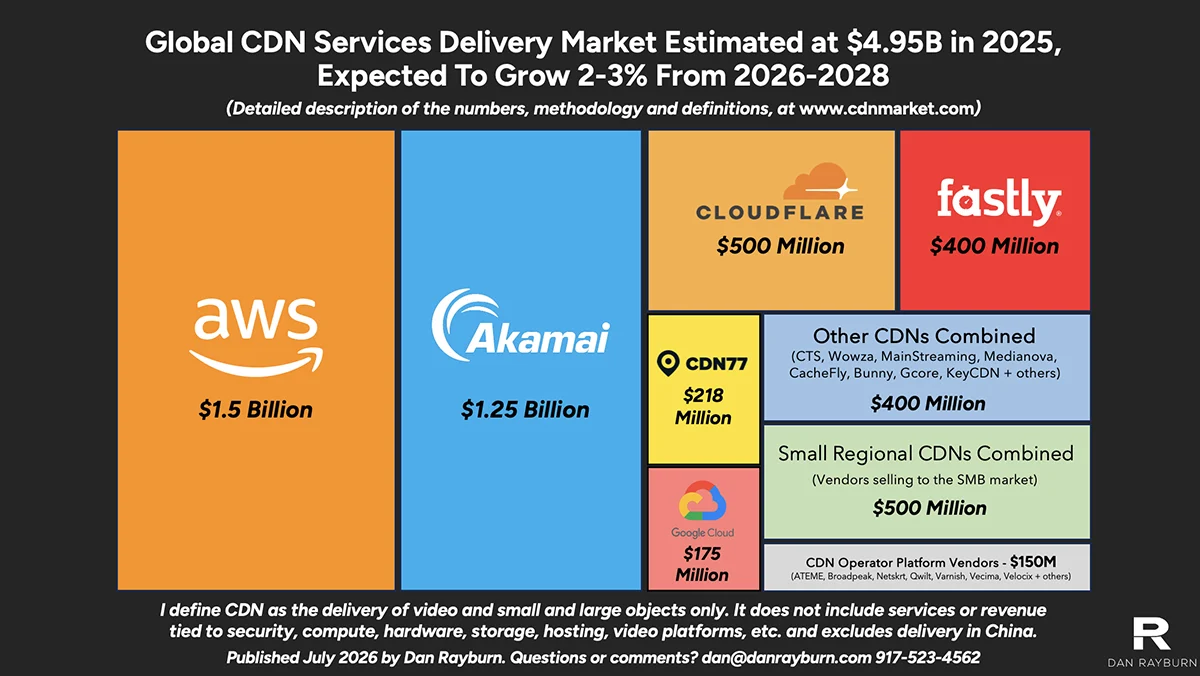
The dream of turning ISPs into CDN vendors has largely failed. Revenue from platforms sold to telcos for "edge delivery" has declined. Vendors that relied on revenue-share models with ISPs have largely abandoned the practice, as most telcos are solely interested in reducing their own transit costs, not in becoming competitors to established CDN giants. The 2025 market for these specialized platform vendors generated a modest $150 million globally.
3. Market Size and Outlook
Estimating the total CDN market size requires extreme caution. When excluding Chinese vendors and isolating delivery-specific revenue from cloud security, compute, and media workflow services, the 2025 global market is estimated at approximately $4.95 billion. Looking ahead to 2026–2028, analysts expect a meager 2–3% growth rate.
The industry is now a game of margin management and capital discipline. The "hype" years are over. Companies that continue to operate on the assumption that traffic will grow exponentially without corresponding investment in infrastructure will find themselves sidelined.
Final Assessment
The CDN sector has matured into a stable, but slow-growth, segment of the global digital infrastructure. The focus for vendors must now shift from capturing "the next big surge" in traffic to maximizing the profitability of existing, high-scale traffic. For customers, the lesson is equally clear: the era of "cheap bits" is over, and the future belongs to those who can effectively manage a consolidated, high-performance, and cost-efficient delivery stack. The data does not lie: we are in the era of the flat-line, and the winners will be those who best navigate this new, disciplined reality.