The landscape of video streaming technology is undergoing a profound transformation, moving away from the "pure software" era toward a highly specialized, hardware-accelerated, and AI-driven future. According to the newly released NETINT State of Video Encoding Survey 2026, the industry has reached a critical inflection point where codec maturity, operational scale, and artificial intelligence are no longer just buzzwords—they are the primary drivers of investment and infrastructure strategy.
With 84% of organizations having already deployed H.264/AVC, the industry has hit a plateau of universal adoption. However, the path forward is marked by a clear transition toward AV1, a rapid shift toward heterogeneous hardware stacks, and the integration of AI directly into the encoding pipeline.
Main Facts: The Codec Hierarchy and the Rise of AV1
The survey highlights a clear "codec progression ladder." As organizations mature, they invariably move from H.264 toward more efficient, next-generation formats. While H.264 remains the bedrock of production, the narrative of 2026 belongs to AV1.
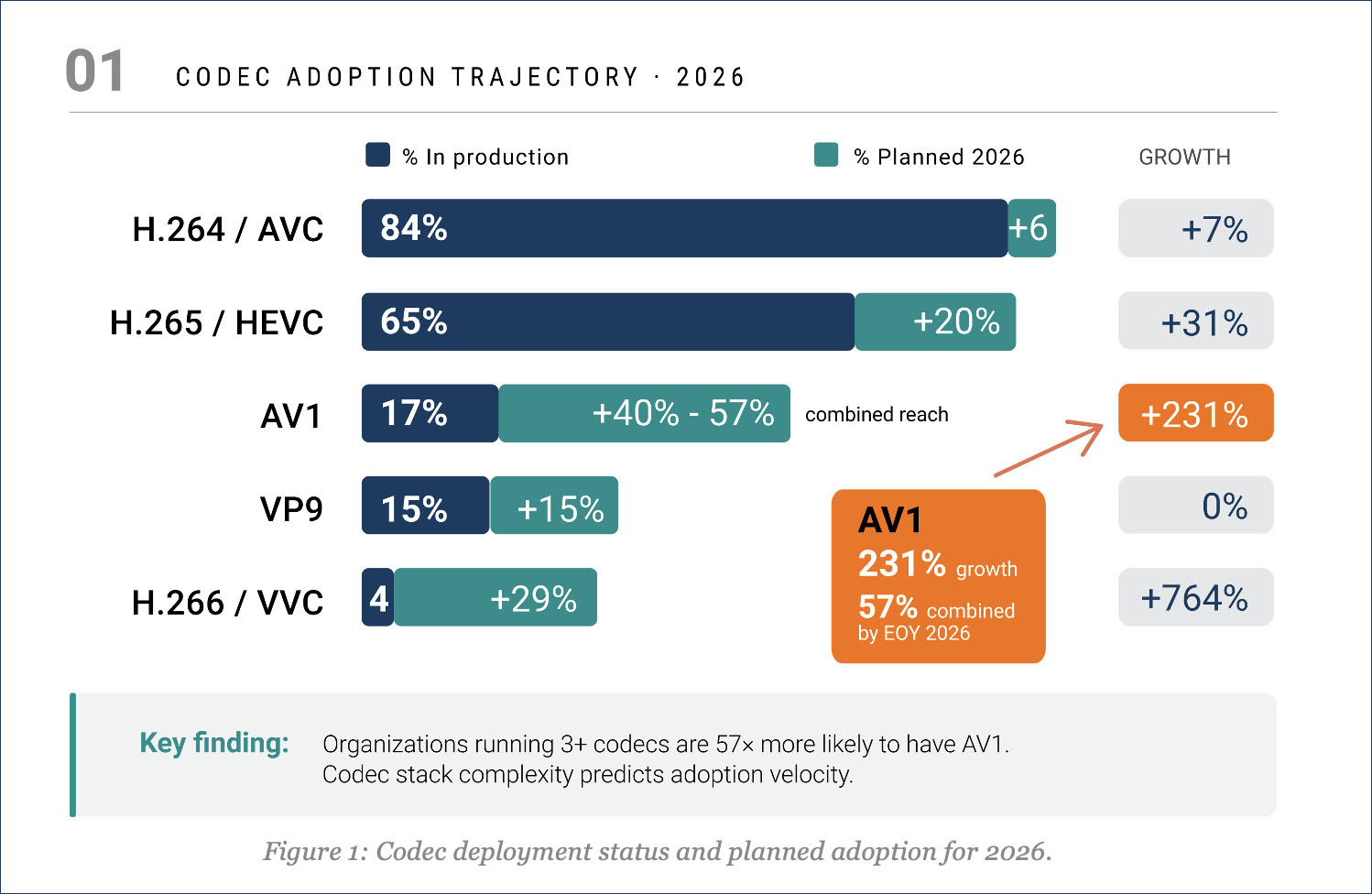
Currently, AV1 sits at 17% in production deployment. While this may appear modest, the future-looking data is staggering: 40% of respondents plan to deploy AV1 by the end of 2026, creating a projected reach of 57%. This is not an "early adopter" experiment; it is a calculated, industry-wide shift toward a codec that offers superior efficiency without the licensing friction associated with proprietary formats.
The Licensing Divide
The contrast between AV1 and VVC (Versatile Video Coding) is stark. While VVC is the technical successor to HEVC, its adoption remains stifled by significant licensing and royalty concerns, with 44% of respondents flagging these costs as a primary barrier. In contrast, fewer than 1% of respondents cited licensing as a concern for AV1. This "licensing gap" is likely to serve as the ultimate arbiter in the next-generation codec wars.
Chronology of Codec Adoption: From Legacy to Intelligence
The data reveals that the current state of a company’s codec stack is the most reliable predictor of its future adoption velocity. Organizations currently managing three or more codecs in their production environment are 57 times more likely to add AV1 to their stack compared to those relying on a single format.
- H.264/AVC (84%): The universal standard. It has effectively plateaued as the baseline for global compatibility.
- HEVC (65%): Currently in the "ubiquity" phase. With 20% of respondents planning deployment, it is following the H.264 trajectory closely.
- VP9 (15%): The data for VP9 serves as a cautionary tale. With 70% of respondents reporting no plans for further adoption, it appears to be a codec trapped in a middle-ground transition phase.
- VVC (4%): While interest is high (29% planning evaluation), the lack of toolchain maturity and the heavy burden of licensing fees have kept production numbers low, suggesting a long road to mainstream viability.
Supporting Data: Hardware Diversification and AI Integration
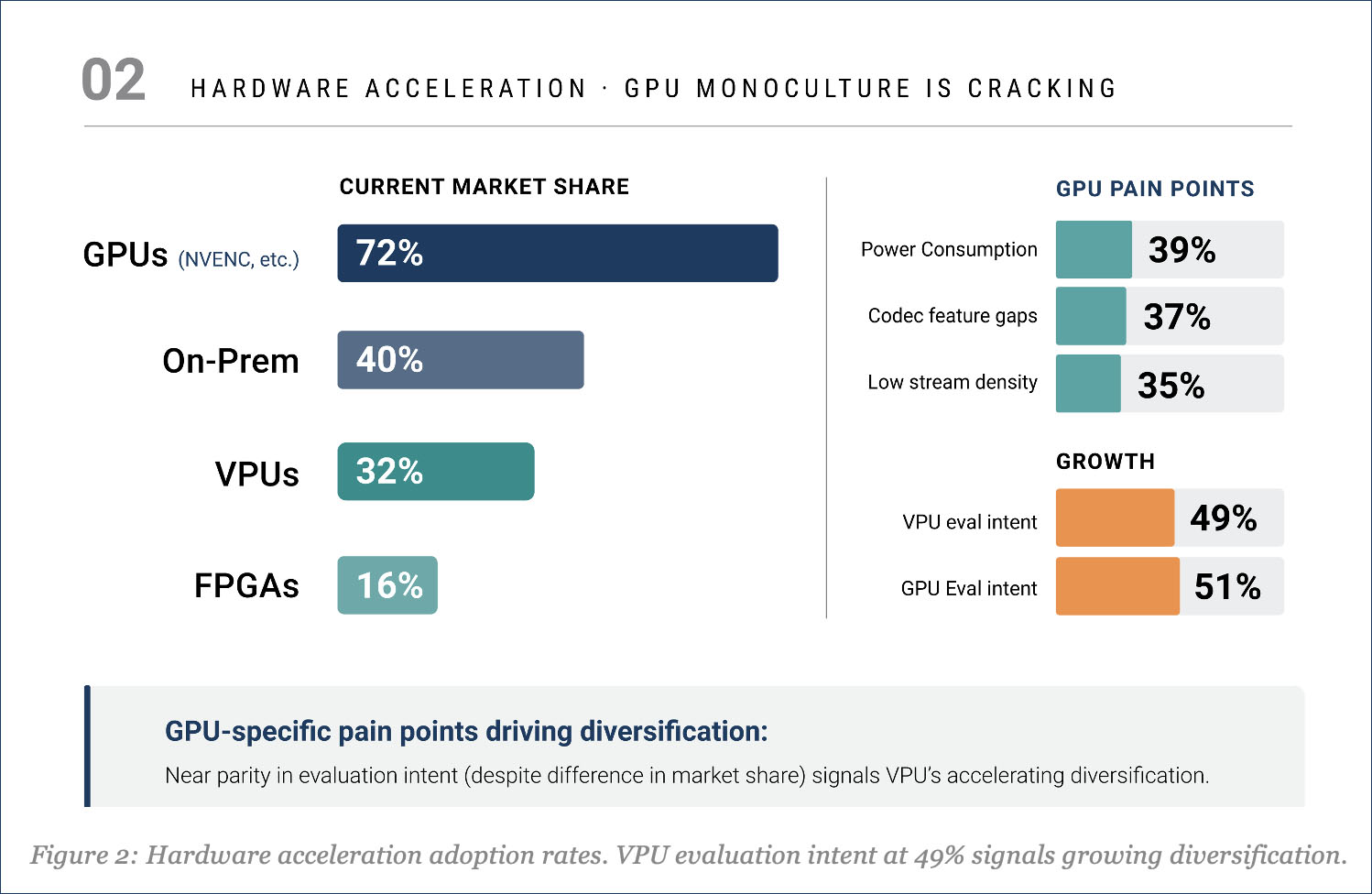
The hardware landscape is no longer dominated by a singular approach. While GPUs hold 72% of the market share—largely thanks to the NVIDIA NVENC ecosystem—the most sophisticated operators are diversifying.
The Heterogeneous Hardware Stack
A surprising 41% of organizations using hardware acceleration now deploy multiple types of hardware simultaneously. This includes combinations of GPUs, VPUs (Video Processing Units), and on-premises appliances. This diversification is driven by specific pain points in GPU-only environments:
- Power Consumption (39%)
- Codec/Feature Gaps (37%)
- Insufficient Stream Density (35%)
For live and broadcast operators, the shift is even more pronounced. The survey indicates that live operators are 2.2 times more likely to adopt VPUs, which offer superior density economics and lower latency compared to traditional GPU architectures.
The AI Mainstream Threshold
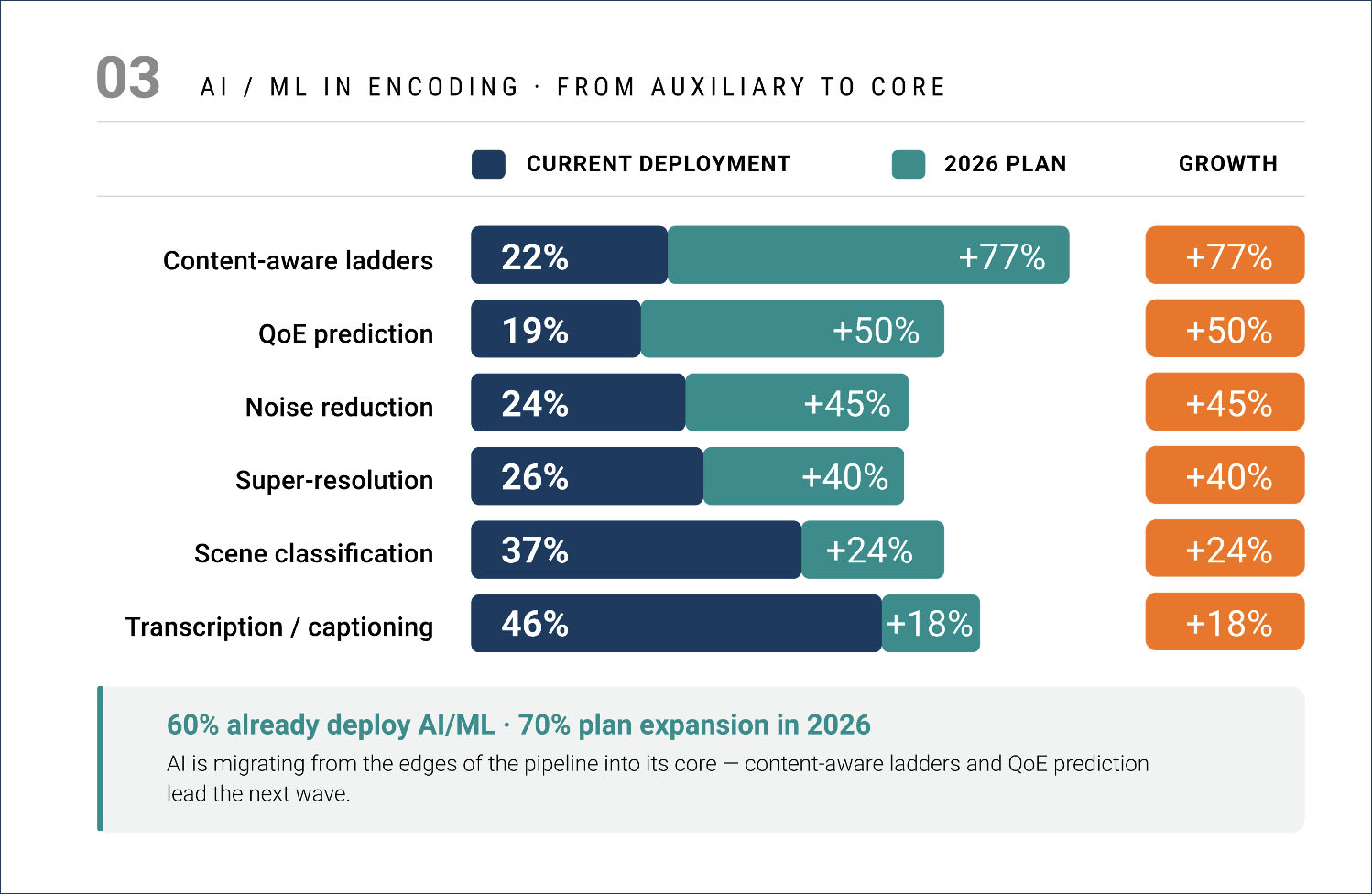
Perhaps the most significant finding is the transition of AI from an "adjacent" application to a "core" component of the pipeline.
- Current Adoption: 60% of organizations use AI/ML in their encoding workflows.
- Future Growth: 70% plan to expand these capabilities by year-end.
Initially, AI was relegated to peripheral tasks like transcription (46%) and scene classification (37%). However, the highest growth rates are now found in "core" encoding intelligence: Content-aware ladder generation (77% growth) and QoE (Quality of Experience) prediction (50% growth). These functions sit inside the encoding pipeline, fundamentally changing how bitrates and resolutions are determined in real-time.
Official Perspectives: The Quality Measurement Gap
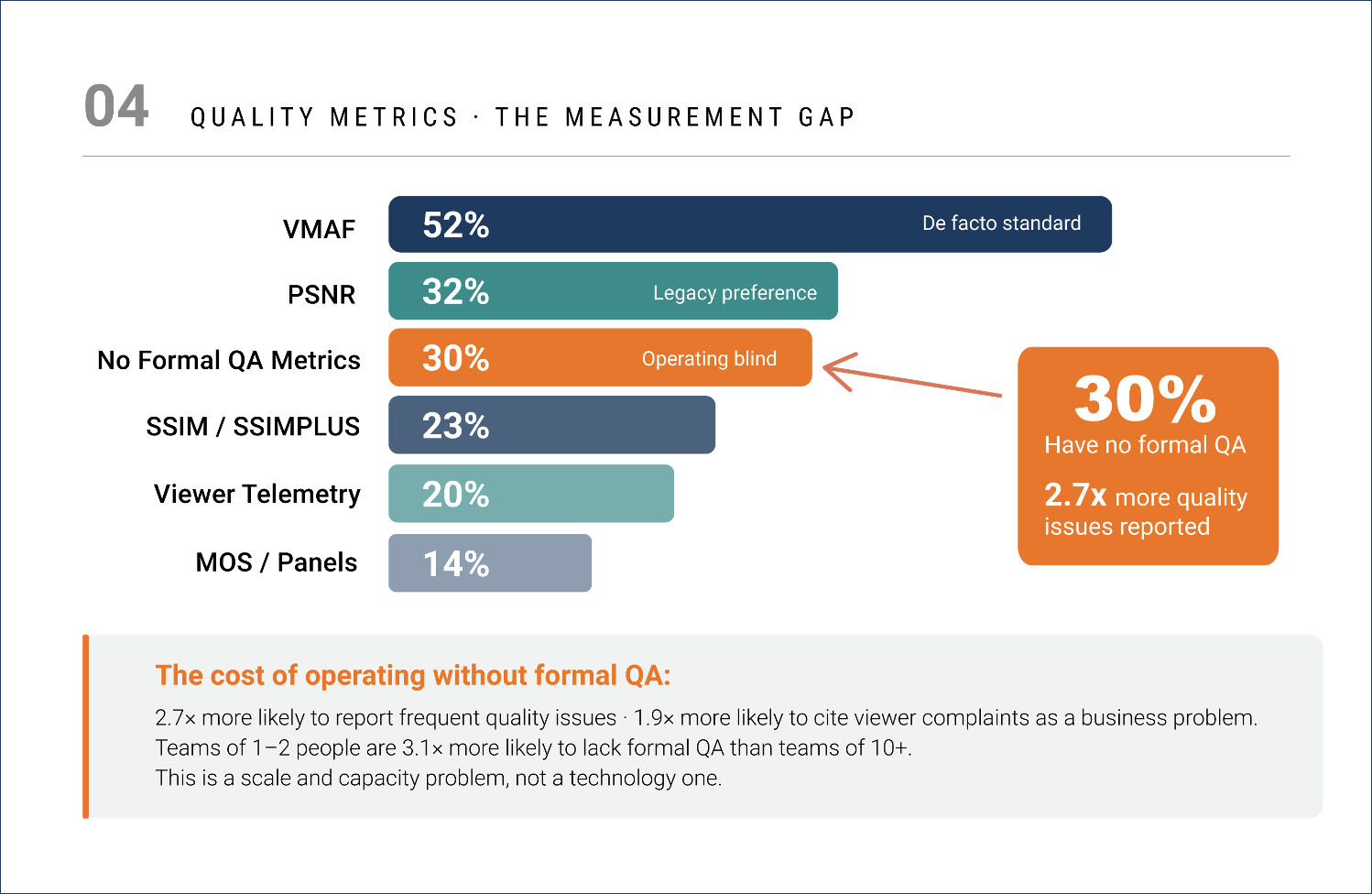
A concerning finding in the 2026 data is the "Quality Measurement Gap." While VMAF has become the de facto industry standard for objective quality measurement (at 52% adoption), a full 30% of organizations operate without any formal QA metrics.
The implications for these organizations are severe:
- They are 2.7 times more likely to report frequent quality issues.
- They are 1.9 times more likely to suffer from business-impacting viewer complaints.
This gap is largely an issue of team scale. Smaller video teams (1–2 people) are 3.1 times more likely to skip formal QA than larger, 10+ person teams. The report suggests that these teams are not just behind on measurement; they are missing the efficiency gains of Content Adaptive Encoding (CAE), which is currently used by roughly one-quarter of the market to optimize streaming economics.
Implications: The Real Bottlenecks are Organizational
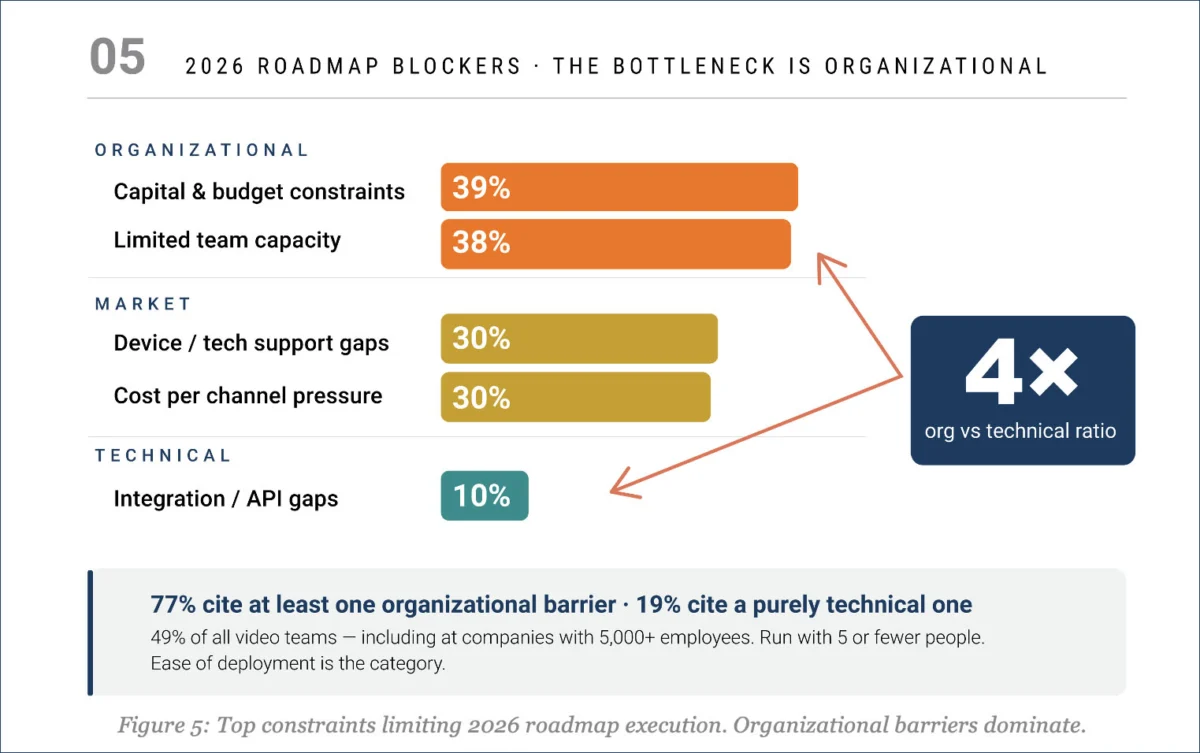
The most critical takeaway from the 2026 survey is that the primary inhibitors to progress are not technical—they are human and financial.
When asked what prevents organizations from executing their 2026 roadmaps, respondents ranked "capital/budget limitations" (39%) and "limited team capacity" (38%) at the top. Purely technical hurdles, such as integration or API gaps, accounted for only 10% of the friction.
The "Lean Team" Reality
Across all company sizes—even among organizations with over 5,000 employees—small video teams of 1 to 5 people remain the norm. This has profound implications for technology vendors. Products that require high operational overhead or complex, multi-month integrations are being rejected in favor of solutions that offer rapid time-to-value.
Edge Encoding: The Uncharted Territory
Edge encoding is currently in a "wait-and-see" phase. While 42% of respondents express interest, 30% remain undecided. The interest is heavily polarized: small startups and massive global enterprises are the most interested, while the mid-market remains hesitant. For vendors, the path to conversion is clear: the market does not need more product specs; it needs reference architectures, concrete ROI use cases, and risk-mitigating trial programs.
Conclusion: The Future is Optimized and Intelligent
The 2026 NETINT survey paints a picture of an industry maturing rapidly. The era of "brute force" software encoding is ending, replaced by a sophisticated, AI-enhanced, and hardware-diverse ecosystem.
For the decision-makers reading this data, the message is clear: the competitive edge in the coming years will not be found in which codec you choose alone, but in how effectively you integrate that codec into a hardware-accelerated, AI-optimized pipeline. As the survey concludes, those who successfully navigate these organizational and technical hurdles will define the next generation of streaming economics.
For those interested in the full analysis, including detailed archetypes of the four distinct organizational segments identified in the survey, the full 50-page report is available via NETINT.