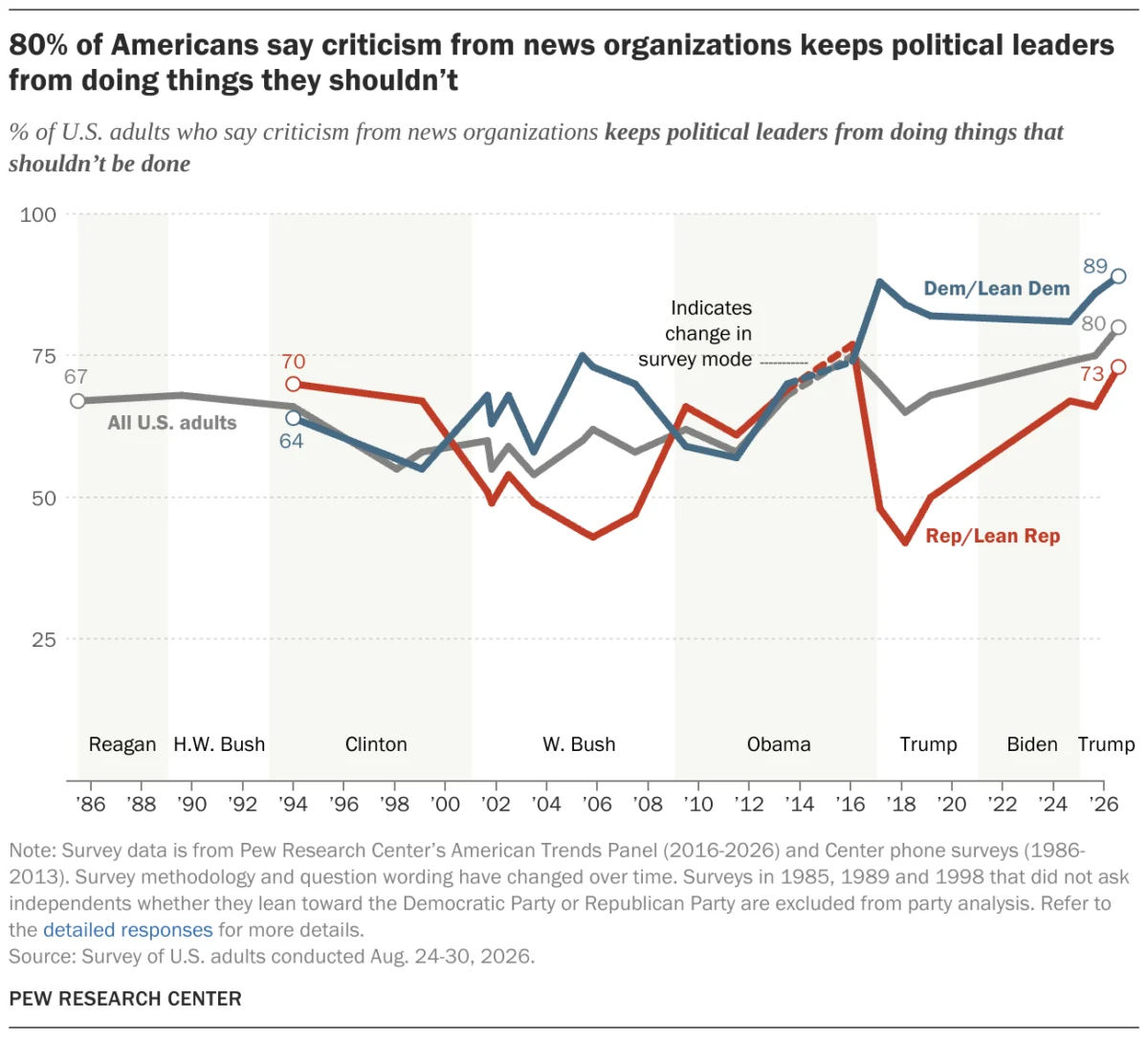
WASHINGTON — In an era defined by deep political polarization and widespread skepticism toward institutional bodies, a striking consensus has emerged among the American public regarding the fundamental utility of the press. According to a comprehensive national survey conducted by the Pew Research Center in late August, an overwhelming 80% of U.S. adults believe that critical coverage and oversight from news organizations effectively prevent political leaders from overstepping their bounds or engaging in improper conduct.
The new data marks a notable upward tick from similar readings taken in recent years, signaling a modest resurgence in public appreciation for the traditional accountability role of journalism. While partisan divides continue to shape how Americans interact with the media ecosystem, the latest findings demonstrate that majorities across both major political parties—Democrats and Republicans alike—agree that a watchful press is a necessary structural safeguard for American democracy.
Main Facts
The Pew Research Center survey, which sampled 5,166 U.S. adults via the nationally representative American Trends Panel between August 24 and August 30, addresses the core function of the media as an institutional check on executive and legislative power.
Key takeaways from the report include:
- Broad Public Consensus: Overall, 80% of Americans state that investigative reporting and press criticism keep political figures from "doing things that shouldn’t be done." This is up from 75% in September 2025 and 74% in September 2024.
- Minority Skepticism: Only a small fraction of the public—just 16%—holds the opposing view, asserting that such media scrutiny primarily serves to obstruct political leaders from efficiently performing their day-to-day governance duties.
- Bipartisan Buy-In: While enthusiasm is higher on the political left, substantial majorities on the right also recognize the press’s watchdog function. Currently, 89% of Democrats and Democratic-leaning independents, alongside 73% of Republicans and Republican leaners, embrace this view.
- Shifting Dynamics on the Right: Historically, public faith in media oversight fluctuated sharply depending on which party occupied the White House. However, the latest figures show that 73% of Republicans express support for media oversight under President Donald Trump, an increase from the 67% who felt similarly during the final year of the Biden administration in 2024.
- Correlating Trust: The rise in appreciation for media accountability mirrors a parallel, slight uptick in overall public trust in information delivered by national and local news outlets over the past year—marking a potential turning point after decades of declining institutional confidence.
Chronology: The Evolution of Public Sentiment (1985–2026)
To understand the weight of the 2026 findings, researchers point to a longitudinal dataset spanning four decades. Pew Research Center and its predecessor surveys have tracked public perception of the media’s watchdog role since the mid-1980s, documenting how seismic cultural, technological, and political shifts have impacted trust.
The Pre-Digital Era (1985–1999)
- July 1985 & August 1989: In the earliest iterations of the survey, roughly two-thirds of Americans (67% and 68%, respectively) recognized the press as an essential check on political misconduct. During this period, before the advent of 24-hour cable news and the internet, media consumption was largely anchored in a few major broadcast networks and local newspapers, fostering a more uniform public perception.
- January 1994 & February 1998: Amid the political battles of the Clinton administration, public support hovered between 55% and 66%. Notably, in 1994, 70% of Republicans saw the media as an effective watchdog, reflecting a different era of cross-partisan media evaluation.
The Post-9/11 and Cable News Expansion Era (2001–2013)
- September & November 2001: In the immediate aftermath of the September 11 terrorist attacks, public unity briefly stabilized media perception, with 60% acknowledging the watchdog function.
- Mid-2000s: As the Iraq War protracted and political polarization deepened under President George W. Bush, partisan divergence began to take root. By November 2005, 73% of Democrats viewed media criticism as vital, compared to just 43% of Republicans—illustrating the emergence of the "partisan pendulum" where supporters of the out-party value the press far more than supporters of the in-party.
- July 2011: Following the 2008 financial crisis and during the Obama administration, overall public support dipped to a modern low of 58%, driven largely by economic anxieties and institutional cynicism across the political spectrum.
The Polarization and Panel Era (2016–2026)
- February 2016 & March 2017: Entering the tumultuous transition from the Obama administration to the first Trump administration, overall numbers stood at 75% and 70%. Interestingly, in February 2016, 77% of Republicans backed the media’s oversight role—a statistic heavily influenced by primary season anti-establishment sentiments.
- March 2018 & March 2019: As investigative journalism probed the inner workings of the Trump White House, partisan polarization reached historic peaks. Democratic support surged into the low 80s, while Republican support plummeted to 42% in 2018 and 50% in 2019.
- September 2024 to August 2026: In the final months of the Biden administration, 74% of all adults (67% of Republicans, 81% of Democrats) supported the watchdog framework. By August 2026, under the Trump administration, overall approval jumped to 80%, accompanied by a softening of partisan extremes as Republican backing climbed to 73% and Democratic backing rose to 89%.
Supporting Data: Deep Dive into the 2026 Findings
A closer examination of the demographic and partisan cross-tabs from the August 2026 survey reveals several nuanced insights into how Americans view journalism today.
The Partisan Breakdown
While the 80% aggregate approval rating is significant, the partisan divide remains the most prominent structural feature of public opinion on the press.

- Democrats and Democratic-Leaning Independents: 89% agree that news organizations keep political leaders from crossing ethical and legal lines. This represents an 8-point jump from September 2024 (81%) and matches the high-water marks seen during past Republican administrations.
- Republicans and Republican-Leaning Independents: 73% share this view. Contrary to strict historical models where out-party support soared while in-party support collapsed, Republican backing has actually increased by six percentage points since 2024 (66% in 2025, 73% in August 2026), even with a Republican in the White House.
Ideological and Generational Uniformity
Unlike many other political questions—such as views on climate change, immigration, or economic policy—attitudes toward the media’s watchdog role do not fracture heavily along ideological or age lines within the respective parties.
- Moderate Democrats and progressive Democrats express largely similar levels of appreciation for investigative journalism.
- Similarly, traditional conservative Republicans and populist-leaning Republicans show broad agreement that some degree of independent oversight is necessary to ensure governance integrity.
The Trust Factor
Crucially, the rise in perceived utility of the press aligns with modest gains in general public trust. For years, pollsters documented a severe erosion of confidence in national news media, driven by accusations of bias, partisan pandering, and the proliferation of low-quality digital content. However, data collected alongside this study indicates that trust in information provided by both local and national news organizations has ticked upward over the past year. Analysts suggest this may reflect consumer fatigue with unregulated social media feeds and an increased reliance on established journalistic institutions during times of geopolitical and domestic policy turbulence.
Official Responses and Expert Analysis
Media analysts, political scientists, and institutional researchers have offered varying interpretations of the 2026 data, particularly concerning the unexpected resilience of Republican support for the press under a Republican administration.
Dr. Kirsten Eddy, a senior researcher focusing on news and information at the Pew Research Center, noted that while the fundamental patterns of institutional trust are complex, the long-term trend lines point to an enduring American belief in the checks and balances system.
"For decades, we have watched how political control of the executive branch shapes public attitudes toward the press," Eddy noted in analytical commentary accompanying the release. "Supporters of whichever party is out of power naturally look to the news media to hold the administration accountable. However, the recent data shows that even when their own party holds the presidency, a substantial and growing majority of Americans still recognize the foundational value of journalistic oversight."
Independent media watchdogs have also weighed in on the implications of the findings. Civil liberties advocates argue that the persistent 80% aggregate support proves that despite relentless political rhetoric labeling certain outlets as "fake news" or partisan actors, the everyday American citizen still relies on and respects the investigative functions that expose corruption, waste, and abuse of power.
Conversely, critics of contemporary journalism caution that while the public supports the concept of a watchdog, deep disagreements remain over how that watchdog executes its duties. Debates over framing, editorial bias, and the economic pressures facing local newsrooms continue to complicate the relationship between the press and its audience.
Implications for American Democracy and the Media Landscape
The implications of Pew Research Center’s latest findings extend far into the realms of policy, journalism economics, and civic education.
1. Re-anchoring the Fourth Estate
The realization that four out of five Americans view press oversight as essential provides a vital morale boost for an industry that has weathered severe economic contractions, mass layoffs, and relentless political attacks over the past twenty years. In an environment where trust is often treated as a casualty of the culture wars, the data demonstrates that the foundational democratic mandate of the "Fourth Estate" retains deep-seated legitimacy among the citizenry.
2. Navigating the Partisan Pendulum
The fact that Republican support for media oversight has risen during a Republican presidency challenges the rigidness of the traditional "out-party watchdog" hypothesis. Political strategists suggest this may indicate a broader maturation—or cynicism—among the electorate, wherein voters recognize that oversight is necessary regardless of who is in power. Alternatively, it may reflect the fragmented nature of the modern media diet, where partisans consume vastly different outlets yet still agree on the abstract principle of accountability.
3. The Economic and Informational Crisis in Local News
Even as public support for the watchdog role remains high, the economic infrastructure supporting local investigative journalism continues to face severe headwinds. As newspapers shutter and "news deserts" expand across rural and suburban America, the ability of the press to actually perform local oversight is diminishing, creating a dangerous disconnect between public desire for accountability and the availability of resources to deliver it.
4. Looking Ahead
As the United States navigates ongoing legislative battles, economic transformations, and evolving technological frontiers—including the rise of generative artificial intelligence in news production—maintaining public confidence will depend heavily on transparency, accuracy, and rigorous adherence to ethical standards.
Ultimately, the 2026 Pew Research Center data serves as both a reminder and a challenge: while Americans overwhelmingly want a watchdog keeping an eye on their leaders, the ultimate health of American democracy will rely on how effectively the press balances its vital oversight mission with the trust of a diverse and demanding public.