WASHINGTON — In an era defined by rapid technological shifts and intense political polarization, a striking consensus has emerged among the American public regarding the entities that shape civic discourse. According to a comprehensive national survey released by the Pew Research Center as part of the Pew-Knight Initiative, roughly seven in ten Americans believe that social media companies wield far too much power and influence in contemporary politics. Furthermore, more than half of the population holds the same critical view regarding traditional U.S. news organizations.
The findings illuminate a deep-seated public unease over how information is curated, moderated, and disseminated across the United States. While political divides continue to fragment the electorate on numerous cultural and legislative issues, the perception of outsized corporate and institutional influence in politics serves as a rare point of convergence—though notable partisan fissures remain regarding the traditional press.
Main Facts: The Anatomy of Public Discontent
The Pew Research Center survey, conducted from June 22 to 28, 2026, among 3,488 U.S. adults via the nationally representative American Trends Panel, underscores a pervasive skepticism toward the gatekeepers of modern communication.
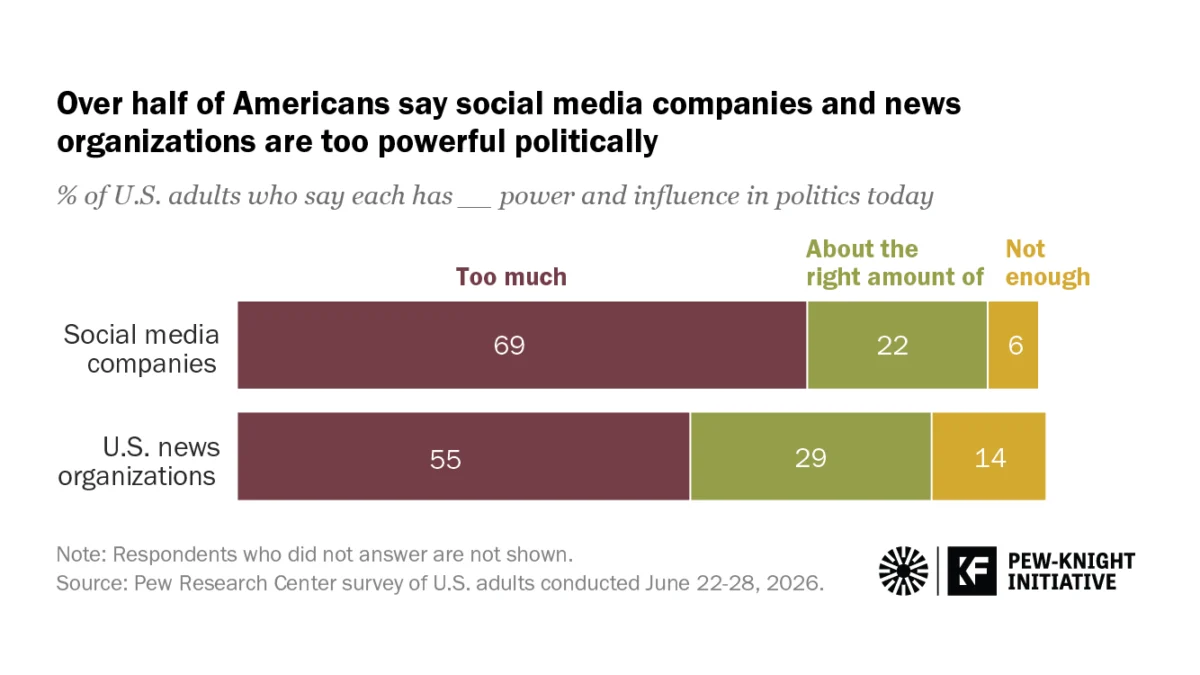
- Social Media Dominance: A commanding 69% of U.S. adults state that social media companies have too much power and influence in politics today. By contrast, just 22% believe these platforms hold "about the right amount" of influence, and a mere 6% argue they have "not enough."
- Traditional Media Skepticism: A clear majority of 55% of Americans feel that U.S. news organizations possess too much political power. Meanwhile, 29% believe the press holds the appropriate amount of influence, and 14% feel news outlets are underpowered.
- The Partisan Divide on News Outlets: While Republicans and Democrats view social media giants with nearly identical levels of suspicion, their assessments of traditional journalism diverge sharply. Fully 71% of Republicans and Republican-leaning independents believe social media companies have too much political power, a figure virtually matched by 69% of Democrats and Democratic-leaning independents. However, while 69% of Republicans also accuse U.S. news organizations of wielding excessive political influence, only 43% of Democrats share this viewpoint.
Chronology: How the Information Landscape Shifted
To understand how public sentiment reached this juncture, it is helpful to trace the evolution of the modern digital information ecosystem over the past decade:
- Early 2010s – The Social Media Optimism: Platforms like Facebook, Twitter (now X), and emerging networks were initially heralded as democratic tools for grassroots organizing, citizen journalism, and direct communication, bypassing traditional media gatekeepers.
- Late 2010s – The Turning Point of Disinformation: Following high-profile political events—including national elections and global health crises—scrutiny intensified regarding foreign interference, algorithmic echo chambers, and the proliferation of unverified content. Public concern over content moderation and platform bias began to surge.
- June 2024 – Platform Influence Recognized: A Pew Research Center study revealed that most regular news consumers on platforms like TikTok, X, Facebook, and Instagram recognized that these algorithms actively influenced the specific news stories appearing in their feeds.
- August 2025 – Perceived Decline of Journalist Clout: In a separate Center survey, roughly half of Americans (49%) observed that the societal influence of journalists was actively declining, pointing to a paradox where media organizations are viewed as simultaneously too powerful politically yet losing cultural authority.
- June 2026 – Comprehensive Assessment: The Pew-Knight Initiative fields its major survey on press freedom and institutional power, capturing a landscape where 69% of citizens view social media and 55% view the press as political heavyweights.
- November 2026 – Official Release: Pew Research Center publishes the combined findings, providing researchers, policymakers, and the public with a side-by-side comparison of corporate tech versus traditional media influence.
Supporting Data: By the Numbers
The empirical data compiled by the Pew-Knight Initiative provides a granular look at public opinion across various demographics and political affiliations.
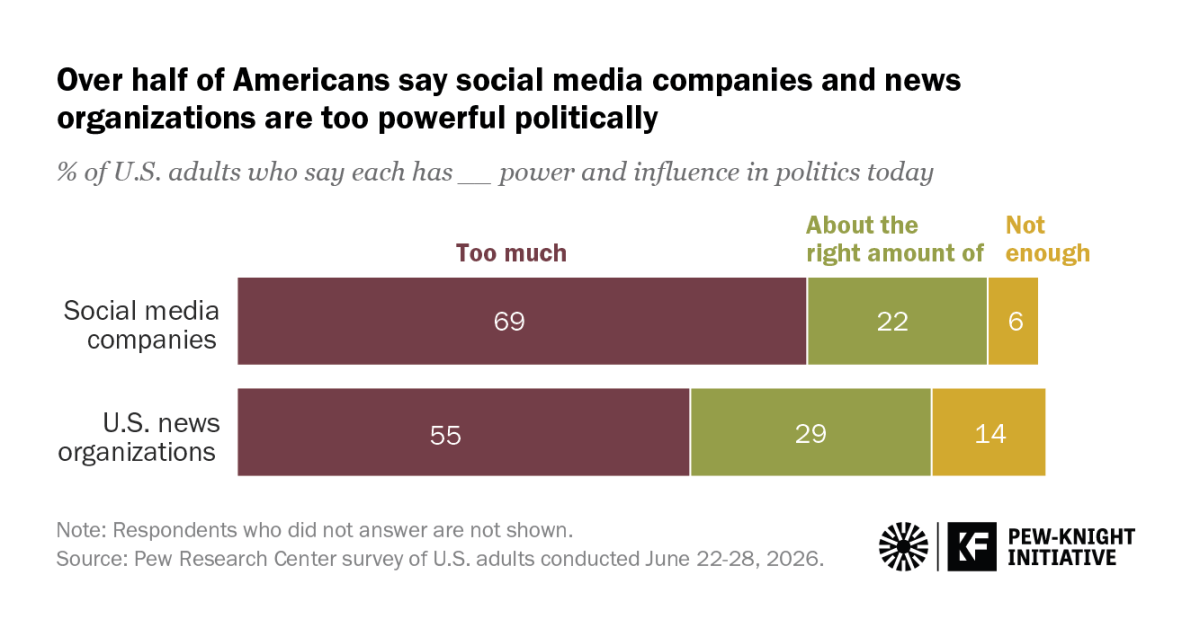
Perceived Political Power and Influence in Society
| Entity | Too Much (%) | About the Right Amount (%) | Not Enough (%) |
|---|---|---|---|
| Social Media Companies | 69 | 22 | 6 |
| U.S. News Organizations | 55 | 29 | 14 |
Note: Respondents who did not provide an answer are excluded from the table.
Partisan Breakdown: "Too Much" Political Power
When examining responses through a political lens, the divergence between the major parties on legacy media becomes glaringly apparent:
- Social Media Companies:
- Republicans / Lean Rep: 71%
- Democrats / Lean Dem: 69%
- U.S. News Organizations:
- Republicans / Lean Rep: 69%
- Democrats / Lean Dem: 43%
Furthermore, trust metrics underline the fragile state of public confidence. Approximately six in ten Americans across both parties—63% of Republicans and 60% of Democrats—report having little to no trust in the information disseminated by social media platforms. Conversely, trust in traditional journalism remains heavily stratified along partisan lines, matching long-term trends where conservative voters express significantly lower confidence in journalists to act in the public’s best interest.
Official Responses and Context from the Research Community
The implications of these findings have drawn commentary from media analysts, sociologists, and representatives of the organizations sponsoring the research.
The Pew Research Center, operating as a nonpartisan fact tank, emphasizes that the goal of this ongoing research is to map out the evolving relationship between citizens, technology, and journalism without taking advocacy stances. The integration of these studies under the Pew-Knight Initiative—a joint effort supported by The Pew Charitable Trusts and the John S. and James L. Knight Foundation—specifically targets how Americans absorb civic information and form democratic identities.

Christopher St. Aubin, a research analyst focusing on news and information research at Pew Research Center, noted in the study’s framework that understanding the dual pressures of tech algorithms and journalistic reach is essential for diagnosing the health of modern American democracy.
In qualitative focus groups conducted alongside the quantitative surveys, everyday participants frequently described major social media platforms as modern “public squares.” However, participants expressed deep anxiety over the invisible mechanisms—such as content removal policies, shadow-banning, and proprietary algorithms—that dictate what content achieves visibility. Rather than acting as neutral digital town halls, these platforms are increasingly perceived by their users as corporate arbiters with disproportionate sway over political outcomes.
Implications: Navigating the Future of Civic Discourse
The revelation that over half of the American public views both social media monoliths and traditional news outlets as overly dominant forces in politics carries profound implications for the future of governance, media literacy, and free speech.
1. The Regulatory Landscape for Big Tech
With broad, bipartisan majorities (71% of Republicans and 69% of Democrats) agreeing that social media companies possess excessive political power, lawmakers face intense constituent pressure to address platform governance. Debates surrounding Section 230 protections, algorithmic transparency, antitrust measures, and data privacy are likely to remain front and center in legislative agendas. The public’s skepticism transcends party lines, signaling that voters across the political spectrum desire greater accountability from Silicon Valley.
2. The Credibility Crisis in Journalism
While Democrats are relatively more forgiving of traditional news organizations, the fact that 43% of Democrats—and nearly seven in ten Republicans—view the press as politically over-influential highlights a severe crisis of institutional legitimacy. For journalism to effectively serve as the "fourth estate," news organizations must grapple with a public that increasingly views them not as objective chroniclers of fact, but as partisan or self-interested political actors. Rebuilding this trust requires rigorous transparency, open correction policies, and a concerted effort to reconnect with communities that feel alienated by national media narratives.

3. The Shift in Information Consumption
As younger generations increasingly turn to platforms like TikTok, Instagram, and X for daily news—despite widespread distrust of those same platforms—the line between entertainment, social interaction, and political persuasion continues to blur. Algorithms that prioritize engagement often amplify sensationalized or polarizing content, compounding public frustration with the political system.
Ultimately, the Pew-Knight Initiative’s findings serve as a stark reminder: American democracy is currently navigating an unprecedented information bottleneck. As citizens grow increasingly wary of the digital architects and legacy gatekeepers vying for control of the public square, addressing the root causes of this distrust remains one of the defining challenges of the modern era.
For detailed questionnaires, methodology reports, and comprehensive data tables regarding this study, consult the official archives published by the Pew Research Center.