By Ivan L. Nagy
Main Facts
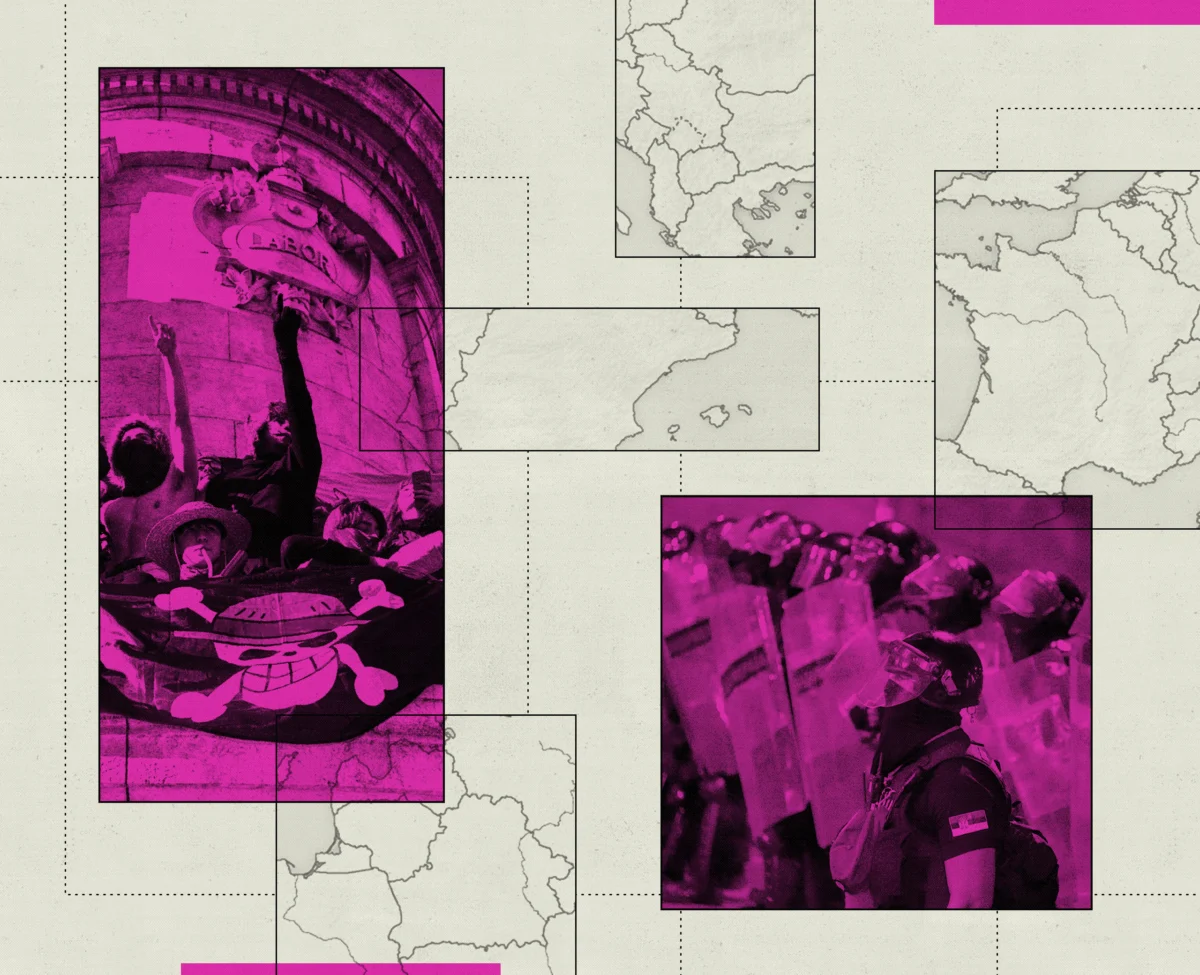
This autumn, dramatic images of protests in Paris flashed across global screens, appearing to signal the arrival of a synchronized, youth-led wave of civil unrest sweeping across Europe. From French student blockades to anti-government demonstrations in Italy, Belgium, Portugal, and Germany, the continent seemed gripped by a unified pulse of discontent. In Serbia, the tragic collapse of a railway station facade in Novi Sad served as the flashpoint for a two-year student-led movement that ultimately precipitated the ouster of Aleksandar Vučić, the nation’s autocratic leader of fourteen years. Meanwhile, in Albania, government backing for Jared Kushner’s planned luxury resort inside a protected nature reserve triggered Gen Z’s so-called "Flamingo Revolution," culminating in violent street clashes with police.
To international media heavyweights, these disparate events are frequently bundled into a single, cohesive narrative—a "European Spring" characterized by fiery youth and demonstrations spilling out of control.
However, The European Correspondent, a rising, pan-European digital newsroom founded just three years ago, rejects this neat and tidy premise. Julius Fintelmann, the publication’s twenty-four-year-old co-founder and editor-in-chief based in Brussels, argues that applying a monolithic label to localized frustration obscures reality.
"It’s a bit silly to call this a European Autumn like the Arab Spring," Fintelmann says. "It’s not a pan-European protest, because they’re not coordinated together."
Instead of leaning on sensationalized helicopter shots of clashes with police, The European Correspondent focuses on structural nuances, localized policy failures, and cross-border comparative analysis. Operating through a decentralized network of over a hundred national correspondents, the newsroom has rapidly evolved from an undergraduate side project into a formidable media startup. Backed by a lucrative 2.1-million-euro ($2.36 million) digital media grant from the European Commission, the outlet reaches 90,000 daily and weekly newsletter subscribers, commands 184,000 followers on Instagram, and publishes across seven European languages.
Rather than chasing breaking news cycles with traditional "parachute journalism," The European Correspondent aims to bridge the gap between continental policy and local kitchen tables, proving that a younger generation of journalists can successfully rethink how Europe communicates with itself.
Chronology: The Evolution of a Grassroots Newsroom
The trajectory of The European Correspondent reflects the very demographic shift it covers: digitally native, highly mobile, and deeply disillusioned with traditional institutional gatekeeping.
- 2022 (Inception): The project begins as a voluntary daily newsletter and social media experiment. Co-founders Julius Fintelmann, Carla Allenbach, and Philippe Kramer run the operation out of their respective undergraduate apartments in different European cities. Contributors are recruited organically through personal networks and professional platforms like LinkedIn.
- 2023–2024 (Scaling the Network): Hundreds of young student journalists and early-career reporters across the continent volunteer to file localized briefs, translating regional political developments into accessible, English-language digests. The social media footprint explodes, particularly on Instagram.
- Late 2024 (The Protests Erupt): Student blockades in Paris, railway tragedies in Spain, environmental mobilization in Albania, and anti-autocratic movements in the Balkans challenge mainstream media frameworks. The European Correspondent deploys its localized network to provide granular, non-sensationalized framing of these events.
- Early 2025 (Institutional Funding): The European Commission awards the newsroom a 2.1-million-euro digital media grant. This financial injection transforms the sprawling volunteer collective into a professional organization with a central office in Brussels and dedicated editorial desks.
- Late 2025–Present (Diversification): The outlet expands its multilingual offerings, implements audience-driven reporting strategies, experiments with microdonations, and prepares for the launch of a monthly, pocket-sized print publication priced at 12 euros.
Supporting Data and Editorial Strategy
To understand The European Correspondent’s operational model is to understand a deliberate rejection of standard wire-service formulas. Mainstream international bureaus typically rely on a centralized hub in London, Brussels, or Paris, sending reporters "into the field" temporarily to cover major crises. This approach often results in superficial coverage that misses underground cultural currents.
The European Correspondent flips this dynamic on its head. While maintaining a lean administrative core in Brussels, the organization embeds its reporting power directly within individual nations.
Key Operational Metrics
-
Subscribers: 90,000 active
readers of daily and weekly newsletters.
- Social Reach: 184,000 followers on Instagram.
- Languages: Published initially in English, with systematic translation into six additional European languages.
- Financial Runway: Backed by a 2.1-million-euro European Commission grant running through 2027, supplemented by roughly 180,000 euros ($200,000) in reader microdonations.
- Audience Demographics: Surprisingly broad; internal surveys indicate that roughly 60 percent of the publication’s readership is over the age of forty-five, despite being founded and largely staffed by Gen Z and Millennial journalists.
Audience-First Reporting
Fintelmann notes that the editorial strategy is anchored directly in the everyday lives of its readers. "We tell them how things that happen across Europe impact their own lives," he explains.
When a catastrophic train crash claimed nearly seventy lives in Spain late last October, the newsroom’s dedicated data team bypassed standard tragedy-reporting tropes to investigate how Spanish railway safety stacked up against alternative modes of transportation across the entire European Union. Similarly, as energy prices spiked across the continent, a reporter synthesized concrete lessons from seven different European cities on successfully transitioning away from gas heating.
Deniz Eker, an editor on the democracy and human rights desk, emphasizes the search for unconventional angles. "People are already seeing things on breaking news outlets, so we always try to find a more unique angle, something that the audience might not immediately expect," Eker says.
For instance, when covering the Albanian protests against Jared Kushner’s proposed luxury resort, the newsroom framed the controversy primarily through an environmental lens. During the French pension and labor protests, coverage zoomed in on the disproportionate use of tear gas as a symbolic motif. When examining Turkish anti-government demonstrations, reporters analyzed the underlying meme culture and how satire effectively engages historically apolitical demographics.
Official Responses and Perspectives
The hybrid nature of The European Correspondent—blending digital-native agility with veteran editorial oversight—has attracted talent from across the generational spectrum.
Nevena Vračar, a thirty-year-old Serbian journalist, was working in Amsterdam when she was recruited to cover her home country. Just two months after she joined, the fatal canopy collapse at the Novi Sad railway station unleashed a wave of anti-corruption protests that ultimately shook the nation’s political establishment.
"All of this really resonates with me," Vračar reflects. "I think if you understand the disappointments that our generation is going through on a personal level, then you can really translate the spirit of the movement."
At the same time, the project has drawn seasoned veterans of traditional international media. Claire Alex Brown spent fifteen years covering global affairs for France 24 before joining the publication as a newsletter editor.
"There are so many different styles, different takes, different ways of writing," Brown observes. "And these journalists are all very young. They’re extremely concerned with what’s going on right now in the world. And their perspective is very interesting compared to the big news machines."
From the perspective of institutional grant-makers, organizations like The European Correspondent represent a vital counterweight to the steady erosion of local journalism across Europe. By distributing funds directly to digital innovators, the European Commission’s media grants aim to foster transnational solidarity without centralizing editorial control in Brussels.
Implications for the Future of European Media
As The European Correspondent approaches the expiration of its initial seed grant in 2027, its leadership is actively constructing a diversified financial bridge to ensure long-term sustainability. Because the digital newsletters remain free, the newsroom relies on a multi-pronged revenue model. Recurring and one-time microdonations have already netted 180,000 euros, and plans are underway to launch an official merchandise line.
The most ambitious component of their commercial growth strategy, however, is the upcoming print magazine. Priced at 12 euros ($14) per issue, the pocket-sized publication is designed to prove a foundational hypothesis about modern media consumption.
"People want to pay for journalism—they just need to have something that they feel is valuable," Fintelmann asserts.
The Broader Media Landscape
The implications of The European Correspondent’s model extend far beyond its subscriber counts. For decades, the "European public sphere" has remained an elusive ideal. European elections suffer from low voter turnout precisely because media ecosystems remain stubbornly nationalized; citizens read about EU policy through the filtered, often antagonistic lens of domestic political debates.
By stitching together local perspectives across borders, The European Correspondent demonstrates that young audiences do care about international affairs—provided the reporting speaks their language, avoids dry institutional jargon, and highlights tangible cross-border solutions.
If local governance experiments in renewable energy in Germany can inform citizens in Portugal, or if anti-corruption strategies in the Balkans resonate with students in France, a cohesive European civic identity may finally begin to take root.
In an era defined by democratic backsliding, information fatigue, and algorithmic polarization, The European Correspondent offers a compelling blueprint: scale local knowledge, empower young voices, and let nuance—rather than sensationalism—dictate the news.