In an era defined by growing concerns over civic isolation and loneliness, a significant paradigm shift is occurring quietly behind screens across the United States. While public discourse frequently laments that technology is tearing communities apart, a comprehensive new study reveals that digital spaces are simultaneously acting as robust incubators for human connection.
According to a nationwide survey conducted by the Pew Research Center as part of the Pew-Knight Initiative, roughly 1 in 4 U.S. adults (24%) report that they have found friends online who remain a part of their lives today. Far from remaining confined to abstract chat rooms or fleeting social media interactions, these digital relationships routinely transcend the virtual world. The data shows that an overwhelming majority of these online friendships eventually materialize into face-to-face meetings, challenging long-held skepticism about the validity and depth of web-based relationships.
Conducted between May 26 and June 1, 2026, and drawing on responses from 9,750 adults on the American Trends Panel, the research illuminates deep demographic divides in how Americans cultivate relationships. From the hyper-connected habits of younger generations to the unique community-building spaces frequented by LGBTQ adults, the internet has fundamentally altered how modern bonds are forged.
Chronology of a Connected Generation: The Evolution of Online Socialization
To understand where modern friendship stands, it helps to trace how the digital landscape has transformed human socialization over the past three decades.
In the early days of the consumer internet during the mid-to-late 1990s, forming relationships online carried a heavy social stigma. Early adopters in chat rooms, message boards, and early mailing lists were often viewed with suspicion, and safety warnings cautioned users

never to reveal their true identities or meet strangers from the web. Relationships formed online were largely categorized as fringe anomalies or risky endeavors.
As the 2000s ushered in the era of Web 2.0—marked by the explosive growth of social networking sites like Friendster, MySpace, and eventually Facebook—the digital social sphere began to mirror offline life. People went online primarily to stay connected with individuals they already knew in the physical world, such as school classmates, family members, and colleagues.
By the 2010s, however, the paradigm began to flip. The rise of smartphones, niche interest forums, gaming platforms like Discord, and algorithm-driven recommendation engines allowed individuals to seek out micro-communities based on shared passions rather than geographic proximity. People dealing with niche hobbies, marginalized identities, or specialized professional interests found global sounding boards that did not exist in their immediate physical neighborhoods.
By 2026, the stigma surrounding online friendships has largely evaporated, particularly among younger cohorts who have never known a world without ubiquitous internet access. For Generation Z and younger millennials, the digital realm is not an alternative to reality; it is simply another dimension of the physical world where organic human interaction occurs. This historical evolution explains why today’s younger adults are exponentially more likely than older generations to cross paths with lifelong friends through digital channels.
Supporting Data: Who Is Finding Friends Online?
The Pew Research Center data paints a clear statistical portrait of how age, identity, and technology intersect in the modern friendship market. While 24% of all U.S. adults have at least one friend they met online, this average masks stark contrasts across different segments of the population.

Age Matters: The Youthful Shift to Digital Spaces
Age is the single most defining factor in whether an American will find friendship online:
- Ages 18–29: A striking 43% of young adults in this age bracket report having friends they first met online. This means nearly half of young Americans rely on digital avenues to expand their social circles.
- Ages 30–49: Three-in-ten adults (30%) in their thirties and forties share this experience, indicating that the comfort with digital relationship-building extends well into middle adulthood.
- Ages 50–64: The share drops significantly to 16%, reflecting a generational divide in early socialization habits.
- Ages 65 and older: Even among older Americans, adoption is present, with 8% reporting friendships that originated on the internet.
The LGBTQ Experience: A Sanctuary for Connection
Beyond age, demographic analysis reveals that LGBTQ adults stand out remarkably in their propensity for finding community online:
- LGBTQ Adults: 45% of adults who identify as lesbian, gay, bisexual, transgender, or queer say they met at least one of their current friends online.
- Non-LGBTQ Adults: By comparison, only 22% of non-LGBTQ adults report the same.
Crucially, Pew researchers noted that this massive gap persists even when controlling for age. This suggests that digital spaces serve a vital, functional role for LGBTQ individuals—many of whom may lack local, physical communities or safe environments in their immediate geographic areas, prompting them to seek out affirming social networks online.
From Screen to Street: The In-Person Transition
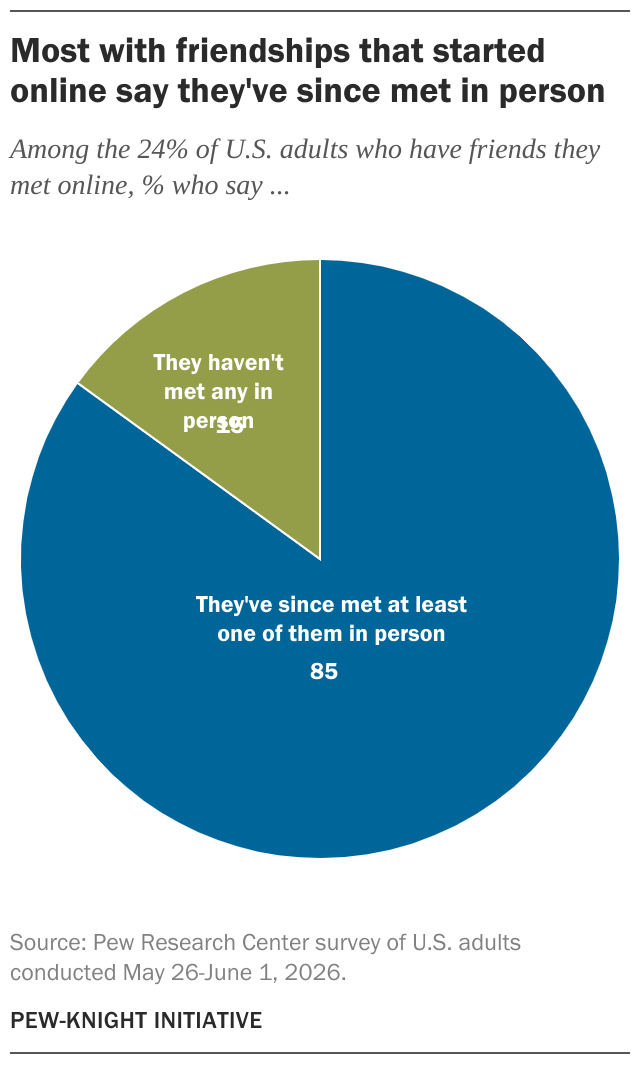
One of the most compelling findings of the study addresses the physical manifestation of digital relationships. Among the 24% of U.S. adults who have friends they met online:
- 85% report that they have since met at least one of those friends in person.
- Only 15% have maintained purely digital connections without a physical meetup.
This high conversion rate of 85% remains remarkably consistent across different age groups, demonstrating that digital initiation is frequently just the first step toward building a tangible, physical relationship.
Official Insights and Research Perspectives
The research initiative was spearheaded by Pew Research Center analysts Olivia Sidoti and senior researcher Colleen McClain under the umbrella of the Pew-Knight Initiative—a collaborative effort funded jointly by The Pew Charitable Trusts and the John S. and James L. Knight Foundation to study how Americans form beliefs, absorb civic information, and engage in communities.
In detailing the rationale behind the study, the research team pointed to a growing societal paradox. At a time when public opinion polling indicates deep ambivalence—with roughly half of Americans expressing skepticism regarding the overall value of relationships formed online—those who actually experience digital friendships hold a drastically different view.
According to the data:
- 62% of adults with at least one online-origin friend believe that these types of relationships can be just as meaningful as connections made strictly in person.
- Even among those whose online friends remain entirely virtual, a majority still validate the deep significance of these bonds.
- Conversely, among Americans who met all of their friends exclusively off the internet, only 25% believe online relationships can carry the same weight as face-to-face interactions.
This perceptual chasm highlights a key behavioral truth: skepticism toward digital relationships is heavily concentrated among those who have never genuinely participated in them. Once an individual experiences the depth of connection fostered through shared online spaces, their perception of digital intimacy shifts profoundly.
Broader Implications for Society and Community Engagement
The normalization of online friendships carries sweeping implications for sociology, urban planning, mental health, and community building in the United States.

1. Redefining "Community" Beyond Geography
Historically, human communities were strictly bound by geography—neighbors, schoolmates, and coworkers were the default sources of social support. The modern data demonstrates that geography is no longer a prerequisite for meaningful community. Individuals separated by thousands of miles can share hyper-specific interests, emotional support systems, and cultural identities that they might never find within their physical ZIP codes. For isolated individuals, rural residents, or those with rare medical conditions and specialized hobbies, the internet provides a lifeline to compatible peers.
2. Mitigating the Loneliness Epidemic
Public health officials have frequently warned of a worsening loneliness epidemic, particularly among young people. While excessive, passive social media consumption has been linked to increased rates of depression and isolation, active relationship-building platforms—such as multiplayer gaming communities, shared creative spaces, and structured digital interest groups—appear to serve a counterbalancing role. By allowing 43% of young adults and 45% of LGBTQ individuals to successfully cultivate supportive peer groups, digital tools are actively combating social isolation.
3. Challenging Generational Prejudices
As adults under 30 age into leadership, governance, and cultural institutions, their baseline acceptance of digital relationships will reshape organizational norms. Traditional corporate, academic, and social frameworks that prioritize physical presence over digital engagement may find themselves increasingly out of touch with a populace that views online and offline friendships as equally valid and authentic.
Conclusion
The Pew Research Center’s 2026 findings serve as an important corrective to blanket moral panics regarding technology and human alienation. While the internet certainly presents complex challenges regarding civic discourse and attention spans, it simultaneously functions as a vital, highly effective social bridge. For millions of Americans—especially the young and the marginalized—the internet is not a substitute for human connection; it is where they finally found their people.