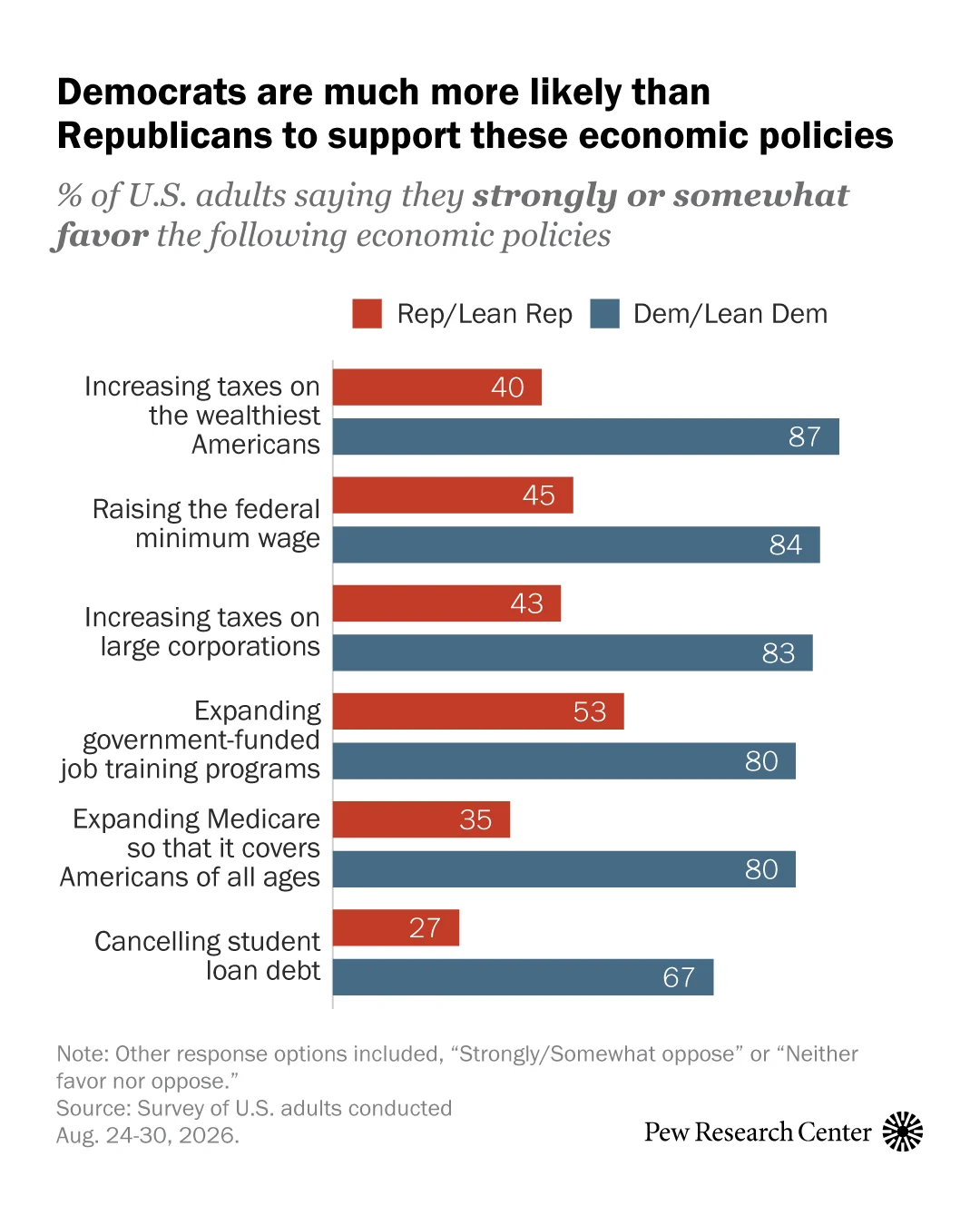
WASHINGTON — Amid persistent debates over the future of the nation’s financial stability, a comprehensive new study released by the Pew Research Center sheds light on how Americans view various economic policies. The nationally representative survey highlights a landscape characterized by stark partisan polarization, revealing areas where Democrats and Republicans sharply disagree, as well as the few rare policy proposals that manage to bridge the political divide.
The findings come at a critical juncture for U.S. lawmakers, economists, and everyday citizens navigating personal finances and broader market uncertainties. By examining public sentiment on taxation, trade, government spending, and regulation, the new data provides a window into the economic priorities of the American electorate.
Main Facts
The latest analysis from the Pew Research Center is built upon responses from 5,166 U.S. adults surveyed between August 24 and August 30. Conducted through the organization’s nationally representative American Trends Panel, the research aims to provide the public, media, and policymakers with an empirical foundation regarding how citizens perceive contemporary economic strategies.
Among the core takeaways of the research:
- Deep Partisan Divides: On a wide array of economic interventions—particularly those involving social safety nets, corporate taxation, and regulatory oversight—Democrats and Republicans exhibit fundamentally contrasting views, often split by double-digit margins.
- Areas of Conservative Consensus: Policies focused on deregulation, certain types of tax relief, and pro-business incentives find robust majorities among Republicans, though they often fail to garner equivalent enthusiasm across the aisle.
- Trade Skepticism Across Parties: Interestingly, proposals such as increasing tariffs on imported goods fail to secure a solid majority of backing within either major political party, signaling a complex public attitude toward protectionist trade measures.
- **Context of Ongoing Financial Anxiety
:** The data builds on Pew’s extensive previous tracking of personal finances and economic well-being, reflecting an American public that remains highly sensitive to inflation, cost-of-living pressures, and fiscal policy.
Chronology and Research Methodology
Understanding the public opinion landscape requires examining how this research was conceived, executed, and brought to light.
- Foundation and Prior Research: For years, the Pew Research Center has tracked shifting public attitudes toward the economy, work, and personal finance. This specific project was designed to update and expand upon those tracking metrics, specifically targeting contemporary policy debates that have dominated legislative agendas in Washington.
- Survey Administration (August 24–30): The empirical backbone of the report was gathered during a late-summer window. A total of 5,166 randomly sampled U.S. adults participated in the online survey.
- Panel Integrity: Participants were drawn from the American Trends Panel, a carefully vetted, probability-based panel designed to accurately represent the demographic, geographic, and political diversity of the United States.
- Data Processing and Release: Following the late-August field period, analysts spent weeks cross-tabulating results, evaluating demographic variables, and preparing accompanying questionnaires, topline data releases, and detailed methodological notes. The complete package was made publicly available to ensure transparency and reproducibility for researchers and journalists alike.
Supporting Data and Policy Breakdown
The Pew analysis is accompanied by detailed visual charts that categorize economic policies into distinct camps based on partisan alignment.
1. Policies Favored Heavily by Democrats
The first major data trend highlights proposals where Democrats are significantly more likely than Republicans to voice support. These typically include measures that expand government intervention in the market, increase taxes on high-income earners and corporations, and strengthen labor or environmental regulations. According to Pew’s findings, progressive and center-left economic tools continue to anchor the Democratic economic platform, driven by the belief that targeted government action is necessary to curb wealth inequality and support working-class households.
2. Policies Backed Primarily by Republicans
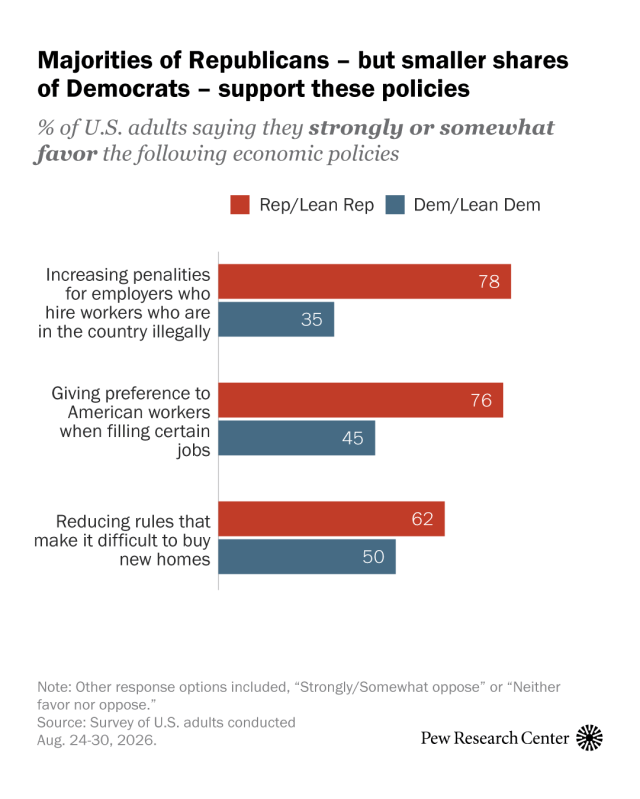
Conversely, a separate cluster of policies enjoys robust backing from majorities of Republicans, while receiving markedly cooler receptions from Democrats. These proposals generally center around free-market principles, reducing the regulatory footprint on small and large businesses, and implementing tax policies that proponents argue stimulate capital investment and job creation. While majorities of Republicans rally behind these initiatives, the data shows that bipartisan consensus on these measures remains elusive.
3. The Tariff Question: A Bipartisan Hesitation
Perhaps one of the most nuanced findings involves international trade policy. The data indicates that increasing tariffs on imported goods does not command a decisive majority of support in either political party. While protectionist trade strategies have been championed by various populist and nationalist factions in recent years, the broader American public—when surveyed systematically—remains divided or unpersuaded regarding the net benefits of sweeping tariff increases, reflecting lingering concerns over consumer prices and supply chain stability.
Official Responses and Expert Reactions
As the findings circulate within political and academic circles, economists and policy analysts have begun dissecting what the data means for the future of American governance.
- Fiscal Policy Analysts: Many independent financial observers note that the widening gap in economic priorities mirrors the broader political polarization in Congress. When voters hold fundamentally divergent views on what constitutes a "fair" tax system or an effective regulatory framework, legislative compromise becomes exceedingly difficult to achieve.
- Political Strategists: Representatives from both sides of the aisle have pointed to the survey to validate their respective messaging strategies. Democratic strategists emphasize that public support for targeted investments and corporate accountability remains strong among their base. Meanwhile, Republican operatives highlight that free-market solutions and tax restraint continue to resonate deeply with conservative voters who feel squeezed by current economic conditions.
- Pew Research Center Representatives: In publishing the methodology and questionnaires alongside the findings, Pew officials emphasized the importance of nonpartisan, empirical data in cutting through political rhetoric. By providing exact topline responses and clear demographic breakdowns, the Center aims to foster a more informed public debate on the trade-offs inherent in any major economic policy decision.
Implications for the Future
The implications of this comprehensive research extend far beyond academic interest; they directly impact the legislative roadmap for the United States.
- Legislative Gridlock: With the American public so sharply divided along partisan lines regarding fundamental economic levers, elected officials face a challenging environment. Crafting bipartisan legislation on taxes, trade, or federal spending will require navigating these deeply entrenched public attitudes.
- The Role of Consumer Sentiment: As everyday Americans continue to grapple with shifting financial realities—ranging from housing costs to employment security—their views on economic policy are increasingly tied to their personal financial well-being. Policymakers who fail to address these ground-level anxieties risk disconnect with an electorate that is closely monitoring the nation’s financial trajectory.
- Future Research and Tracking: The Pew Research Center’s ongoing commitment to monitoring these trends ensures that policymakers and the public will have access to continuous data as economic conditions evolve. Whether future surveys will show a narrowing or widening of these partisan divides remains one of the most critical questions facing the nation’s political economy.