WASHINGTON — In an era where physical neighborhoods often feel increasingly disconnected, the internet has long promised a digital sanctuary. For decades, millions of Americans have turned to social media groups, niche discussion forums, messaging threads, and multiplayer video games to forge deep bonds, find empathetic support networks, and explore shared passions.
Yet, according to a comprehensive new study released by the Pew Research Center as part of the ongoing Pew-Knight Initiative, these digital safe havens are not built to last for everyone. A striking number of Americans are packing up their virtual bags and moving on.
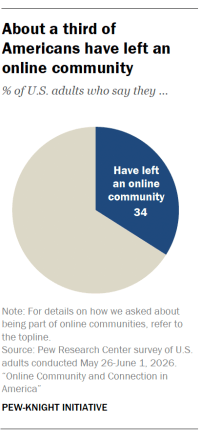
Data from the nationally representative survey reveals that approximately one-third of all U.S. adults (33%) have permanently left at least one online community in their lifetime. This growing digital diaspora spans across generations and demographics, raising vital questions about the psychological sustainability, health, and future of online socialization in America.
Main Facts: The Anatomy of the Digital Departure
The findings are part of a broader October 2026 report examining online community and connection in the United States. To capture a holistic view of the digital landscape, researchers surveyed 9,750 U.S. adults between May 26 and June 1, 2026, utilizing the Center’s American Trends Panel.
When researchers asked participants to define what constituted an "online community," the scope was intentionally broad. It included everything from specialized subreddits and Facebook groups to Discord servers, email distribution lists, professional networks, and persistent multiplayer gaming environments.
The core takeaway is clear: while millions of Americans actively seek out online connections to combat modern isolation, retention is a massive hurdle for digital spaces. Among those who have severed ties with an online group, the motivations vary wildly—ranging from natural personal growth and shifting life stages to a toxic erosion of civil discourse, rampant harassment, and political fatigue.
Chronology of Connection: How Digital Spaces Evolve and Fray
To understand why a third of the country has walked away from virtual groups, it helps to examine the lifecycle of modern digital spaces and how the digital habits of Americans have transformed over the last two decades.
The Rise of Digital Enclaves (2000s–2010s)
In the early days of the modern web, online communities were largely centered around message boards, specialized mailing lists, and nascent social platforms. Joining a community required intentional effort, often tied to niche hobbies or technical troubleshooting. Back then, digital spaces were viewed primarily as novel extensions of offline life—supplemental hobbies rather than primary pillars of daily socialization.
The Smartphone Boom and Over-Saturation (2010s–Early 2020s)
As smartphones permeated nearly every facet of daily life, online communities migrated into our pockets. Apps allowed for constant, frictionless connectivity. People joined dozens of groups simultaneously. However, this hyper-accessibility brought unintended consequences. By the mid-2020s, studies from the Pew Research Center showed that roughly half of all Americans felt they were spending far too much time staring at their screens, leading to a profound psychological reckoning regarding digital clutter and boundary fatigue.
The Breaking Point: Toxicity, Politics, and Burnout (2026)
Today, the pendulum has swung toward deliberate digital minimalism. As reflected in the latest Pew-Knight data, users are no longer passively tolerating declining community standards. When online spaces become hotbeds for toxic arguments, endless political vitriol, and unchecked harassment, contemporary users are increasingly exercising their right to hit the "leave" button. The digital landscape has transitioned from an era of unchecked accumulation to an era of curated, protective curation.
Supporting Data: Why Are Americans Leaving?
The Pew Research Center survey provides a granular look at the exact pain points driving users away from their favorite digital hangouts. The data reveals a hierarchy of grievances, led overwhelmingly by personal disinterest, but quickly followed by institutional and cultural decay within these groups.
1. Loss of Interest and Declining Quality
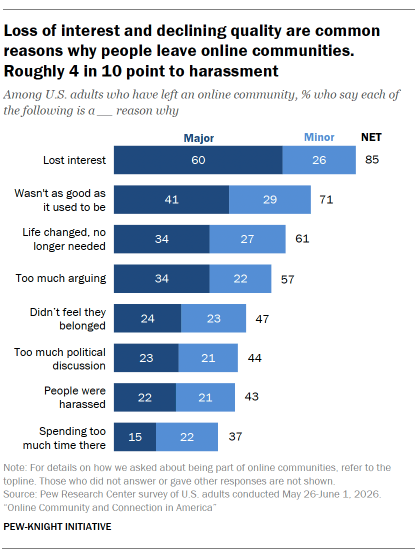
By far, the most pervasive catalyst for departure is a natural evaporation of enthusiasm. More than eight-in-ten respondents (80%+) who have left an online community cite a loss of interest as a factor, with a clear majority identifying it as a major reason for their exit. People change, hobbies fade, and the content that once felt riveting eventually becomes mundane.
Closely tied to this is declining quality. As groups scale in size, they often suffer from the "eternal September" effect—diluting the expert discourse, warmth, or utility that initially drew members in. Majorities of former members note that falling standards played at least a minor role in their departure.
2. Toxicity, Arguments, and Harassment
Beyond benign disinterest, darker cultural elements within online spaces are actively pushing people out.
Endless Arguing: More than half (57%) of those who have left a community point to excessive quarreling and toxic infighting as a driving factor.
Harassment: Nearly half (43%) of departees state that people within the group were engaging in direct harassment. This aligns with longstanding research from the Center documenting widespread cyberbullying and online harassment targeting both adults and teenagers.
3. The Shadow of Politics
In an increasingly polarized sociopolitical climate, political friction is bleeding into spaces that were originally created for entirely non-political purposes—such as hobbies, local neighborhood news, or professional networking.
Just over four-in-ten respondents (40%+) report leaving a community because politics was brought up too frequently.
When broken down by political affiliation, intriguing partisan divides emerge. While roughly equal shares of Republicans and Democrats have left communities overall (32% vs. 36%), Republicans are significantly more likely than Democrats to cite politics as their primary reason for leaving (50% vs. 39%). Liberal Democrats are particularly unfazed by political chatter, with only 32% citing it as a reason for departure.
4. Screen Fatigue and Life Changes
Modern life demands physical presence and shifting priorities, which naturally creates friction with digital obligations.
Screen Time Anxiety:37% of those who left communities did so simply because they realized they were spending far too much time staring at their devices.
Life Milestones: Major life changes—such as starting a new job, having a child, moving to a new city, or graduating—render certain online support groups or hobby forums obsolete.
Demographic Deep-Dive: Age Matters Most
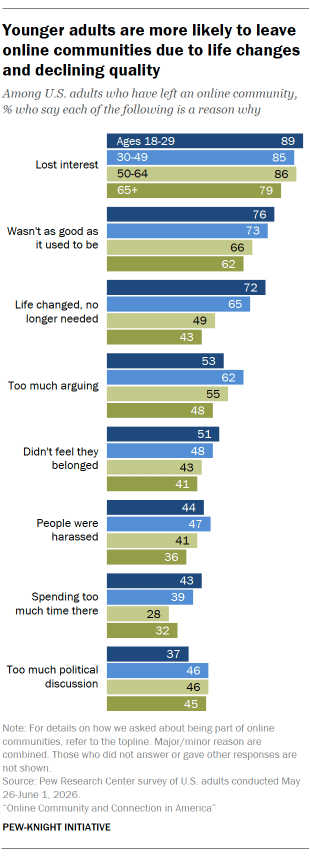
Age serves as one of the most reliable predictors of digital migration. While younger adults (ages 18 to 29 and 30 to 49) are far more likely to join and participate in online communities in the first place, they are also significantly more likely to leave them.
Younger Adults: Majorities of adults under 50 who have left a community cite changing life needs as a primary driver. Their fluid life stages require more adaptable digital ecosystems.
Middle-Aged Adults: Among those aged 50 to 64, about 32% report having left an online community.
Older Adults: For Americans aged 65 and older, the rate drops sharply to just 19%, reflecting more stable, long-term digital habits and lower turnover in online socialization.
Official Responses and Expert Context
The implications of these findings extend far beyond individual app preferences, touching on the core health of civic engagement and societal well-being in the United States.
Jeffrey Gottfried, Associate Director of Internet and Technology Research at the Pew Research Center and lead author of the project, emphasizes the duality of the modern digital experience.
"Online communities offer incredible potential for finding shared meaning, education, and empathy," Gottfried noted in connection with the broader research initiative. "However, the very mechanisms that bring people together—anonymity, rapid communication, and scalable platforms—can also quickly devolve into polarization, burnout, and toxicity. Understanding why people walk away tells us a lot about what Americans value in their social lives and where digital spaces are failing them."
The Pew-Knight Initiative—a joint research endeavor funded by The Pew Charitable Trusts and the John S. and James L. Knight Foundation—was explicitly designed to unpack these dynamics. By investigating how Americans absorb information, build identities, and interact within digital environments, the initiative hopes to arm community leaders, platform architects, and policymakers with actionable insights to foster healthier, more resilient online ecosystems.
Implications: What the Great Digital Migration Means for Society
As roughly one-third of the nation processes its collective exit from various online groups, several profound implications emerge for the future of digital architecture, community moderation, and social psychology:
1. The Death of the Mega-Group
As platforms scale, quality invariably degrades under the weight of trolls, spam, and political polarization. The mass exodus driven by "too much arguing" and "declining quality" suggests that the era of massive, unmoderated public forums may be giving way to smaller, highly curated, private digital spaces (such as private Discord servers, encrypted messaging chats, or small-scale subscription communities). Users are voting with their feet in favor of intimacy and strict moderation over scale.
2. The Mental Health Imperative
With 37% of departees citing screen fatigue and excessive time consumption as reasons for leaving, digital detoxing is moving from a wellness trend to a practical necessity. Platforms that fail to respect user boundaries or foster healthy engagement loops risk losing their user bases entirely to burnout.
3. Reclaiming Non-Political Spaces
The finding that political over-saturation drives people away—particularly conservative users—highlights a deep-seated craving for neutral territory. When every digital hobby space becomes a proxy culture war battlefield, users seek out pure escapism. Community administrators and platform designers face an urgent mandate to enforce strict topical boundaries if they wish to retain members who are exhausted by political tribalism.
Ultimately, the Pew Research Center’s findings serve as both a warning and an opportunity. While the internet remains a powerful tool for human connection, it is increasingly clear that Americans are no longer willing to sacrifice their peace of mind, mental health, or civil patience for the sake of a digital badge of membership. As virtual spaces mature, survival will depend entirely on their ability to cultivate safety, quality, and genuine, low-stress connection.