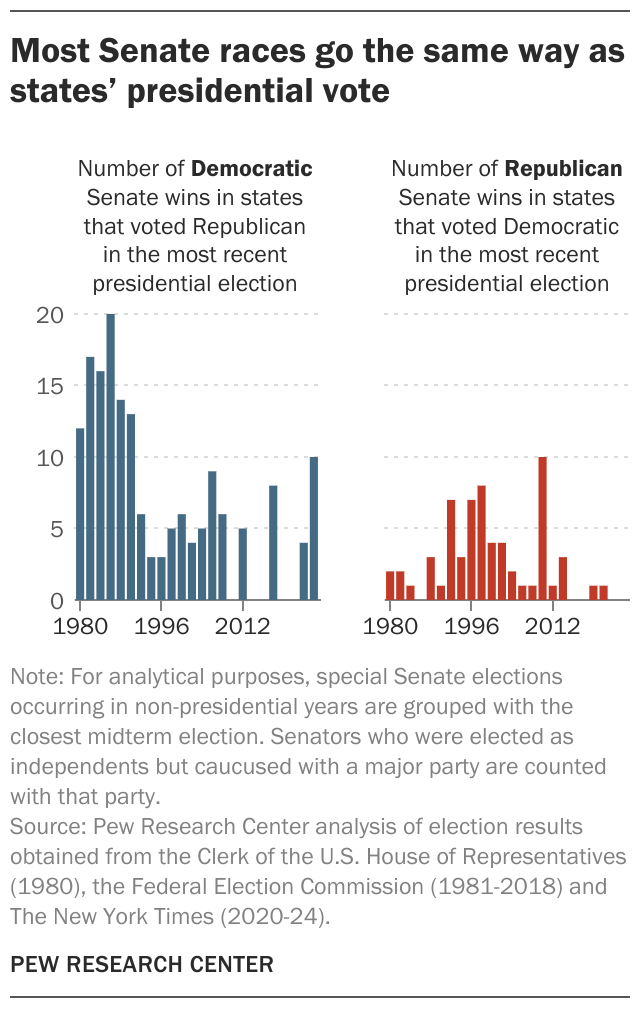
WASHINGTON — In a political landscape increasingly dominated by nationalized messaging and uniform voting patterns, a notable counter-trend has emerged. According to a comprehensive new election analysis released by the Pew Research Center, voters in 10 states that supported Republican Donald Trump in the 2024 presidential election went on to elect Democratic senators this year.
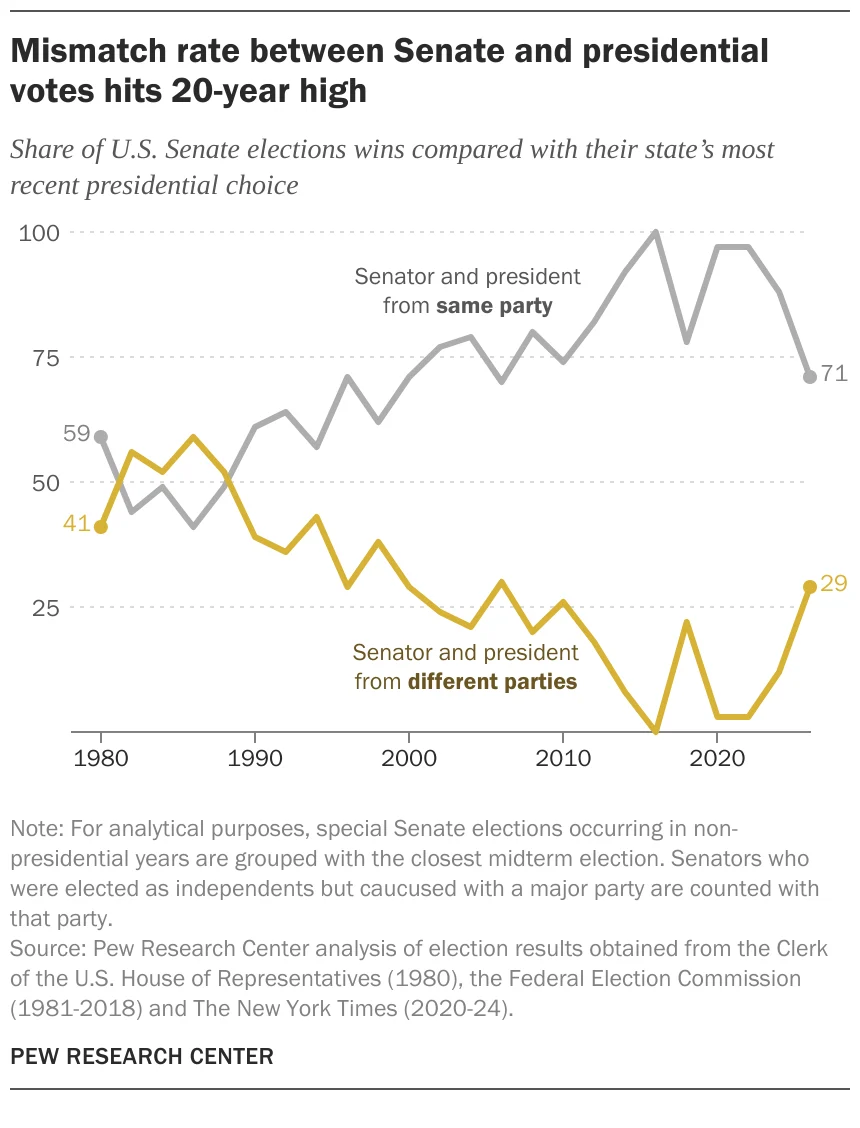
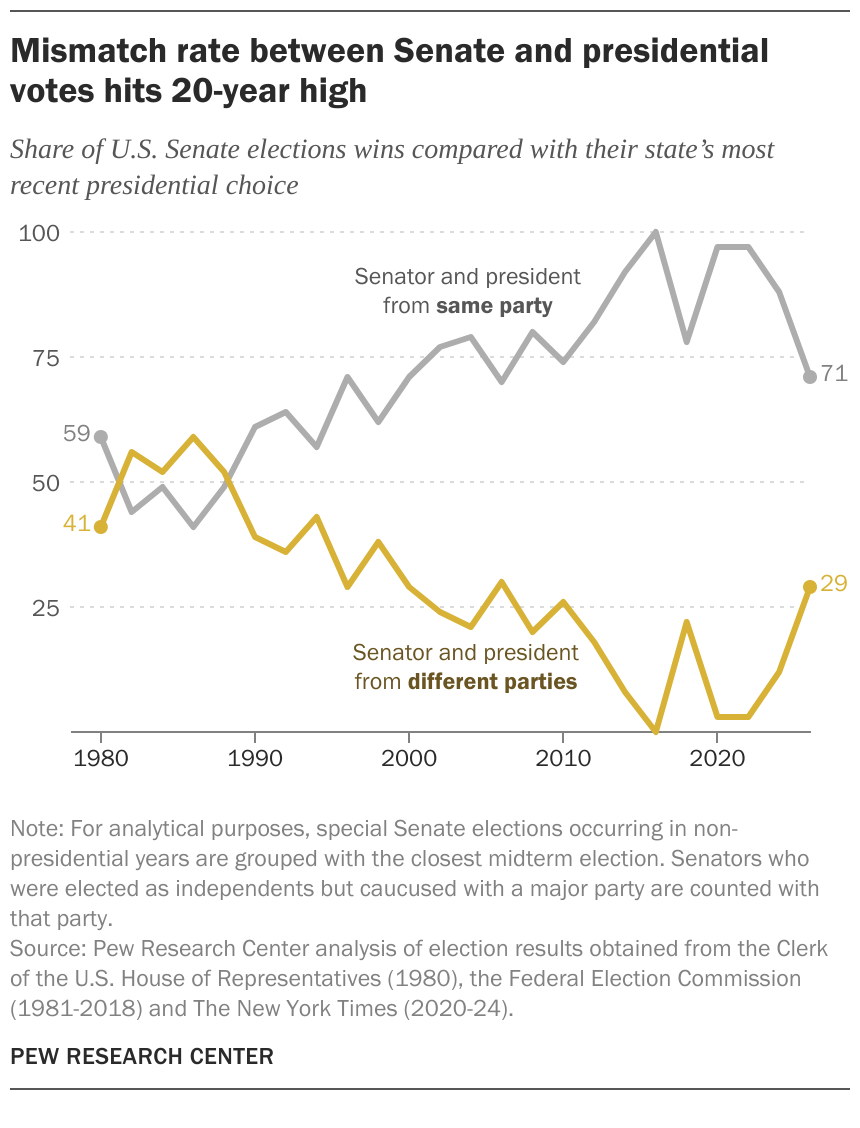
This phenomenon—referred to by political scientists and data analysts as a "mismatch rate" between a state’s presidential choice and its Senate representation—has climbed to its highest level in two decades. Out of the 35 Senate seats contested this election cycle, roughly 28.6% resulted in outcomes that bucked the state’s recent presidential preference.
While still far below the hyper-independent ticket-splitting seen in the late 20th century, this year’s data points to a subtle yet significant resurgence of geographic and candidate-specific pragmatism. It suggests that while national polarization remains the baseline of American politics, local candidate appeal, incumbent advantage, and shifting regional priorities can still pierce the partisan armor.
Main Facts and Figures
The Pew Research Center’s latest tracking provides a granular look at how federal voting habits have evolved over the last 46 years.
- The 2026 Mismatch Rate: Out of 35 Senate seats up for grabs, 10 went to Democrats in states carried by Donald Trump in 2024, yielding a mismatch rate of 28.6%.
- One-Way Street: In a striking directional asymmetry, exactly zero states that voted for Democratic presidential nominee Kamala Harris in 2024 elected a Republican senator this cycle. Every single split favored the Democratic party.
- The 20-Year Peak: The last time the mismatch rate during a midterm election cycle sat higher than this year’s figure was in 2006, when 10 out of 33 races (30.3%) featured a split ticket.
- The Modern Baseline: Between 2016 and the present, American voters have overwhelmingly aligned their Senate choices with their presidential preferences. Fully 88.5% of all Senate contests (185 out of 209) during this timeframe were won by candidates belonging to the party that carried the state in the most recent presidential vote.
This year’s uptick contrasts sharply with the hyper-nationalized environment of 2016, where the mismatch rate plummeted to 0%—meaning every single state voted for the same party in both the presidential and Senate contests. It also dwarfs the ultra-tight alignment seen in 2020 and 2022, when only a single mismatch occurred across multiple cycles.
Chronological Evolution: From Habitual Splitters to Nationalized Lockstep
To understand how remarkable—or conversely, how historically modest—the 2026 mismatch rate is, one must examine the long-term trajectory of American voting behavior. Pew’s historical dataset, stretching back to 1980, reveals a profound transformation in how the electorate views federal offices.
The Era of the Ticket-Splitter (1980s–1990s)
When the data series begins in 1980, ticket-splitting was not an anomaly; it was a fundamental feature of American politics. During the 1980 and 1984 landslide presidential victories of Republican Ronald Reagan, the mismatch rate consistently hovered around or exceeded 50%.
In 1982, for instance, a staggering 56% of Senate races were won by a candidate from a different party than the state’s recent presidential choice. Even as Reagan swept entire regions, resilient "establishment" Democrats routinely held onto Senate seats across the American South and Midwest.
Even through the 1990s, ticket-splitting remained robust. In the 1996 and 1998 cycles, mismatch rates sat at 29% and 38%, respectively, with both parties regularly picking up Senate seats in hostile territory.
The Great Sorting (2000s–2010s)
As the 21st century progressed, the American electorate underwent a profound geographic and ideological sorting. The "conservative Democrat" and the "liberal Republican" became near-extinct species.
By 2008, the mismatch rate had dropped to 20%. By 2012, it fell to 18%. The nationalization of politics meant that voters were increasingly casting ballots based on national party brands rather than local personalities.
The apex of this trend occurred in 2016. For the first time in modern history, every single Senate election in the United States mirrored the presidential outcome of that state. Not a single state crossed party lines.
The Midterm Rebound Effect (2018–Present)
While nationalization remains the dominant force, recent cycles have exposed a recurring pattern: "wave" midterms or post-presidential corrections.
In the 2017–18 election cycle following Trump’s first term, the mismatch rate ticked up to 22.2%, driven by eight Democratic victories in states Trump had carried. A similar phenomenon materialized in 2024, when four Democratic candidates won Senate seats in Trump-won states. The 2026 cycle represents an acceleration of this exact dynamic, pushing the mismatch rate to a two-decade high for midterms.
Supporting Data and Methodological Framework
Pew Research Center’s analysis relies on a rigorous comparison of official election outcomes certified by the Clerk of the U.S. House of Representatives, the Federal Election Commission, and comprehensive contemporary tracking by The New York Times.
To maintain consistency over decades of shifting political alignments, the researchers applied specific methodological parameters:
- Special Elections: Special Senate elections occurring in non-presidential years are grouped analytically with the closest midterm or presidential election cycle.
- Independents: Lawmakers elected as independents who officially caucus or caucused with a major party—such as Bernie Sanders of Vermont, Angus King of Maine, and former Senator Joseph Lieberman of Connecticut—are counted with the party of their caucus. Kyrsten Sinema of Arizona, who left the Democratic Party to register as an independent, was counted as a Democrat due to her retention of committee assignments within the Democratic caucus.
Historical Mismatch Rates (Selected Years)
| Midterm Year | Senate/President Same Party (%) | Senate/President Different Parties (%) |
|---|---|---|
| 1980 | 59% | 41% |
| 1986 | 41% | 59% |
| 1992 | 64% | 36% |
| 2000 | 71% | 29% |
| 2006 | 70% | 30% |
| 2012 | 82% | 18% |
| 2016 | 100% | 0% |
| 2022 | 97% | 3% |
| 2026 | 71% | 29% |
The data clearly illustrates that while the 2026 mismatch rate is high relative to the past twenty years, it remains tame compared to the mid-1980s, when split outcomes were the majority experience.
Official Responses and Political Analysis
Political strategists from both major parties have offered divergent interpretations of the 2026 results, underscoring the tension between nationalized brand toxicity and local candidate durability.
Democratic campaign operatives argue that the 10 split-ticket states demonstrate the viability of localized, independent-minded brands. "National branding can only carry a candidate so far when voters are looking for a senator who understands their local economy, infrastructure needs, and community values," noted one senior Democratic strategist speaking on condition of anonymity. "In these 10 states, voters made a clear distinction between who they wanted sitting in the White House and who they trusted to fight for their state in the Capitol."
Conversely, Republican strategists have downplayed the long-term significance of the mismatch rate, characterizing it as a temporary manifestation of the traditional midterm penalty levied against the party in power. GOP analysts point out that Senate candidates in these 10 states often benefited from massive personal fundraising advantages, long-standing local incumbency, or unique missteps by Republican challengers.
"Ticket-splitting hasn’t made a structural comeback; rather, exceptional candidate dynamics in specific cycles will always produce idiosyncratic results," argued a prominent Republican pollster. "Look at the broader picture: over the last decade, nearly 90% of races follow the presidential line. That is not a sign of a fluid electorate—it’s a sign of a hardened, nationalized map."
Implications for the Future of American Governance
The persistence—and minor resurgence—of Senate-presidential mismatches carries profound implications for the legislative branch, executive-legislative relations, and the future of congressional coalitions.
1. The Survival of the Moderate and Independent Voice
With a significant bloc of senators representing states that voted for the opposing presidential candidate, the political center of gravity in the Senate remains distinct from that of the White House. These cross-pressured lawmakers often find themselves holding the balance of power on key judicial nominations, cabinet confirmations, and bipartisan legislative compromises. They serve as institutional buffers against total partisan polarization, even if their numbers are diminished compared to the 20th century.
2. Complications for Presidential Agendas
For a sitting president—regardless of party—working with a Senate that includes members beholden to cross-pressured electorates can be perilous. Senators from Trump-won states who wear a "D" next to their names must constantly weigh party loyalty against the conservative or populist leanings of their home states. This dynamic frequently forces protracted negotiations on trade, regulation, and federal spending, preventing either party from exercising absolute legislative discipline.
3. The Myth of the Completely Monolithic Map
While pundits often speak of "red states" and "blue states" as immutable monoliths, the 2026 data serves as a reminder that American federalism still accommodates regional divergence. Voters continue to exercise independent judgment when individual politicians cultivate a distinct local brand, separate from national party toxicity.
As the nation looks toward future election cycles, political scientists will closely monitor whether the 2026 mismatch rate is an isolated spike or the beginning of a modest plateau in ticket-splitting. For now, the data proves that while national polarization rules the day, geography and candidate quality still retain the power to disrupt the script.