
WASHINGTON — A comprehensive new report released by the Pew Research Center sheds light on the complex, deeply divided perspectives of Israelis and Palestinians regarding the prospect of peaceful coexistence between Israel and an independent Palestinian state. Based on nationally representative face-to-face surveys conducted in the spring of 2026, the study moves beyond simple quantitative metrics by analyzing more than 1,500 open-ended, qualitative responses translated from Arabic and Hebrew.
The findings illuminate the profound psychological, historical, and geopolitical barriers to peace, while simultaneously capturing the underlying rationales of those who still envision a path toward mutual accommodation. The research arrives at a critical juncture in the Middle East, offering policymakers, academics, and the global public a nuanced look at public sentiment on the ground.
Main Facts
The Pew Research Center report is built upon extensive fieldwork conducted across Israel, the West Bank, and East Jerusalem.
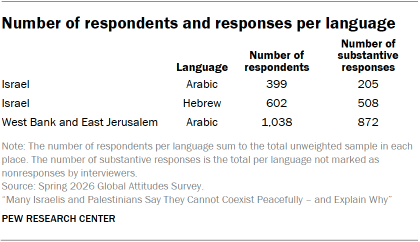
- Sample Sizes and Demographics: Researchers surveyed 1,001 Israeli adults between April 5 and May 6, 2026, and 1,038 Palestinian adults in the West Bank and East Jerusalem between March 30 and April 28, 2026. All data were weighted to ensure accurate representation of the adult population in each surveyed region.
- Methodology: The surveys were administered face-to-face under the direction of Gallup. Respondents were first asked a closed-ended question: “Do you think a way can be found for Israel and an independent Palestinian state to coexist peacefully with each other, or not?” Those providing substantive answers (“Yes,” “No,” or “It depends”) were subsequently asked an open-ended follow-up: “In your own words, can you tell us why you feel that way?”
- Translation and Coding: Interviewers transcribed responses in the language they were spoken. More than 1,500 substantive Arabic and Hebrew responses were professionally translated into English by cApStAn. A team of three Pew researchers developed a rigorous codebook using open coding, tested it for conceptual validity, and double-coded 1,585 total responses to ensure reliability.
- Thematic Breakdown: Responses were categorized into distinct frameworks for both optimists and pessimists. Those who believe coexistence is possible cited themes such as a fundamental interest in peace, the inevitability of living side-by-side, diplomatic solutions, and conditional qualifiers. Conversely, those who rejected the possibility of coexistence cited competing claims to land, the ongoing occupation of the West Bank, security threats, historical and recent violence—including the legacy of the October 7 attacks and the subsequent war in Gaza—deep-seated distrust, fundamental ideological incompatibilities, and a perceived lack of political leadership.
Chronology of the Research Project
The execution of this landmark public opinion study followed a methodical, multi-month research timeline designed to maintain academic rigor and cultural sensitivity.

- Late March – Late April 2026: Gallup-directed interviewers conduct face-to-face surveys with 1,038 Palestinian adults across the West Bank and East Jerusalem.
- Early April – Early May 2026: Fieldwork is carried out among 1,001 Israeli adults throughout Israel, capturing a broad demographic cross-section of the Israeli public, including Jewish and Arab citizens.
- Post-Fieldwork Phase: Professional transcriptionists record responses in their original languages. Over 1,500 substantive qualitative answers in Arabic and Hebrew are sent to translation specialists at cApStAn for precise English translation.
- Codebook Development: Three Pew Research Center researchers review the translated transcripts. They utilize open coding to identify recurring themes, drafting an initial codebook. This framework is tested on a random sample of 149 responses to evaluate conceptual validity. Following internal debates and adjustments, the codebook is finalized.
- Coding and Reconciliation: The 1,585 responses are split among the three researchers, with each response independently coded by two individuals (resulting in over 1,000 coded responses per researcher). Discrepancies are systematically reviewed and reconciled to guarantee consistency.
- September 2026: Pew Research Center officially publishes the findings, complete with methodological breakdowns, item nonresponse data, and a curated selection of illustrative direct quotes.
Supporting Data and Response Characteristics
Understanding public opinion requires examining not only what people said, but also who chose not to speak. The Pew report highlights significant variations in item nonresponse rates—instances where respondents declined to answer or stated they “don’t know”—across the surveyed populations.
Item Nonresponse Rates
- In Israel: 20% of total respondents did not answer the initial question regarding peaceful coexistence. This figure reveals a sharp internal demographic divide: only 14% of Jewish respondents declined to answer, compared to 46% of Arab respondents. Furthermore, an additional 2% of Israeli respondents provided a substantive answer to the primary question but opted out of the open-ended follow-up.
- In the West Bank and East Jerusalem: 10% of respondents stated they “don’t know” or refused to answer the coexistence question entirely. An additional 6% answered the initial prompt but chose not to provide a qualitative explanation.
Thematic Coding Framework
To make sense of the open-ended explanations, researchers mapped qualitative data into two overarching categories, assigning multiple codes to a single response where applicable:
1. Arguments Supporting Coexistence ("Yes, can coexist")
- Interest in Peace: Respondents highlighted a universal human desire for peace, the tangible economic and social benefits of stability, shared mutual interests, interpersonal relationships, and historical instances of past coexistence as evidence that harmony is achievable.
- Inevitability of Peace: This argument posits that because neither Israelis nor Palestinians are leaving the land, both groups have no choice but to learn how to coexist, minimize mutual harm, and recognize that all protracted conflicts eventually conclude with a negotiated peace. International pressure and the absence of viable alternatives were also frequent sub-themes.
- Diplomatic Solution: Responses in this category focused on structured peace processes, the formal affirmation of Palestinian statehood, historical lessons from past diplomacy, border demarcations, and a clear rejection of a single bi-national state solution.
- Conditional Coexistence: Frequently signaled by the word "if," these respondents conditioned peace on specific prerequisites: the emergence of genuine political will, mutual compromises, robust international intervention, the re-education of younger generations to foster tolerance, and fundamental changes in political leadership.
2. Arguments Rejecting Coexistence ("No, cannot coexist")
- Land Disputes: Respondents asserted that the contested land cannot or should not be divided, emphasizing rightful historical ownership and accusing the opposing side of attempting to seize total territorial control.
- The West Bank Occupation: Palestinian respondents frequently pointed to harsh material realities associated with ongoing occupation, including institutionalized restrictions, house demolitions, military checkpoints, expanding Israeli settlements, and systemic policies targeting the Palestinian population.
- Threat to Israel: Israeli respondents frequently framed an independent Palestinian state as an existential security threat, emphasizing that Israel remains surrounded by hostile actors.
- Violence and Trauma: The profound scars of historical conflict—most notably explicitly cited references to the events of October 7, 2024 (noted as October 7th in survey responses), and the subsequent war in Gaza—were central to arguments that reconciliation is currently impossible.
- Deep Distrust: A pervasive lack of trust characterized many responses, with participants expressing generalized fear, mutual accusations of deceit, and the perception of the other side as fundamentally untrustworthy.
- Fundamental Incompatibility: Respondents pointed to irreconcilable religious, cultural, and ideological differences, an outright rejection of the adversary’s national identity or sovereign claims, and entrenched, generational hatred.
- Lack of Political Leadership: Many participants blamed current political figures by name and criticized ruling governments for lacking the political courage, vision, or domestic support necessary to pursue a genuine peace process.
Official Responses and Expert Reactions
The release of the Pew Research Center study has generated significant commentary from geopolitical analysts, human rights advocates, and regional observers.
Independent policy experts note that the 2026 data reflects a hardening of attitudes, particularly in the wake of the Gaza war. While international diplomats frequently emphasize the necessity of a two-state framework, the qualitative data reveals a widening chasm between high-level diplomatic models and ground-level psychological realities.
Representatives from civil society organizations focused on grassroots peacebuilding in the region have pointed to the "conditional" and "interest in peace" codes as proof that dormant pockets of pragmatism still exist among civilian populations. However, they caution that these sentiments are heavily overshadowed by trauma, security fears, and institutional barriers.
Governments and international bodies have yet to issue formal policy papers responding directly to this specific dataset, but human rights monitors have emphasized that the qualitative testimonies regarding occupation, security threats, and trauma mirror the immense humanitarian challenges currently facing the region.
Implications for the Future
The implications of Pew’s 2026 findings extend far beyond academic sociology, directly impacting diplomatic strategy and future peace initiatives.
- The Crisis of Leadership: The widespread citation of poor leadership and a deficit of political will underscores a major structural obstacle. For any future peace process to gain traction among local populations, new political figures must actively cultivate domestic legitimacy and demonstrate a tangible commitment to breaking cycles of violence.
- Addressing Core Material Grievances: The prominence of land disputes and West Bank occupation in Palestinian responses indicates that abstract diplomatic formulas will fail unless they address immediate, lived conditions—such as freedom of movement, settlement expansion, and security architecture.
- Overcoming Deep Trauma: The heavy shadow cast by recent escalations, including the trauma of October 7 and the war in Gaza, demonstrates that the timeline for psychological healing will be exceptionally long. Trust-building measures must go hand-in-hand with physical security guarantees for both Israelis and Palestinians.
- Informing International Policy: Global mediators, including the United Nations, the United States, and European Union partners, must factor these public sentiments into their diplomatic playbooks. Imposing top-down solutions without accounting for the profound skepticism, fear, and conditional demands of the citizenry risks immediate failure on the ground.
Ultimately, the Pew Research Center report serves as an unvarnished mirror for Israelis and Palestinians alike—reflecting an arduous road ahead where peace is viewed by many as an impossibility, yet remaining stubbornly tied to the inescapable reality that both peoples must share the same land.