If survey researchers could possess any superpower, most would likely choose telepathy—the ability to peer directly into the minds of respondents to understand the unfiltered truth. In the absence of such abilities, researchers rely on meticulously crafted questions to map the complex, shifting landscape of global public opinion. Recently, the Pew Research Center embarked on a methodological experiment to solve a long-standing challenge: How do we accurately capture public perception of "superpowers" in an era where the geopolitical ground is constantly moving?
For years, the Center has utilized standardized questions to gauge which nations the public views as the world’s leading economic or military powers. However, as the global order evolves, these traditional metrics have begun to show their age. They often rely on pre-defined lists of countries that may exclude emerging players, and their rigid structure fails to account for respondents who view power as a shared, multipolar reality—or even those who believe the traditional concept of a "superpower" has become obsolete.
In March 2026, the Center launched an ambitious survey experiment on its American Trends Panel to address these limitations. By moving away from restrictive, closed-ended formats, researchers aimed to uncover whether a more open-ended approach could better reflect the nuanced, modern understanding of global dominance.
The Genesis of the Experiment: Why Change Was Necessary
The impetus for this research was the realization that the old guard of survey questions might be missing the forest for the trees. When researchers ask, "Which country is the leading economic power?" they are effectively forcing the respondent to choose a winner in a contest that may no longer have a single champion.

These legacy questions share three primary flaws:
- The Fixed List Trap: By providing a set list of countries, researchers inadvertently nudge respondents toward established powers, potentially ignoring rising regional influencers.
- The Binary Constraint: They often fail to capture the reality of a world where influence is fragmented across multiple domains and nations.
- The "Multiple" Blind Spot: They do not allow for the view that several countries might simultaneously hold superpower status, nor do they easily accommodate those who believe no country currently fits the definition.
To address these, the Center turned to "cognitive interviewing"—a qualitative method where trained interviewers probe the thought processes of respondents. By asking, "What does ‘superpower’ mean to you?" researchers discovered a consistent, if simplistic, definition: a country that is both militarily and economically dominant. Armed with this insight, the team designed a new, open-ended question: “Thinking about the world today, what country or countries are global superpowers, where ‘superpower’ means a country that is both militarily and economically dominant?”
A Chronology of the Research Process
The road to the 2026 experiment began in the winter of 2024. The research team first conducted cognitive interviews with 12 U.S. adults, testing a variety of phrasing to gauge how they interpreted concepts like "unipolar," "bipolar," and "multipolar."
The participants’ feedback was revealing. They were less concerned with the abstract number of superpowers and far more focused on specific national entities. This shift in focus from the structure of the world to the actors within it was a turning point for the study design.

In March 2026, the team took these findings to the American Trends Panel, a nationally representative group of U.S. adults. The experiment used a "split-form" approach:
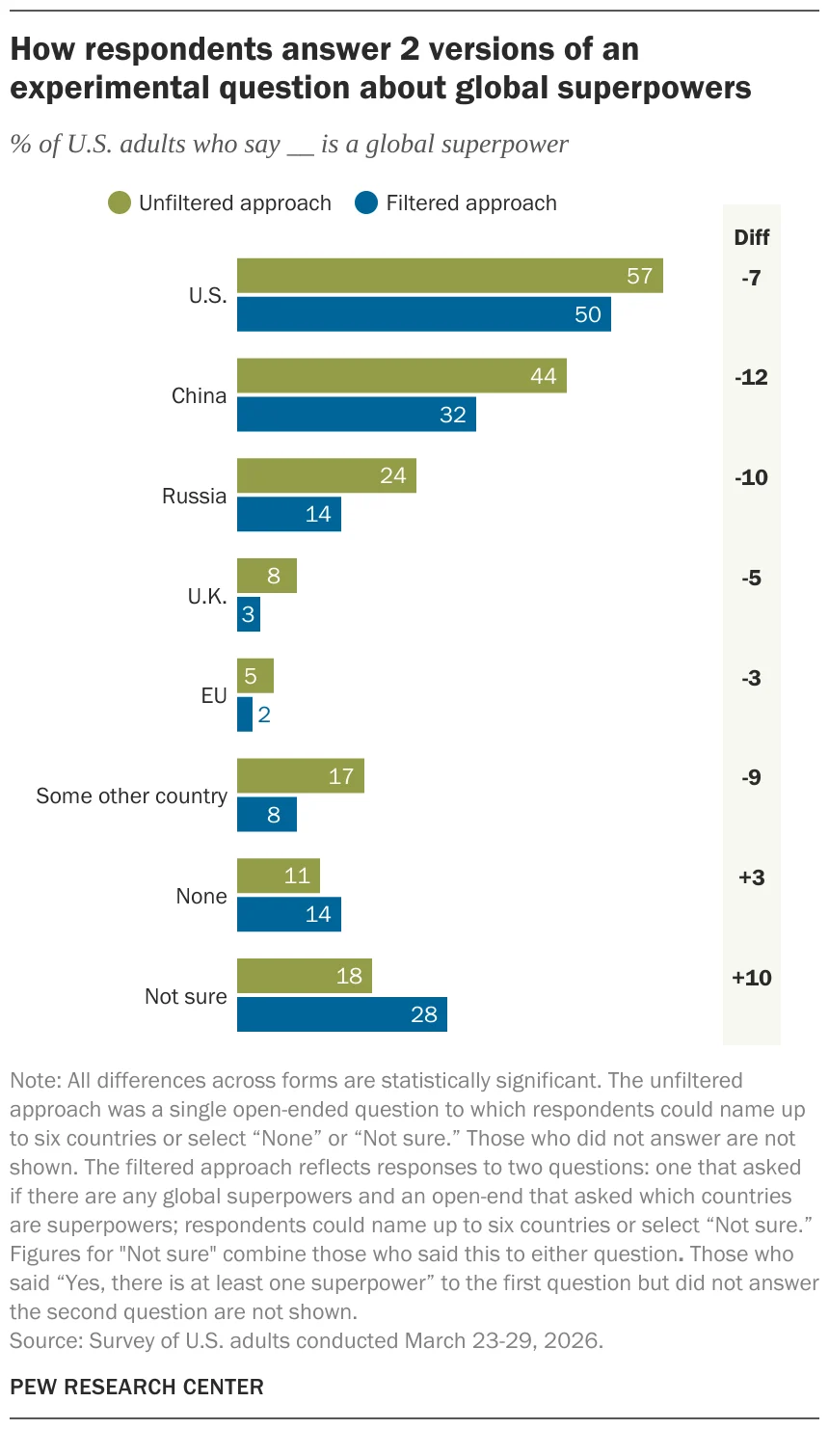
- The Unfiltered Approach: Respondents were given a single, open-ended text box where they could list up to six countries or select "None" or "Not sure."
- The Filtered Approach: Respondents were first asked if any global superpowers existed at all, followed by an open-ended question to name those countries.
The primary objective was to determine if the "filter" (the initial Yes/No question) acted as a barrier, potentially biasing the results toward a more simplistic or skeptical view of global power.
Supporting Data: What the Results Reveal
The data from the March 2026 survey, which included responses from 1,770 participants who had previously answered traditional economic and military power questions in 2025, provided a fascinating look into the American psyche.
Comparing the Approaches
Overall, the results were surprisingly consistent across both formats. The United States was most frequently cited as a superpower, followed by China and Russia. However, the "Filtered" approach saw a higher rate of uncertainty. Approximately 23% of respondents said they were "not sure" when asked the initial filter question, compared to significantly lower rates of indecision in the unfiltered group.

The Rise of Multipolarity
Perhaps the most striking finding was the persistence of "multipolar" views. Even among respondents who, in 2025, identified the U.S. as the undisputed leader in both economic and military domains, the 2026 experiment revealed a willingness to acknowledge other powers.
When given the "unfiltered" option, 44% of these traditionalists categorized the world as having two or more superpowers. In contrast, the "filtered" group was more likely to revert to a "one superpower" model (36%) or express uncertainty (25%). This suggests that when given the freedom to define the world without a gatekeeper question, Americans are more likely to perceive a complex, multi-nation power structure.
Diversity of Thought
The breadth of responses was also wider in the unfiltered test. Respondents named 47 different countries in the unfiltered format, compared to just 30 in the filtered version. This underscores a critical insight: when survey design is less prescriptive, the public is more likely to engage with the reality of a decentralized global order.
Official Interpretations and Institutional Response
Pew researchers have noted that while the differences between the two methods are statistically significant, they do not fundamentally alter the narrative that the U.S., China, and Russia remain the pillars of the global power hierarchy in the eyes of the public.

However, the methodology team emphasizes that the administrative benefits of the unfiltered approach are significant. It is easier to program, easier for respondents to navigate, and—crucially—leads to lower nonresponse rates. By removing the "gatekeeper" question, the researchers found that they actually captured more nuanced data rather than less.
The findings are being treated as a validation of "open-ended" survey design. By allowing respondents to define the world in their own terms, researchers are better able to capture the fluidity of geopolitical influence. The Center views this as a vital step in maintaining the relevance of their longitudinal data as the 21st century progresses.
Implications for Future Geopolitical Research
The success of this experiment has profound implications for how public opinion organizations will conduct future global surveys.
Moving Beyond the "List"
The traditional reliance on pre-populated lists of countries is increasingly at odds with a world where economic influence, technological dominance, and soft power are shifting rapidly. By moving toward open-ended, respondent-driven questions, the Center can track the emergence of new power brokers—such as India, Brazil, or the European Union—without having to constantly update the survey "menu."

The "Uncertainty" Factor
The experiment also highlights the importance of the "Not sure" option. In an increasingly complex global environment, acknowledging that a segment of the public is either unsure or cynical about the concept of a "superpower" is a data point in itself. It reflects a growing skepticism or confusion regarding global dynamics that a forced-choice question would simply erase.
A Path Forward
Looking ahead, the evidence suggests that the unfiltered, open-ended question is the superior tool for cross-national surveys. It provides a more accurate reflection of public perception while simplifying the logistical burden for the researchers.
As we look toward future waves of the American Trends Panel and other global initiatives, the lesson from this experiment is clear: if we want to understand how the world sees power, we must give them the space to define it. By shedding the constraints of the past, the Pew Research Center has not only improved the accuracy of its data but has also provided a blueprint for measuring the pulse of a globalized, rapidly changing world. The experiment proves that when it comes to measuring global power, sometimes the best way to get an answer is simply to stop asking leading questions and let the respondents do the talking.